
The Credit Report: Credit Fundamentals Take Center Stage Amid Persistent Volatility
Week of November 9, 2026 – By Larry Holzenthaler, Senior Portfolio Manager, Catalyst Capital Advisors, LLC
Summary
High Yield: High yield (HY) was fairly volatile last week, though price action was relatively tame when compared to equities. Despite the intraweek volatility, the Bloomberg High Yield Index returned +0.25% for the week, with spreads tighter by -3bp. High yield mutual funds and ETFs have seen $1B+ of inflows during the last two weeks, indicating that investors generally remain confident in credit fundamentals despite the volatility.
Senior Loans: Loan prices were relatively stable last week, with prices nearly unchanged to up slightly. The S&P UBS Leveraged Loan Index returned +0.36%. Despite the macro uncertainty, loan demand also remained rather strong last week across both retail and institutions, including CLO formation (which can be sensitive to the type of volatility seen last week).
The dislocation in lower quality credit, which in our view appears to be showing some signs of stabilizing, seems to have caught several prominent credit investors offside. Most notably, Arini Capital Management, run by superstar high yield trader Hamza Lemssouguer, has seen its flagship fund down -32% YTD, including a -19.7% loss in October. The firm said it maintains high conviction in its largely CCC-rated portfolio and cited market technicals as the reason for its underperformance.
Additionally, this week saw an anonymous seller initiate a $500M auction, known as a “BWIC” (Bids Wanted in Competition), with respect to a portfolio made up entirely of data center debt. The seller was believed to be ING. The forced sale of these types of assets in a stressed market is extremely unusual and another data point that suggests to us some level of capitulation in the market.
Is Credit Finding a Bottom?
The relative stability of high yield and loans last week, including lower quality assets, is a sign that the markets are potentially beginning to stabilize following the dramatic underperformance of riskier credits in recent weeks and months. In many ways, it feels like the credit markets were ahead of equities in terms of pricing in an elevated level of risk (which is not unusual).
As an example, the “Blue Wave” put intense pressure on data center names last week given the potential for increased political risk. Intraweek, data center operator CoreWeave saw its stock down nearly -13%; its bonds, however, which have been under intense pressure since June, were only down marginally.
While calling a market bottom is impossible, many bonds and loans are trading at levels that, in our view, appear somewhat disconnected from fundamentals. While negative sentiment can certainly continue to impact prices going forward, bonds and loans are contractual obligations with a relatively short life. What ultimately determines the value of corporate debt has little, if anything, to do with sentiment and is instead all about fundamentals.
Chart of the Week: CCC HY spreads have begun to see more two-sided volatility in recent weeks following months of consistent widening. This has happened even as equities have grown increasingly volatile and a risk-off tone has emerged.
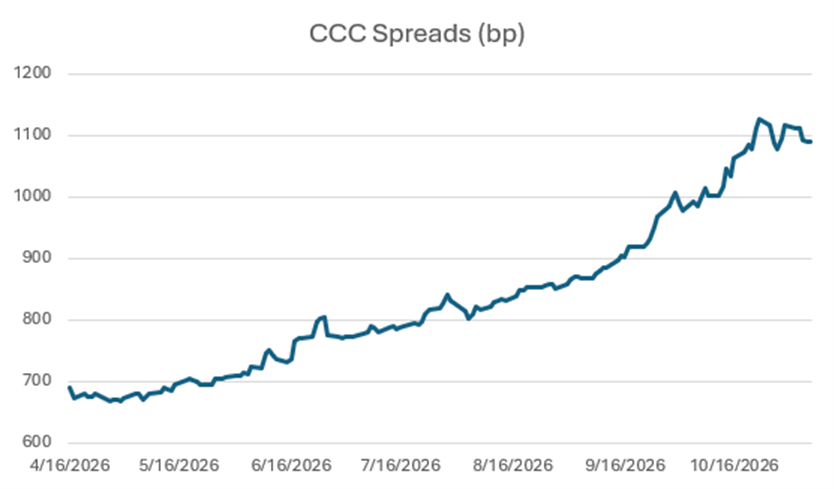
Source: Bloomberg, as of 11/6/26. Bloomberg US Corporate High Yield Index.
Important Disclosures
This commentary is provided by Catalyst Capital Advisors LLC, a registered investment adviser (“Catalyst”), and is for informational purposes only. Registration with the U.S. Securities and Exchange Commission does not imply a certain level of skill or training. This material does not constitute investment, legal, or tax advice. It is not an offer to sell or a solicitation of an offer to buy any security or interest in any fund or strategy, and it should not be relied upon in making an investment decision. Advisory services are offered only pursuant to a written agreement and/or offering document, including a fund prospectus, if applicable. Additional information about Catalyst, including its fees, services, and conflicts of interest, is available in its Form ADV Part 2A, which is available upon request or at adviserinfo.sec.gov. The views expressed are those of the author as of the date indicated, are subject to change without notice and may not reflect the views of Catalyst as a whole. Information has been obtained from third-party sources believed to be reliable, but its accuracy and completeness are not guaranteed.
Risk Considerations: High yield bonds and leveraged loans are below investment-grade and are speculative. Such securities carry greater risk of default, price volatility, and illiquidity than investment-grade securities, and investors may lose some or all of their principal. Senior secured status does not eliminate the risk of loss, and recoveries in default may be lower than historical averages. Loans may have extended settlement periods and limited secondary market liquidity. Securities trading at a discount to par may continue to decline, and a discount does not indicate that a security is undervalued or will return to par. These investments are not suitable for all investors. Past performance and historical default or recovery rates are not indicative of future results.
Index Information: Index returns are for illustrative purposes only. They do not reflect fees, expenses, or transaction costs, and do not represent the performance of any account, fund or strategy managed by Catalyst. Indices are unmanaged and cannot be invested in directly. Bloomberg® and the Bloomberg US Corporate High Yield Index are trademarks of Bloomberg Finance L.P. and are used under license. S&P UBS Leveraged Loan Index data is provided by S&P Dow Jones Indices LLC and/or its affiliates.
Conflicts: Catalyst and its affiliates may serve as investment adviser to, and/or sponsor, funds that invest in the asset classes discussed. Catalyst, its personnel, and its client accounts may hold, buy, or sell positions in these asset classes at any time, including in a manner inconsistent with the views expressed herein, and Catalyst may benefit if the market conditions described materialize.
Forward-Looking Statements: This material contains forward-looking statements, including views on market conditions, valuations, credit fundamentals, and potential opportunities in the high yield and leveraged loan markets. Forward-looking statements can often be identified by words such as “expect,” “anticipate,” “opportunity,” “believe,” “may,” “should,” and similar expressions, or by characterizations of current market conditions as temporary or dislocated. These statements reflect the author’s current views and assumptions as of the date indicated. They involve known and unknown risks and uncertainties that could cause actual results to differ materially from those expressed or implied. Such risks include changes in interest rates, economic conditions, default and recovery rates, credit spreads, market liquidity, trade and tariff policy, and investor sentiment. There is no assurance that current discounts to par will narrow, that market conditions described as dislocated will normalize, or that any opportunity described will be realized. Catalyst undertakes no obligation to update or revise any forward-looking statement, whether as a result of new information, future events, or otherwise.
