Building a Winning Portfolio for Trump’s Second Term

As speculation grows about a potential second Trump presidency, investors brace for a major shift in the markets. Energy stocks lead the charge, while cryptocurrencies remain a hot topic despite regulatory uncertainty. But is following the crowd the right move? Opportunities are emerging in unexpected places, and pitfalls abound for the unwary. Now is the time to craft a portfolio that not only survives but thrives in a Trump 2.0 economy.

Building a portfolio for a second Trump term means focusing on companies positioned to benefit from shifting regulatory priorities and trade dynamics. Tesla, Palantir, and Amazon stand out as key players likely to excel amid these changes. They are well-prepared to thrive in a trade war and capitalize on regulatory shifts. Blockchain technology is set to grow, but the regulatory uncertainty around Bitcoin makes direct investment risky. Nvidia and PayPal offer a safer way to tap into the blockchain boom, with potential gains whether Bitcoin thrives or a new digital currency takes the lead. This strategy creates a balanced approach, navigating both opportunities and risks in a Trump 2.0 economy.

Challenges for Energy Stocks Under a Trump Presidency

While the prospect of increased oil drilling on federal land and the opening of pipelines is widely seen as a boost to domestic energy production, the implications for energy stocks are more complex.

Recent Gains Already Priced In

Energy stocks have seen significant appreciation in recent months, largely driven by strong oil and natural gas prices. However, if a Trump administration leads to reduced geopolitical tensions or increased domestic production, commodity prices could decline. This could erode some of the recent gains, making further upside for energy stocks less certain.

Oversupply Risks

A more permissive regulatory environment could spur higher production levels of oil and natural gas. While this might benefit consumers through lower prices, it could also lead to supply gluts. Lower commodity prices would compress profit margins for energy companies, even as operational costs decrease.

Demand Uncertainty

Policies favoring domestic energy independence could inadvertently limit exports, reducing revenue opportunities for major energy players. At the same time, global initiatives to expand renewable energy adoption could create long-term demand challenges for traditional energy sources.

Tesla (TSLA): Leading the Charge in a Looser Regulatory Environment

Tesla stands out as a clear winner in a world of relaxed regulations and shifting trade policies.

  1. Minimal Impact from EV Tax Credit Removal
    While the removal of EV tax credits could hurt competitors like the Big Three automakers, Tesla is well-positioned to weather the change. Its strong brand and market dominance, coupled with a loyal customer base, make it less reliant on subsidies to drive sales.
  2. Domestic Manufacturing Advantage
    Tesla’s manufacturing approach gives it a unique edge. Unlike the Big Three, which depend heavily on components sourced from Mexico, Tesla produces many of its parts domestically at its Gigafactory in Texas. This reduces exposure to potential tariff hikes on imports and aligns well with policies prioritizing U.S.-based manufacturing.
  3. Potential Boost from Infrastructure Spending
    Investments in infrastructure under a second Trump term could include provisions for expanding EV charging networks, further supporting Tesla’s ecosystem. As the leader in electric vehicle adoption, Tesla would be a prime beneficiary of such initiatives.

Under these conditions, Tesla not only maintains its dominance but strengthens its position in the rapidly growing EV market.

Amazon (AMZN): A Strategic Shift for Political Neutrality

Amazon’s approach heading into a second Trump presidency suggests a calculated strategy to navigate the political landscape more effectively.

  1. A More Neutral Bezos
    Unlike during Trump’s first term, when tensions between the administration and Jeff Bezos over The Washington Post culminated in Amazon losing a major government contract to Microsoft, this time Bezos appears to be charting a more neutral course. The Washington Post notably refrained from endorsing any candidate in the recent election, potentially easing political friction that previously affected Amazon’s federal prospects.
  2. Regulatory Tailwinds for Distribution
    Amazon’s extensive network of distribution centers stands to benefit significantly from loosened regulations. Policies reducing red tape around zoning, labor laws, and environmental restrictions could lower operational costs and accelerate expansion. This positions Amazon to enhance its dominance as one of America’s largest employers and an indispensable player in e-commerce logistics.
  3. A Potential Ally in Job Creation
    As one of the country’s largest employers, Amazon’s contributions to local economies may resonate with Trump’s focus on domestic job creation. This dynamic could foster a more favorable relationship between the administration and the company, paving the way for new government contracts or policy advantages.

By taking a more politically neutral stance and leveraging reduced regulations, Amazon could position itself to thrive in a Trump 2.0 economy while avoiding the pitfalls of previous conflicts.

Palantir (PLTR): Driving Efficiency in Government and National Security

Palantir stands out as a company uniquely aligned with the priorities of a potential second Trump administration, particularly in its focus on cost reduction and AI-driven solutions.

  1. Support for Government Efficiency
    With a renewed emphasis on cutting government spending and increasing efficiency, Palantir’s technology is well-positioned to shine. Its suite of data analytics tools has already proven effective in streamlining processes and reducing costs for federal agencies, making it an attractive partner in an era of fiscal restraint.
  2. Alignment with the AI Revolution
    As artificial intelligence reshapes industries, Palantir’s advanced AI capabilities put it at the forefront of this technological transformation. The company’s ability to harness big data for actionable insights positions it as a key player in enhancing both efficiency and effectiveness for public and private sector clients alike.
  3. Opportunities in Defense and Security
    A second Trump presidency would likely bring continued investment in defense and border security, areas where Palantir has significant expertise. The company’s long-standing government contracts and proven track record in national security applications align perfectly with policies emphasizing border control and domestic safety.

By bridging the gap between cost-cutting measures and technological innovation, Palantir offers a compelling investment case in an administration focused on streamlining government operations.

Cryptocurrency Risks Under a Trump Presidency

While the deregulation mindset could help blockchain technology flourish, cryptocurrencies, especially Bitcoin, could face significant risks in a second Trump administration.

  1. Regulatory Uncertainty:
    Trump has expressed skepticism about cryptocurrencies, including Bitcoin, often viewing them as a threat to the U.S. dollar. While his administration may push for broader deregulation, this uncertainty could lead to selective regulation that benefits certain tokens and harms others. Investors could face sudden shifts in policy, leaving the crypto market vulnerable to unpredictable legal changes.
  2. Geopolitical Risks:
    A nationalist agenda could lead to trade restrictions or limitations on foreign blockchain projects, undermining international collaboration. Such moves might reduce liquidity in the crypto market, as cross-border transactions and investments could be curtailed. If foreign blockchain projects or cryptocurrencies are seen as competitors to U.S. interests, they may face heightened scrutiny or even bans.
  3. Market Volatility:
    Cryptocurrencies are already known for their volatility. If the U.S. government takes an inconsistent or unclear approach to regulating crypto, it could exacerbate this volatility, further deterring institutional investors and retail traders alike. The uncertainty surrounding their future use could result in major price swings, making it a risky asset class for those seeking stability.
  4. Risk of Outright Bans:
    Imagine a scenario where a terrorist attack occurs under a Trump presidency, and it’s discovered that Bitcoin was used to finance the terrorists’ operations. In this situation, Bitcoin could be outlawed with the snap of a finger, as the government could move quickly to curtail its use in illicit activities. The decentralized nature of Bitcoin and other cryptocurrencies might offer some resistance, but governments have the power to impose bans, making such an event a significant risk for investors.

Nvidia (NVDA): Blockchain and AI Synergy

Nvidia (NVDA) stands out as a key player in both the AI and blockchain space, making it a strong candidate to benefit from the emerging blockchain revolution, even though its core business is centered around AI technologies.

  1. Leader in Cryptocurrency Mining Hardware:
    Nvidia’s graphics processing units (GPUs) are a critical component in the mining of many altcoins. While the company’s primary growth engine remains AI and data centers, the demand for its high-performance GPUs from the cryptocurrency mining community has been a significant revenue contributor. In a deregulated environment where blockchain adoption grows, Nvidia stands to benefit from increased demand for mining equipment, especially for altcoins that depend on GPU power for validation.
  2. AI & Blockchain Synergy:
    The AI revolution and blockchain are increasingly intertwined. Nvidia’s expertise in building GPUs for AI processing makes the company well-positioned to benefit from the growth of blockchain technology, which requires heavy computational power. As AI-driven applications become more widespread, Nvidia’s hardware will continue to support both AI-driven financial systems and blockchain technology, positioning the company as a dual beneficiary in this evolving landscape.
  3. Infrastructure Investment:
    As blockchain networks expand and new altcoins emerge, the demand for high-performance computing infrastructure will likely increase. Nvidia’s robust portfolio of GPUs places it in an excellent position to capitalize on this trend. While regulatory uncertainties may impact certain cryptocurrencies, Nvidia’s role in the underlying infrastructure that supports both crypto and AI will help secure its continued success, regardless of market fluctuations in individual tokens like Bitcoin.

PayPal (PYPL): Positioned for Blockchain Integration and E-commerce Growth

PayPal, a trailblazer in online payments, is well-positioned to take advantage of the blockchain revolution, leveraging its vast network, innovative fintech services, and history of disruption in the payments space. Though its leadership has changed over the years, the company’s foundational role in the evolution of digital payments links it directly to the ongoing transformation in both e-commerce and cryptocurrency.

  1. E-commerce and Fintech Growth:
    With deregulation in financial technology, PayPal has a unique opportunity to expand and innovate in the online payment ecosystem. The loosening of regulatory barriers could allow PayPal to offer even more diverse payment solutions, potentially incorporating blockchain technology to facilitate faster, more secure transactions. Whether it’s Bitcoin or a new cryptocurrency, PayPal’s infrastructure is primed to serve as a major player in the future of digital payments, continuing its legacy of simplifying online transactions.
  2. Blockchain Integration:
    Though PayPal has integrated cryptocurrency into its platform, its true potential lies in its ability to take advantage of blockchain technology more broadly. Having been at the forefront of digital payments, PayPal is positioned to expand into new forms of payment, such as cryptocurrency transactions, by leveraging its global user base. Whether it’s Bitcoin or another token that emerges as dominant, PayPal is ready to act as a major facilitator in online payments, driving adoption of digital currencies while serving as a bridge to the traditional financial system.
  3. Tax Incentives for Digital Transactions:
    A pro-digital tax policy that incentivizes cashless and cryptocurrency transactions could be a significant boon for PayPal, which already benefits from widespread adoption across merchants and consumers. With a focus on reducing transaction costs and enabling faster, more seamless payments, PayPal is poised to benefit from these policy shifts and extend its leadership in the digital payment space.
  4. Expansion of Small Business Support:
    Policies aimed at supporting small businesses could further accelerate PayPal’s growth. By providing small and medium-sized businesses with easy access to payment processing services, PayPal stands to benefit from both its established merchant services and its ability to adapt to new, deregulated payment systems, including those based on blockchain technology.

Conclusion

A potential second Trump presidency could reshape the landscape for innovation and investment, especially in technology, finance, and infrastructure. The former president’s deregulation mindset may create opportunities for companies like Tesla, Amazon, Palantir, and PayPal to thrive. However, it also presents significant risks for cryptocurrencies and blockchain projects.

Companies that adapt to changing regulations could see major growth. Tesla could benefit from policies supporting electric vehicles and domestic manufacturing. Amazon, a logistics giant, may strengthen as regulations ease. Palantir, with its advanced AI and data analytics, is positioned to capitalize on increased government scrutiny and national security priorities. PayPal, deeply rooted in digital payments, stands ready to embrace blockchain technology and the cashless trend.

But the risks are real. Cryptocurrencies could face significant hurdles, from regulatory uncertainty to geopolitical tensions. If the Trump administration cracks down on cryptocurrencies, Bitcoin and others could face existential challenges. However, blockchain technology itself may still thrive as part of a broader trend.

In conclusion, a second Trump term offers both opportunities and risks. Investors must stay vigilant. Success will depend on adapting to new policies, embracing innovation, and navigating government shifts. The most successful companies will be those that can balance growth with careful strategy in uncertain times.

David Miller on CNBC’s Market Navigator: Will Overheating Hurt Nvidia?

Will Mag 7 stock Nvidia beat estimates? David Miller, Co-Founder and Chief Investment Officer of Catalyst Funds, Rational Funds, and Strategy Shares, provided his insights to CNBC on Nov. 19 on why he believes the company will come out ahead this week despite potentially challenging headlines.

Chart of the Week: is the Stock Market Getting Ahead of Itself?

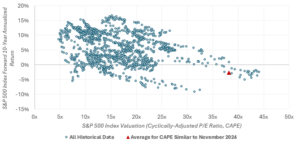
S&P 500 Cyclically Adjusted Price-to-Earnings Ratio (CAPE)

Even before November’s post-election rally, Wall Street was growing increasingly worried that the stock market was starting to get ahead of itself.

  • In October, Goldman Sachs strategists cautioned investors to be prepared for stock market returns during the next decade that are toward the lower end of their typical performance distribution.
  • As of November 11, 2024, the cyclically adjusted price-to-earnings ratio (or CAPE) hit a staggering 38.12x. Looking at these valuation levels going back to 1900, there has only been one instance where the S&P 500 produced a positive return in the following 10 years. In July 1998, the CAPE hit 38.26x and the 10-year return after was 0.84% annualized.
  • S&P 500 10-year returns averaged -2.75% annualized following valuations like in November 2024.

What’s the Real Value of Active Management?

Key Summary:

  • ETF’s have become the preferred investment wrapper of choice for investors.
  • The vast majority of ETF assets are passive, rules-based, & market-cap weighted.
  • Active strategies with high tracking error can add significant value to the portfolio mix.

Very Important thesis: If equities generate roughly ~10-11% a year over time, leading brands, dominant global franchises, particularly those serving the dominant driver of the economy, in theory, should compound at 13-15%+ over time. In a world where rates and inflation will likely trend higher for longer, business models with pricing power, exposure to quality factors, and that generate strong profits and free cash are set up to win versus broad markets. Brands Matter.

ETFs are the Preferred Investment Wrapper.

The data is very clear: actively managed mutual funds continue to lose assets to ETF’s. That’s the headline we all see every day. Remember, headlines are bold because they want your attention, the real story lives in the details. It makes sense that a portion of the active market is losing share to ETFs. Why pay a higher fee for a less tax efficient strategy, particularly if it’s a closet index strategy? In my opinion, true active strategies have a very important role in portfolios as complements to passive, cheap beta. Advisors need to understand what they own. Are the active funds’ benchmark huggers or do they do things very differently than the benchmark? Is there a similar strategy available in an ETF wrapper? Important: to have the chance to beat a benchmark, a strategy needs to look very different than the benchmark. The way to track this is by using Tracking Error. A high tracking error means the fund looks very different and can therefore be very valuable to a portfolio from a diversification and returns perspective. If you can get access to the themes you want and do it in a tax efficient wrapper while gaining high tracking error, congratulations, that’s valuable! Spoiler alert: that’s not easy to do, it requires a lot of research and sadly, the analytics providers do not make the research easy because they rarely look at the sector, sub-industry, and single-stock level.

In this week’s note, I’ll make the case that active deserves a place in portfolio’s along with passive ETF’s. Thank heavens there are more active ETF’s being launched because the market has been dominated by passive, rules-based, market cap weighted ETF’s (90% of ETF assets). What does that mean for a portfolio? It means more and more portfolio’s look the same and they are more tied to MOMENTUM as a style factor than ever before. That works until it doesn’t. This also means, benchmark hugging active managers are also too tethered to the momentum factor making “size and momentum” the biggest part of most portfolios.

Active, Contrarian Opportunities Are Everywhere.

Image: Created for Eric Clark by ChatGPT.

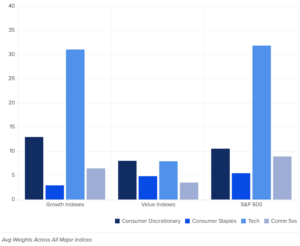
I am not saying run from passive, market-cap weighted ETF’s, I’m simply saying properly active strategies should be blended with passive, so portfolio’s get the benefit from many different style factors and exposures. As more and more “active funds” take on more passive characteristics, the value of true active strategies will grow by leaps and bounds. One area that’s likely the least crowded trade: the Consumer Discretionary, Consumer Staples, and Communication Services sectors. Our team traffics in highly relevant, high quality global brands. Many of which live in these three sectors and as you can see below, at the index level, these sectors are under-represented in a meaningful way, while a heavy tech weighting drives the returns. If the S&P 500 is the proxy investment for an allocation to the U.S. economy, and the economy is 70% household consumption, why on earth would the weighting to Consumer Discretionary & Staples be this low? We think that’s the opportunity today for investors.

I can almost guarantee your portfolio is chronically underweight the primary beneficiaries of a consumption-led economy. As you can see below, Tech holds the highest weighting across blend and growth indexes and Consumer Discretionary, Staples, and Communication Services is low. In the brands portfolio, we have 2-3x the discretionary and staples exposure, 40% more communication services and one-third the tech exposure. Our tracking error is almost 10, and this is not an accident.

What Does High Tracking Error Look Like?

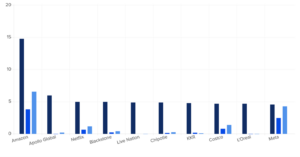
To highlight the high tracking error theme, below I show a chart of the top 10 brands and the weights in the Brands portfolio relative to the S&P 500 and the Russell 1000 Growth Index. Remember, these two broad style boxes are where the bulk of the typical portfolio is allocated. In the brands strategy, we focus on the dominant global theme of household consumption and business innovation spending through the leading brands. According to the economy and business cycle, we allocate to important sub-themes through market share leaders. Here’s why the tracking error is high. We own a lot of brands that are significantly under-represented or fully absent from indexes. That’s valuable!

The Top 10 Brands in the Brands Portfolio (57% of the total):

  1. Amazon: 15% versus 3.8% (S&P 500), 6.6% (R1Growth).
  2. Apollo Global: 6% versus ,0.55% in both indexes.
  3. Netflix: 5% versus <1.2%.
  4. Live Nation: 4.9% versus essentially 0%.
  5. Blackstone: 5% versus <.50%.
  6. Chipotle: 4.9% versus <.30%.
  7. KKR: 4.9% versus <0.20%.
  8. Costco: 4.7% versus <1.5%.
  9. L’Oreal: 4.7% versus 0%.
  10. Meta: 4.6% versus <4%.

Bottom Line:

  1. If you own any active funds or ETF’s, make sure they are truly active and have high tracking error to the benchmark.
  2. Blend active and passive in a portfolio to achieve maximum diversification and return benefits.
  3. Do not ignore the winners in a consumption led global economy, these brands are wonderful businesses, have significant economic moats, generate massive profits, and always have demand for their shares when the stocks go on sale. That makes them terrific adds to a portfolio and right now, buying consumer-focused brands is likely the least crowded trade in markets.

BE A CONTRARIAN

Disclosure: The above data is for illustrative purposes only.  This information was produced by Accuvest and the opinions expressed are those of the author as of the date of writing and are subject to change. Any research is based on the author’s proprietary research and analysis of global markets and investing. The information and/or analysis presented have been compiled or arrived at from sources believed to be reliable, however the author does not make any representation as their accuracy or completeness and does not accept liability for any loss arising from the use hereof. Some internally generated information may be considered theoretical in nature and is subject to inherent limitations associated therein. There are no material changes to the conditions, objectives or investment strategies of the model portfolios for the period portrayed. Any sectors or allocations referenced may or may not be represented in portfolios managed by the author, and do not represent all of the securities purchased, sold or recommended for client accounts.  The reader should not assume that any investments in sectors and markets identified or described were or will be profitable. Investing entails risks, including possible loss of principal. The use of tools cannot guarantee performance. The charts depicted within this presentation are for illustrative purposes only and are not indicative of future performance. Past performance is no guarantee of future results.

Election Trepidation: October 2024 HANDLS Monthly Report

Election Trepidation

October was marked by continued volatility across fixed income and equity markets as investors faced various challenges, including persistent inflation concerns, rising yields, tightening monetary policy, and the backdrop of a U.S. Presidential election. U.S. Treasury yields saw substantial gains, with the 10-year yield reaching levels not seen since the early 2000s. This increase was primarily driven by hawkish statements from the Federal Reserve and stronger-than-expected economic data, reinforcing expectations that rates will remain elevated for an extended period to combat inflation. As a result, longer-duration bonds faced headwinds, underperforming throughout the month. Investment-grade corporate bonds also struggled, with credit spreads widening modestly due to growing recession fears and concerns in certain sectors. Conversely, high-yield bonds showed some resilience, buoyed by stronger-than-expected earnings from select companies that helped alleviate broader investor anxiety.

Equities in October experienced mixed performance, weighed down by concerns over higher interest rates and the potential for an economic slowdown. The S&P 500 was volatile, driven by fluctuating earnings reports and persistent macroeconomic uncertainty. A rally in growth stocks at the start of the month quickly met skepticism as investors grew wary of overvalued sectors in an environment where the cost of capital is rising. While the tech sector showed some strength, other sectors—particularly consumer discretionary and industrials—underperformed. The shift toward value stocks was evident, with energy and financials benefiting from higher oil prices and broader interest rate spreads.

The Nasdaq Dorsey Wright Explore portion of the HANDLS Indexes experienced negative performance across all categories in October. Interest-rate-sensitive sectors struggled the most, while more equity-like categories showed relative resilience. The worst performer was REITs, which lost more than 3.5% for the month but remained positive year-to-date.

Overall, all HANDLS indexes posted negative returns in October:

  • Nasdaq 5HANDL™ Index: -1.92%
  • Nasdaq 7HANDL™ Index: -2.62% (1.3x leveraged)
  • Nasdaq 10HANDL™ Index: -4.25% (2.0x leveraged)

As we move into the final stretch of the year, the impact of higher interest rates and a new election mandate will continue to influence performance, with a focus on how each sector navigates these headwinds.

Disclosure: Nasdaq® is a registered trademark of Nasdaq, Inc. The information contained above is provided for informational and educational purposes only, and nothing contained herein should be construed as investment advice, either on behalf of a particular security or an overall investment strategy. Neither Nasdaq, Inc. nor any of its affiliates makes any recommendation to buy or sell any security or any representation about the financial condition of any company. Statements regarding Nasdaq-listed companies or Nasdaq proprietary indexes are not guarantees of future performance. Actual results may differ materially from those expressed or implied. Past performance is not indicative of future results. Investors should undertake their own due diligence and carefully evaluate companies before investing. ADVICE FROM A SECURITIES PROFESSIONAL IS STRONGLY ADVISED. © 2024. Nasdaq, Inc. All Rights Reserved

Important Disclosure. HANDLS Indexes receives compensation in connection with licensing its indices to third parties. Any returns or performance provided within are for illustrative purposes only and do not demonstrate actual performance. Past performance is not a guarantee of future investment results. It is not possible to invest directly in an index. Exposure to an asset class is available through investable instruments based on an index. HANDLS Indexes does not sponsor, endorse, sell, promote or manage any investment fund or other vehicle that is offered by third parties and that seeks to provide an investment return based on the returns of any index.  There is no assurance that investment products based on an index will accurately track index performance or provide positive investment returns. HANDLS Indexes is not an investment advisor, and HANDLS Indexes makes no representation regarding the advisability of investing in any such investment fund or other vehicle. A decision to invest in any such investment fund or other vehicle should not be made in reliance on any of the statements set forth in this document. Prospective investors are advised to make an investment in any such fund or other vehicle only after carefully considering the risks associated with investing in such funds, as detailed in an offering memorandum or similar document that is prepared by or on behalf of the issuer of the investment fund or other vehicle. Inclusion of a security within an index is not a recommendation by Indexes to buy, sell, or hold such security, nor is it considered to be investment advice. The information contained herein is intended for personal use only and should not be relied upon as the basis for the execution of a security trade. Investors are advised to consult with their broker or other financial representative to verify pricing information for any securities referenced herein. Neither Indexes nor any of its direct or indirect third-party data suppliers or their affiliates shall have any liability for the accuracy or completeness of the information contained herein, nor for any lost profits, indirect, special or consequential damages. Either Indexes or its direct or indirect third-party data suppliers or their affiliates have exclusive proprietary rights in any information contained herein. The information contained herein may not be used for any unauthorized purpose or redistributed without prior written approval from HANDLS Indexes. Copyright © 2024 by HANDLS Indexes. All rights reserved.


The Election Results Are In. The Market Likes the Results.

Key Summary:

  • Change is coming to Washington, there will be ramifications for investors.
  • The over-arching theme is a more pro-business, less regulatory environment.
  • Inflation & interest rates staying higher continues to be the base case.

Very Important thesis: If equities generate roughly ~10-11% a year over time, leading brands, dominant global franchises, particularly those serving the dominant driver of the economy, in theory, should compound at 13-15%+ over time. In a world where rates and inflation will likely trend higher for longer, business models with pricing power, exposure to quality factors, and that generate strong profits and free cash are set up to win versus broad markets. Brands Matter.

Election Uncertainty Has Passed.

Even though we have all been inundated with the hard data showing equity markets generally do not care whether a Democrat or Republican is in the White House, market participants were still on edge as we headed into Tuesday’s election. We will have a new President on January 20, 2025. As an investor, it’s nice to know what we should expect from President Trump, because we have seen the movie before in 2017 – 2021. Apart from the early part of the Pandemic period, the economy and stock markets generally performed well. I remember this period well and there were wonderful active trading opportunities along with solid buy-hold opportunities. Each period is different, and the future always looks different than the past but here’s what worked best the last time Trump was president: Between the inauguration January 20/2017 and just before the pandemic on 2/27/2020, The S&P 500 rose 57.9% as the baseline for a comparison. The Nasdaq 100 rose 96%, technology stocks rose 115%. The Consumer Discretionary sector was the second-best performing sector at +62%.  Large Cap Growth was the best performing style box at +84% followed by Mid-Cap Growth. Like the recent past, Small-Cap Value was the worst performing style box +13%. Energy stocks were the worst performing sector -17%.  Based on today’s reaction to the elections, the Financials could be a top performer, but one day does not a trend make. FYI, Financials have been leading all year as well.

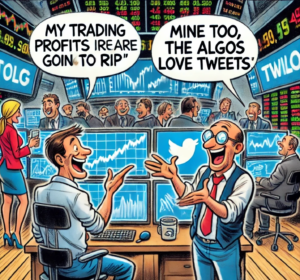
Using AI via ChatGPT, I thought I would have some fun with cartoons to tell the story of what the market thinks about Trumps win. As I write this note, equity markets are hitting all-time highs with some very powerful moves across financial services and smaller, leveraged companies. My crystal ball is no better than anyone else’s but here’s what the market believes across certain themes where a Trump presidency is concerned.

The DNC Seems to Have Gotten Off-Course

The information I have currently says Trump won the popular vote and the electoral vote. The last time this happened for a republican was 2004 I believe. This is not a political statement; I try to stay out of politics. The DNC seems to have gone incredibly off course and has lost touch with the average American. That cost the Democrats dearly in this election.

Consumer Sentiment Should Improve

Election uncertainty is just one reason consumer sentiment has been lower than the stock market might indicate. With a Fed marginally cutting rates over the next 12 months and with the knowledge of tax cuts not being reversed plus other potential initiatives that could incentivize them to spend more broadly, consumers could be in a better mood heading into 2025.  Remember, more spending is good for GDP and consumer stocks.

Trump Likes to Be in the News Daily

Like him or loathe him, Trump understands branding and we should expect him to continue his quest to be in the news almost daily. With algo’s driving daily volume on stock exchanges, everyone should expect bouts of volatility at the single stock and sector level on a frequent basis. This is wonderful for active trading, which is part of our 3-step investment process: Offense, Defense, Special Teams (fast twitch trading).

The Regulatory Environment is Going to Improve.

When one handbag and apparel brand isn’t allowed to be acquired by another similar company, you know the regulatory environment is restrictive. Corporate M&A is about to heat up. Private equity M&A and monetization’s should heat up. The brands related to this eventuality were on fire today. Corporate executives have been holding back from inorganic growth strategies because of onerous restrictions and regulations. Everything from anti-competitive behavior to same industry mergers and acquisitions have been stifled by the FTC and DOL. There’s a likely marketable improvement coming in corporate actions as the new administration inserts a less restrictive group of leaders.

The IPO & M&A Markets Could Roar Back

Because of a restrictive DOL and FTC, M&A advisory and IPO’s have seen below-trend growth for many years. With a Republican controlled government, we are set for a less restrictive regulatory environment which could drive economic growth to re-accelerate.

Interest Rates Are Reaching for the Skies.

Interest rates are up >20% since the Fed cut rates in September. Who saw that coming? With a massive budget deficit and higher funding costs, interest rates have been rising to account for rampant spending by the government. Whether Elon Musk can help Trump cut costs remains to be seen but for now, rising rates is not the friend of your bond portfolio or your bond proxy stocks. We should all expect interest rate volatility to stay elevated for longer. Perhaps that’s why so much money is moving to Private Credit funds? That’s why we have loved Blackstone, KKR, and Apollo for many years.

Re-accelerating Growth Should Push Inflation Up from Here.

Everyone loves economic growth and prosperity. With a less regulatory environment, more potential M&A and IPO’s, tax cuts that stick around for longer and potentially new, creative stimulus efforts, and a Fed that’s cutting rates, the potential risk of inflation re-asserting itself is not insignificant. While we do not believe inflation will heat up meaningfully, the rate of change going forward could be enough to cause consumers to stay in the “trade down and save” mentality. Our stock selection is certainly focused on this theme through the brands that offer consumers the best value, highest quality and differentiation.

Disclosure: The above data is for illustrative purposes only.  This information was produced by Accuvest and the opinions expressed are those of the author as of the date of writing and are subject to change. Any research is based on the author’s proprietary research and analysis of global markets and investing. The information and/or analysis presented have been compiled or arrived at from sources believed to be reliable, however the author does not make any representation as their accuracy or completeness and does not accept liability for any loss arising from the use hereof. Some internally generated information may be considered theoretical in nature and is subject to inherent limitations associated therein. There are no material changes to the conditions, objectives or investment strategies of the model portfolios for the period portrayed. Any sectors or allocations referenced may or may not be represented in portfolios managed by the author, and do not represent all of the securities purchased, sold or recommended for client accounts.  The reader should not assume that any investments in sectors and markets identified or described were or will be profitable. Investing entails risks, including possible loss of principal. The use of tools cannot guarantee performance. The charts depicted within this presentation are for illustrative purposes only and are not indicative of future performance. Past performance is no guarantee of future results.