The End of Easy Beta: Navigating a Market That Demands Selectivity

The Macro View: A More Selective Market Emerges

By David Miller, Co-Founder and Chief Investment Officer, Catalyst Capital Advisors LLC and Rational Advisors, Inc.

Macro Outlook

The market is entering a period where macro, not momentum, is, in our opinion, likely to drive returns. A big issue is that investors are now trying to handicap whether the Middle East shock, even after the recent ceasefire, becomes a short-lived geopolitical spike or a more durable inflationary event. If oil continues to retreat and the conflict truly does de-escalate, equities have room to recover because the first quarter already reflected a meaningful repricing of geopolitical and inflation risk.

However, if energy remains elevated, Q2 becomes much more challenging because higher fuel costs start to pressure margins, consumer spending, and the Fed’s flexibility all at once. Recent reporting and Fed-related data suggest exactly that tension: markets are hoping for de-escalation, while inflation nowcasts are already showing war-related pressure on headline prices.

A Selective Market Could Mean a Rising Tide Does Not Lift All Boats

My base case is that Q2 could be a more selective market than investors got used to in prior rallies. This is probably not the kind of backdrop where everything rises together. If rates stay higher for longer and inflation stays sticky, leadership should favor businesses with pricing power, durable free cash flow, and balance-sheet strength, while more rate-sensitive and lower-quality parts of the market remain vulnerable.

In other words, investors may still want exposure, but they are likely to become much less forgiving about valuation and much more focused on earnings durability. That matters because the Fed does not appear eager to change course quickly, even as markets debate whether the next move is a cut, a long pause, or in more extreme scenarios even a hike if inflation worsens.

Can the Consumer Economy Absorb a Shock?

The consumer will be one of the key swing factors this quarter. So far, the economy has held up better than many expected, with February retail sales coming in solidly, but there is a real question about how long that resilience lasts if gasoline prices stay elevated and broader cost pressures continue feeding through the system.

That is why I think Q2 is less about broad optimism and more about whether the U.S. economy can absorb an external shock without rolling over. If the consumer remains intact, the market can stabilize. If not, investors will start worrying more seriously about margin compression and slower growth into the back half of the year.

Bottom Line: Volatility Ahead

Expect volatility, expect narrower leadership, and expect markets to stay highly headline-sensitive. A benign outcome is still possible, especially if oil keeps falling and inflation pressure proves temporary.

But this is not a clean “risk-on” environment yet. It is a market that wants to rally, but still needs confirmation from energy prices, inflation data, and the Fed before investors can feel confident.

Mr. Miller is a portfolio manager for the Catalyst Systematic Alpha Fund (ATRFX)Catalyst Insider Buying Fund (INSIX), Catalyst Insider Income Fund (IIXIX), Rational Strategic Allocation Fund (RHSIX) and the Strategy Shares Gold Enhanced Yield ETF (GOLY).

Macro and Structural Pressures Likely to Sustain Elevated Volatility

By Roy Niederhoffer, Founder & President, R. G. Niederhoffer Capital Management

Equity Outlook

While the Iran war spiked volatility in March, there are other factors ruminating that seem likely to keep markets volatile well into Q2 and beyond.

Although a recent ceasefire may begin to ease some of the pressure, the Strait of Hormuz remains effectively closed, with roughly 800 tankers stranded and Iran permitting only selective passage. Even with the ceasefire, re-opening commercial shipping will take months. Brent is above $110 and WTI near $99, gas has moved from $2.93 to $3.88 in a single month, and disrupted shipping is adding costs across the supply chain. The strain on a consumer already stretched by years of cumulative inflation is likely to intensify.

The Fed has shifted to a hawkish lean, and with consumer price pressure and a 10% global tariff, easing is unlikely, particularly with nearly $40T of debt to service. Oil has already spiked, however, and this is not a situation where we might expect prices to rise indefinitely.

What makes the current dislocation particularly interesting is the speed of narrative rotation. Within a single month, the dominant market story shifted from AI monetization concerns to geopolitical supply shock to stagflation risk to tentative peace optimism. Each rotation forces a repricing. Each repricing triggers the same cognitive reflexes: recency bias drives momentum chasers into the trade just as it reverses; loss aversion forces liquidation at precisely the wrong moment; anchoring to pre-crisis levels creates a false sense of how far markets can move.

The Stressed Private Credit Market

Private credit remains under stress, with the Cliffwater BDC Index down -19% since July and 25 to 40% of private credit concentrated in software, the sector most threatened by AI disruption. At conferences, private credit managers are touting dispersion of returns: “It’s not us, it’s those other bad managers.” When an industry competes on relative survival rather than absolute merit, it has a problem.

The stock-bond correlation has remained positive since 2021, meaning fixed income allocations add equity beta rather than reduce it. The S&P beta of a 60/40 portfolio has climbed to +0.71 since 2020, from +0.50 over the prior two decades. And underneath the major indices, single-stock realized volatility versus the index is at a record, as the market prices in the AI transformation per company.

And yet the right tail must also be considered. The U.S. runs deficits of 6% of GDP, and with $40 trillion in debt, asset prices could rise merely because their denominator loses value. The midterms and the government’s inability to tolerate austerity suggest the new Fed Chair may take a more accommodative stance, creating an upside surprise for stocks.

At Niederhoffer, our overlay strategy is designed to provide upside enhancement as well as downside risk mitigation. Since inflation returned post-Covid, the S&P has been up in 5 of 6 years at double its average return, and this may be the norm as the dollar debases.

Bottom Line

We believe that factors driving increased two-sided volatility are likely to persist well beyond the current quarter.


Dual Shocks Drive a Shift in Credit Sentiment

By Natalia Lojevsky & Stan Sokolowski, CIFC Asset Management

The first quarter closed on a decidedly more cautious note than it began. Two successive shocks reshaped investor psychology across credit markets: first, the rapid repricing of the Technology and Software complex as concerns about AI-driven disintermediation spread from sector to sector with unusual speed, and second, the outbreak of armed conflict in the Middle East, which sent oil prices sharply higher and closed the Strait of Hormuz to commercial shipping.

The geopolitical dimension, still very much unresolved as we enter the second quarter, has materially altered the inflation and rate-path calculus for investors. What had been a relatively constructive backdrop for credit entering 2026 gave way to a more complex one, as rising energy costs reignited inflation expectations and all but eliminated the near-term prospect of further Fed easing. Investor confidence was further tested by a wave of elevated redemption requests from semi-liquid private credit vehicles.

Against this backdrop, the senior secured corporate loan market posted its weakest first-quarter performance since 2020, though the stress was concentrated rather than systemic. Double-B loans held positive returns even in February’s most acute period of dislocation, while several defensive sectors demonstrated genuine resilience throughout and the asset class notably outperformed both equities and traditional fixed income in March.

Duration, Inflation, and Geopolitical Risk in Focus

Entering the second quarter, the key open questions facing credit investors are not primarily about credit quality but about duration and resolution. The Strait of Hormuz closure is the most immediate macro wildcard, with oil supply constraints keeping inflation expectations elevated and the likelihood of near-term rate cuts diminished considerably. Even after the ceasefire announcement, it will take some time for normalcy to return.

Technology Credit: Differentiation Likely to Replace Indiscriminate Selling

The coming weeks will also bring the first full earnings season for Software and Technology borrowers since the AI disruption narrative took hold, providing hard revenue data against which to measure fears that have, in our view, run materially ahead of underlying fundamentals.

The broad-based selloff in software loans penalized mission-critical, deeply embedded platforms alongside genuinely vulnerable point solutions — a distinction the market’s indiscriminate selling largely ignored. We are closely monitoring credits with near-term refinancing exposure and elevated AI-substitution risk and have selectively reduced positions where business model vulnerability and maturity pressure create a compounding risk profile.

At the same time, we continue to find compelling opportunities in software sub-sectors where deep domain knowledge, workflow integration, and customer relationships built over decades create durable barriers to displacement, particularly in cybersecurity, core systems of record, and vertical platforms serving risk-averse enterprise end markets.

Bottom Line: Discipline, Dispersion, and the Primacy of Carry

The macro backdrop is noisy, the list of risks is always long, and anxiety remains high, but fundamentals are broadly sound, default risk is manageable, and starting yields have potential to do a lot of work for investors willing to underwrite credit risk thoughtfully.

In a world where equity indices are concentrated in a handful of megacap names and valuations are rich, investors have a chance to rotate into credit strategies that offer the prospect of long-run equity-like returns for senior secured risk, effectively mitigating risk in the portfolio while keeping return targets intact.

Credit may not dominate the headlines the way AI or tariffs do — but in an environment like this, it remains a compelling opportunity to compound capital.

Q2 Spotlight: Energy Infrastructure

By Simon Lack, Founder, SL Advisors

Looking Back

The first quarter of 2026 has been characterized by a powerful rotation back into energy infrastructure, driven by three key forces:

  • Liquified Natural Gas (LNG) Expansion Momentum
  • Fee-Based Cash Flows
  • Recovery from 2025 Weakness

Internally, we are heavily tilted toward LNG-linked names such as Cheniere Energy, Venture Global and NextDecade, all of which benefited from rising global gas demand and continued export capacity expansion. Midstream operators like Energy Transfer and Targa Resources also rallied as investors sought yield and inflation-resistant income streams.

After a negative 2025 return of (−7.8%), the sector entered 2026 with lower valuations, enabling a sharp re-rating as sentiment improved.

Looking Ahead

As we look ahead, we believe several catalysts are likely to shape performance in the midstream energy sector. Continued geopolitical uncertainty and energy security concerns are supporting LNG demand, particularly in Europe and Asia. Qatar, formerly the world’s #3 LNG exporter, is now a less reliable supplier after having declared force majeure and closing their facility. This can benefit US LNG exporters.

Midstream companies remain focused on returning capital rather than overbuilding, supporting equity valuations. As interest-rate-sensitive assets, midstream equities could outperform if yields stabilize or decline.

Despite strong fundamentals, several risks could impact the sector. While midstream revenues are largely fee-based, prolonged declines in oil or gas consumption could reduce volumes flowing through pipelines. Companies in this sector are growing payouts and also buying back stock. Higher rates could compress valuations, although many pipeline companies have contracts that link price increases to PPI.

Bottom Line

Given the conditions, we favor the North American LNG and midstream growth story, combining high current income with capital appreciation potential. The sector’s strong Q1 performance reflects improving sentiment, LNG tailwinds, and capital discipline across the sector.

However, its concentrated structure and sensitivity to macro variables — particularly interest rates and global energy demand — mean that while upside remains compelling into Q2, there may be times of increased volatility.


IMPORTANT DISCLOSURES

Past performance is not a guarantee of future results.

INVESTORS SHOULD CAREFULLY CONSIDER THE INVESTMENT OBJECTIVES, RISKS, CHARGES AND EXPENSES OF LIQUID ALTERNATIVE FUNDS, INCLUDING THE CATALYST FUNDS AND THE RATIONAL FUNDS. THIS AND OTHER IMPORTANT INFORMATION ABOUT A FUND IS CONTAINED IN THE PROSPECTUS, WHICH CAN BE OBTAINED BY CALLING 866-447-4228 OR AT WWW.CATALYSTMF.COM OR WWW.RATIONALMF.COM, AS APPLICABLE. THE RELEVANT PROSPECTUS SHOULD BE READ CAREFULLY BEFORE INVESTING. BOTH THE CATALYST FUNDS AND THE RATIONAL FUNDS ARE DISTRIBUTED BY NORTHERN LIGHTS DISTRIBUTORS, LLC (“NLD”). NLD HAS HAD NO ROLE IN THE STRUCTURING OR DISTRIBUTION OF ANY OTHER INVESTMENT PRODUCTS REFERENCED HEREIN, AND IS NOT RESPONSIBLE FOR THE MARKETING OR PROMOTIONAL MATERIAL RELATED TO THE OTHER INVESTMENT PRODUCTS PRODUCED OR SPONSORED BY ANY OTHER FIRM. DAVID MILLER, JOE TIGAY, DWAYNE MOYERS, MARTIN LUECK, IAIN CAMERON, STRATEGY SHARES, EQUITY ARMOR, SMH ADVISORS, AND ASPECT CAPITAL ARE NOT AFFILIATED WITH NLD AND ULTIMUS FUND SOLUTIONS.

Though the objectives, strategies and assets traded may differ significantly across liquid alternative approaches, investing in liquid alternatives generally carries certain risks. These risks may include, but are not necessarily limited to, the following: Certain funds may invest a percentage of their assets in derivatives, such as futures and options contracts. The use of such derivatives and the resulting high portfolio turn-over may expose such funds to additional risks that they would not be subject to if they invested directly in the securities and commodities underlying those derivatives. These funds may experience losses that exceed those experienced by funds that do not use futures contracts, options and hedging strategies. Investing in commodities markets may subject a fund to greater volatility than investments in traditional securities. Currency trading risks include market risk, credit risk and country risk. Foreign investing involves risks not typically associated with U.S. investments. Changes in interest rates and the liquidity of certain investments could affect a fund’s overall performance. Other risks include U.S. Government securities risks and investments in fixed income securities. Typically, a rise in interest rates causes a decline in the value of fixed income securities or derivatives owned by a fund. Furthermore, the use of leverage can magnify the potential for gain or loss and amplify the effects of market volatility on a fund’s share price. All funds are subject to regulatory change and tax risks; changes to current rules could increase costs associated with an investment in a fund.

The value of a fund may decrease in response to the activities and financial prospects of an individual security or group of securities held in a fund’s portfolio. Investments in foreign securities could subject a Fund to greater risks, including currency fluctuation, economic conditions, and different governmental and accounting standards. A fund’s portfolio may be focused on a limited number of industries, asset classes, countries or issuers. Certain funds may invest in high yield or junk bonds, which present a greater risk than bonds of higher quality. Other risks may include credit risks and interest rate risk, particularly with respect to floating rate loan funds. Changes in short-term market interest rates will directly affect the yield on the shares of a fund whose investments are normally invested in floating rate debt. Floating rate loan funds tend to be illiquid, and a fund might be unable to sell the loan in a timely manner as the secondary market is generally a private, unregulated inter-dealer or inter-bank re-sale market.

The views expressed herein are as of April 8, 2026, and represent a general guide to the perspectives of the authors. The information and opinions contained in this document have been compiled or arrived at based on sources believed to be reliable and in good faith; however, no representations or warranties of any kind are intended or should be inferred with respect to the accuracy of the information contained herein or the economic return of an investment in a fund, and no assurance can be given that existing laws will not be changed or interpreted adversely. All such information and opinions are subject to change without notice. There is no assurance that these opinions or forecasts will come to pass, and past performance is no assurance of future results.

Quality ratings reflect the credit quality of the underlying securities in the Fund’s portfolio and not that of the Fund itself. Quality ratings are subject to change. Moody’s assigns a rating of AAA as the highest to C as the lowest credit quality rating.

20260413-5376989

Download PDF


Q1 2026 Market Outlook: Navigating a Steady Approach in An Uncertain Market

The Macro View: Late-Cycle Resilience Highlights the Importance of Quality, Flexibility, and Selectivity

By David Miller, Co-Founder and Chief Investment Officer, Catalyst Capital Advisors LLC and Rational Advisors, Inc.

Macro Outlook

We expect the macro environment over the coming quarter to remain defined by growth at roughly 3% acceleration in Gross Domestic Product (GDP), persistent though moderating inflation pressures, and an increasingly data-dependent Federal Reserve. While recession risks have eased relative to earlier expectations, the economy appears to maintain late cycle resilience.

Economic Growth

U.S. growth is likely to continue, driven by loosening financial conditions, positive consumer momentum, and considerable government spending. Labor markets remain relatively firm but are showing early signs of normalization, with slower job creation and easing wage growth. This scenario favors selective exposure to individual equities that benefit from the current economic backdrop.

Inflation

Inflation continues to trend lower from prior peaks, but progress remains uneven. Goods inflation has largely normalized, while services inflation (particularly housing adjacent and labor-intensive categories) remains sticky. As a result, inflation is likely to remain above the Fed’s long-term target longer than markets initially anticipated.

Monetary Policy

The Federal Reserve appears to be acting in a very data-dependent manner. Rate cuts, if they occur, are likely to be gradual and driven by clearer evidence of slowing growth, rather than a rapid return to target inflation. This supports a moderate for longer rate backdrop.

Financial Markets

Markets are likely to experience higher volatility as investors recalibrate expectations around growth, rates, and geopolitical tensions. Equity leadership may continue to favor companies with strong balance sheets, pricing power, and durable cash flows. Fixed income is increasingly attractive from both an income and diversification perspective, particularly in higher-quality segments.

Key Risks

Primary risks include a sharper-than-expected slowdown in consumer spending, renewed inflationary pressures stemming from energy or geopolitical developments, and policy missteps that overly tighten financial conditions. Potential upside surprises include faster-than-expected disinflation or improved productivity trends.

Bottom Line

We believe the current macro environment favors a balanced, risk-aware approach emphasizing quality, income, and diversification while remaining flexible as the economy transitions into the next phase of the cycle.

Mr. Miller is a portfolio manager for the Catalyst Systematic Alpha Fund (ATRFX), Catalyst Insider Buying Fund (INSIX), Catalyst Insider Income Fund (IIXIX), Rational Strategic Allocation Fund (RHSIX) and the Strategy Shares Gold Enhanced Yield ETF (GOLY).


Equity Outlook: Keeping an Eye on the Growing Tails of Equity Risk

By Paul Shen, Chief Investment Officer, R. G. Niederhoffer Capital Management

Over the past three years, equities and precious metals have rallied in unison, producing returns well above historical averages. The S&P 500 has delivered an annualized return of +22.3% since 2023—roughly 2.5 times its long-term norm. Gold’s annualized return stands at +33.1%, and silver’s at +44.6%.

Historically, equities and precious metals show no fixed relationship. They have moved together at times, diverged at others, or shown little correlation. The current positive correlation, with both asset classes advancing sharply, suggests investors are increasingly focused on real returns rather than nominal ones. This pattern often appears when confidence in fiat currencies weakens and expectations rise for declining purchasing power.

While most investors have legitimate concerns about the downside of equities, we see a potential risk on the upside as well. With the U.S. accumulating unsustainable debt and interest on debt combined with an inability on both sides of the political aisle to cut spending, paying back the $39 Trillion in significantly debased dollars is a real possibility. And in that event, is being fully invested in stocks or hard assets a necessary hedge against debasement?

Is 100% net long financial assets the new starting point of portfolio construction, rather than a diversified portfolio that seeks to earn some fraction of equity returns? In a high-inflation world, cash and assets that fail to keep pace with inflating financial assets will erode value. Diversification and downside risk mitigation could result in negative real returns, even as nominal returns appear positive.

Looking to 2026

Investors must remain alert to the possibility of an equity correction while also considering that the recent performance in silver, gold, and bitcoin may signal the onset of sustained debasement. Arguments exist on both sides:

On the bullish side (right tail risks), we see earnings growth amid a pro-business environment and the AI boom, the push upward of an accommodative new Fed
chair, continuing unchecked deficit spending, an expanding Fed balance sheet, and Trump’s desire to keep interest rates low to grow our way out of our massive debt, refinance maturing debt and finance additional deficit spending at lower interest rates.

On the bearish side (left tail risks), we have the pull downward of a potentially bursting AI bubble, inflationary pressures from tariffs (if they are upheld), trade tensions, potentially rising unemployment, tightening pressure from rising rates in Japan, higher interest rates resulting from the huge supply of U.S. debt, the unknown of geopolitical outliers, and of course stratospheric current stock market valuations which historically have led to long periods of flat performance. Finally, given the debt overhang, should inflation or some other factor keep a check on the ability to debase, a 1930’s style debt deflationary collapse is within the window of possible outcomes.

Leaders and policymakers have historically favored the path of debasement. This raises the prospect of a stock market that experiences periodic corrections yet trends higher over time as currency supply expands. In this context, effective multi-strategy portfolios will feature:

  • The potential to match or exceed the S&P 500 over long
    periods
  • Demonstrated risk mitigation during equity declines
  • Sufficient liquidity to capitalize on opportunities that arise in crises

Mr. Shen is a Portfolio Manager for the Rational/RGN Hedged Equity Fund (RNEIX).

Fixed Income Outlook: Quiet Strength Beneath the Noise

By Natalia Lojevsky and Stan Sokolowski, CIFC Investment Partners

The past year was yet another reminder that the U.S. economy and markets have an uncanny ability to confound forecasters who, once again, showed that the prognostication business is rarely a fruitful enterprise. As Howard Marks has famously said: “Being too far ahead of your time is indistinguishable from being wrong.”

Throughout the year, the headlines were bursting with panic about tariffs, AI bubbles, government shutdowns and geopolitical flashpoints and yet, growth stayed resilient, inflation cooled, and risk assets delivered a third consecutive year of exceptionally strong returns. Against that backdrop, credit markets quietly did what they are supposed to do: provide an income alternative to traditional fixed income, absorb a lot of volatility and compensate investors well for taking measured risk.

Macro Review: Resilience With Anxiety

Economic activity again “beat the over.” Growth ran ahead of many early year expectations, helped by solid consumer spending, healthy household and corporate balance sheets, and a powerful AI and tech-driven Capex cycle while tariff-induced inflation undershot the direst projections.

Monetary policy shifted from restraint to gentle support as the Federal Reserve delivered a cumulative 175 basis points of rate cuts from the 2024 peak, helping ease financial conditions in combination with tighter credit spreads, higher equity prices, and lower oil in the back half of the year.

At the same time, investor anxiety remained elevated. Realized equity volatility sat in the upper historical percentiles, sentiment measures never fully embraced the good news, and investors spent the year juggling: a new U.S. administration, “Liberation Day” tariff shocks and walkbacks, the longest U.S. government shutdown on record, sticky inflation, a K-shaped economy, and constant debate about whether AI represented a productivity revolution or the next bubble.

The industrial recession also continued and bifurcation between good performers and the rest persisted (to quote David Zervos of Jefferies – “Not every company gets a participation trophy”). Yet the net result was a broadening stock market rally, record corporate margins and free cash flows, and one of the best years for buybacks and global M&A activity, underscoring how much stronger the underlying system was than the headlines implied.

Credit Review: Quiet Strength Beneath the Noise

In credit, it was hard to find a bullish investor, but the tape told a constructive story. Default rates in high yield and leveraged loans remained below their post-Global Financial Crisis averages and JPMorgan estimates showed default activity declined by roughly half from the prior year.

Liability management exercises (“LMEs”) helped to manage balance sheets and preserve some value. On the flip side, concerns surrounding erosion in underwriting standards and the speed and scale of capital deployment caused some indigestion in certain pockets of the market.

Also, although the U.S. M&A market saw the most activity in the past four years, highly anticipated issuance usually associated with these deals did not fully materialize. Regardless, credit fundamentals were broadly supported, leverage levels contained, and interest coverage ratios improved as interest rates fell and spreads were repriced lower.

Many issuers used this strong backdrop to term out maturities yet again as capital markets remained open, even for lower quality issuers. Tariff-sensitive sectors that were volatile in equities generally remained resilient in credit, reinforcing the message that it takes sustained earnings pressure, not just headline noise, to impact credit in a meaningful way.

Credit markets also displayed more pronounced selectivity as both credit quality and industry dispersion showed investors differentiating risk.

Overall, the dynamics of the year left credit looking quietly resilient: far from euphoric, but fundamentally sound, well refinanced, and still compensating investors. In a year dominated by anxiety and headline volatility, credit served its intended purpose in portfolios.

Macro Outlook: More Non-Consensus Outcomes Ahead?

What has been striking in recent years is how little actually played out the way consensus had expected, and 2026 is unlikely to be different, in our view.

Baseline forecasts from across the Street see a resilient U.S. economy with above-trend or at least trend-like growth supported by pro-growth policies, One Big Beautiful Bill (“OBBBA”) stimulus, larger tax refunds, and still healthy balance sheets, even as many households feel only a mediocre recovery.

Labor markets are expected to stay relatively tight given ongoing constrained supply despite slower hiring trends, while inflation is seen remaining above the pre-COVID 2% norm in a somewhat higher and more volatile regime tied to elevated debt and deficit levels, as well as other structural shifts.

Overall, the year is likely to bring more of the same (with the usual caveats and vulnerabilities that will inevitably rear their heads).

Uncertainty clusters around tariffs, immigration, AI, fiscal dominance, and geopolitics. A new Fed chair, uneven global monetary policy, and the implementation details of the OBBBA will shape the macro path, as will the psychology of consumers and corporates—an always underappreciated but powerful driver of cycles.

Risks range from another U.S. government shutdown or policy shock to a slower rate cut path, lingering tariff effects, midterm elections, or a meaningful risk-off episode if high equity valuations decide to reset and wealth effects turn negative.

Still, most baseline scenarios call for no recession in 2026, continued AI-driven capex, and an environment where growth will be good for credit even if it never feels particularly comfortable, especially as it relates to the labor market.

The always lurking unidentified unknown remains—a major disruption, crisis or downturn that could impact all markets. Nevertheless, as the late, great Art Cashin observed, “Never bet on the end of the world, because it only happens once.”

Credit Outlook: Carry, Dispersion, and Convergence

For credit, the setup remains constructive. Most issuers enter 2026 with better fundamentals than they had a few years ago, helped by earlier refinancings, easing policy, and ongoing GDP growth, while capital markets access remains wide open, even for weaker borrowers.

Spreads should remain rangebound to the upper end of their recent bands as fundamentals hold up, and they can stay tight for longer given that rates are still relatively elevated and likely to come down only gradually.

Defaults (including Liability Management Exercises) are expected to remain contained, with demand robust due to historically high yields. Supply could be sluggish again and punctuated by bouts of “feast and famine,” all amid persistent dispersion.

From a credit cost perspective, JPMorgan’s Private Bank work suggests that, at current yield levels, default rates would need to exceed roughly 6%—in line with GFC-level averages—with recovery rates below about 40% for long-run total returns to turn negative, an extreme outcome they (and we) view as unlikely.

Carry from both rates and spreads will likely remain a meaningful driver of returns. With all-in yields still near multi-decade highs and default expectations edging lower into 2026, investors are being paid equity-like returns for senior, often first-lien risk in many parts of the credit market.

At the same time, risk is real, but it is concentrated in the tails of weaker sectors, issuers, structures, and managers.

Credit markets will also continue to converge. The line between bonds, broadly syndicated loans, and private credit continues to blur as issuers ebb and flow across channels and as private credit evolves from an illiquid, tightly held niche into a larger ecosystem reminiscent of the broadly syndicated loan market of the 1990s—albeit on a faster timeline.

Additionally, as the traditional 60/40 portfolio has exhibited nearly double its pre-COVID volatility, investors will continue to migrate toward larger alternative credit sleeves to restore portfolio resilience and income.

Lastly, with roughly $8 trillion currently parked in money market funds, any drift lower in short-term rates could catalyze a renewed hunt for yield, with floating rate and high income focused credit strategies often the first “toe in the water” for income seekers.

Of course, new years bring their share of anxiety. Key risks include, credit quality meaningfully deteriorating, or investor demand reversing but for now, the balance tilts toward opportunity for those who embrace it.

Conclusion: Why Credit Now

Credit is a market and an asset class that can benefit discipline over drama. The macro backdrop is noisy, the list of risks is always long, and anxiety remains high, but fundamentals are broadly sound, default risk is manageable, and starting yields do a lot of work for investors willing to underwrite credit risk thoughtfully.

In a world where equity indices are concentrated in a handful of megacap names and valuations are rich, investors have a chance to rotate into credit strategies that offer the prospect of long-run equity-like returns for senior secured risk—effectively mitigating portfolio risk while keeping return targets intact.

For the year ahead, that means staying invested in credit, emphasizing quality and structure, embracing risk for which you are being compensated, leaning into dispersion opportunities where available, and maintaining disciplined underwriting and risk management as guiding principles.

Credit may not dominate the headlines the way AI or tariffs do, but in an environment like this, it remains a compelling place to compound capital.

CIFC Asset Management is the sub-advisor to the Catalyst/CIFC Senior Secured Income Fund (CFRIX).


Q1 Spotlight: Familiarizing Yourself with Insider Buying

By Charles Ashley, Portfolio Manager, Catalyst Capital Advisors

Intro to Insider Buying

For those unfamiliar with the term, insider buying is the legal purchase of a company’s stock by its own officers, directors, or major shareholders. It is widely considered one of the most reliable bullish market signals because these insiders—such as the CEO, CFO, and directors—likely know more about their own company than anybody else.

A logical reason for corporate insiders to buy their own stock in a meaningful manner is that they believe the stock will outperform the market.

This signal is typically used by investors to help identify stocks that are undervalued by the market; however, we have also found that insider buying can be used to identify undervalued bonds. The logic is that these well-informed insiders would not buy their own company’s shares if they believed there was a meaningful risk of bankruptcy.

We’ve found that companies default at significantly lower rates when there is insider buying in the recent past. This can be particularly valuable for bonds with shorter maturities, generally under four years.

What the Team Looks For

Insider buying can be a powerful signal in any market environment, but the data must be used correctly. We focus on “open market” transactions where executives are using their own money to buy stock rather than exercising option awards.

We also like seeing cluster buys, where multiple insiders purchase shares within a short period. Additionally, buys from top executives—such as the CEO, CFO, COO, or CIO—are more valuable than those from junior executives. Finally, we look for purchases that are large enough to meaningfully impact the executive’s personal wealth.

Expectations for Insider Buying in Q1

During bull markets, when equity valuations are high, insider buying tends to slow while insider selling increases as executives take profits. In these environments, most insider purchases are “buy the dip” transactions at companies experiencing overdone, event-driven selloffs or within industries that have fallen out of favor and become oversold.

We believe this dynamic is likely to define the bulk of insider buying activity in Q1.

Based on activity observed in late 2025, corporate insiders appear to be positioning for a year in which gains in mega-cap technology have largely been realized and value is unlocked in interest-rate-sensitive and overlooked sectors.

Insiders have exited top performers—particularly in AI and semiconductors—and are rotating capital into smaller, undervalued companies that stand to benefit from rate cuts.

We favor companies with industry dominance, growing free cash flow, strong competitive moats, solid earnings-per-share growth, and high returns on equity.

Examples and Reading the Signs

There were several notable insider purchases in December at beaten-up companies. Nike director Tim Cook purchased approximately $3 million of NKE stock. Additionally, the CFO and CAO of Fiserv combined for a $1.5 million purchase of FISV stock.

Both companies represent turnaround stories with new leadership. The Nike purchase by Tim Cook is particularly noteworthy, as it marks his first open-market purchase and comes after serving as Nike’s Lead Director since 2016.

Navigating the Current Bull Market

We remain optimistic that insider buying contains valuable information that can be acted upon when used correctly. In a bull market, this signal is most useful for identifying bottoms in beaten-down stocks, but it can also highlight companies that are already performing well and poised to accelerate their growth.

If markets become volatile or experience event-driven selloffs, insider activity deserves even closer attention. Periods of volatility create information vacuums, and monitoring those with an inside view can provide investors with a meaningful advantage.

Mr. Ashley is a portfolio manager for the Catalyst Systematic Alpha Fund (ATRFX), Catalyst Insider Buying Fund (INSIX), Catalyst Insider Income Fund (IIXIX), Rational Strategic Allocation Fund (RHSIX), and the Strategy Shares Gold Enhanced Yield ETF (GOLY).


Important Disclosures

Past performance is not a guarantee of future results.

Investors should carefully consider the investment objectives, risks, charges, and expenses of liquid alternative funds, including the Catalyst Funds and the Rational Funds. This and other important information about a fund is contained in the prospectus, which can be obtained by calling 866-447-4228 or at www.catalystmf.com or www.rationalmf.com, as applicable. The relevant prospectus should be read carefully before investing.

Both the Catalyst Funds and the Rational Funds are distributed by Northern Lights Distributors, LLC (“NLD”). NLD has had no role in the structuring or distribution of any other investment products referenced herein and is not responsible for the marketing or promotional material related to other investment products produced or sponsored by any other firm.

David Miller, Joe Tigay, Dwayne Moyers, Martin Lueck, Iain Cameron, Strategy Shares, Equity Armor, SMH Advisors, and Aspect Capital are not affiliated with NLD or Ultimus Fund Solutions.

Risk Considerations

Though the objectives, strategies, and assets traded may differ significantly across liquid alternative approaches, investing in liquid alternatives generally carries certain risks. These risks may include, but are not necessarily limited to, the following.

Certain funds may invest a percentage of their assets in derivatives, such as futures and options contracts. The use of such derivatives and resulting high portfolio turnover may expose funds to additional risks beyond those associated with direct investments in underlying securities or commodities. These funds may experience losses exceeding those of funds that do not use futures, options, or hedging strategies.

Investing in commodities markets may subject a fund to greater volatility than investments in traditional securities. Currency trading risks include market risk, credit risk, and country risk. Foreign investing involves risks not typically associated with U.S. investments.

Changes in interest rates and liquidity conditions may affect a fund’s overall performance. A rise in interest rates typically causes a decline in the value of fixed income securities or derivatives owned by a fund.

The use of leverage can magnify both gains and losses and amplify the effects of market volatility on a fund’s share price. All funds are subject to regulatory and tax risks, and changes to existing rules could increase investment costs.

A fund’s value may decrease due to the activities or financial prospects of individual securities or groups of securities held in its portfolio. Investments in foreign securities may expose a fund to currency fluctuations, economic conditions, and differing governmental and accounting standards.

Certain funds may focus on a limited number of industries, asset classes, countries, or issuers. Investments in high-yield or “junk” bonds involve greater risk than higher-quality bonds.

Floating-rate loan funds may be subject to credit risk, interest rate risk, and liquidity risk. These loans tend to be illiquid, and a fund may be unable to sell them promptly, as the secondary market is generally private and unregulated.

Any or all of these risk factors may adversely affect the value of an investment.

The views expressed herein are as of January 8, 2026, and represent a general guide to the perspectives of the authors. Information contained herein is believed to be reliable but is not guaranteed as to accuracy or completeness and is subject to change without notice.

Some statements may constitute forward-looking statements, reflecting current expectations or forecasts. Such statements are subject to risks and uncertainties, and actual results may differ materially. No assurance is given that any fund will achieve its objectives.

There is no assurance that opinions or forecasts will come to pass. Past performance is not indicative of future results.

There is a risk that issuers and counterparties may fail to make payments on securities and other investments.

Glossary

All-In Yield – The total, fully loaded return or cost of a financial instrument, including all material components.

Bearish Sentiment – A negative outlook regarding the value or future prospects of an asset or market.

Bloomberg Commodity TR Index – A diversified benchmark designed to measure commodity market performance.

Bloomberg U.S. Aggregate Bond TR Index – A market-capitalization-weighted index measuring U.S. investment-grade bond performance.

Bullish Sentiment – A positive outlook regarding the value or future prospects of an asset or market.

Commodities – Basic goods used in commerce that are interchangeable with others of the same type.

Correlation – A statistical measure of how two securities move in relation to each other.

Credit Spreads – The yield difference between debt instruments of the same maturity but differing credit quality.

Currencies – Legal tender issued by governments and used as a medium of exchange.

K-Shaped Economy – A recovery where different sectors or groups experience divergent outcomes.

Liability Management Exercise (LME) – A strategy used by distressed borrowers to avoid traditional default or restructuring.

Mega Cap – The largest companies in the market, measured by market capitalization.

MSCI EAFE Index – An index tracking large- and mid-cap stocks across developed markets outside the U.S. and Canada.

S&P 500 TR Index – A market-cap-weighted index representing U.S. large-cap equities.

20260116-5118491


Click here to read the full report.


Q4 2025 Market Outlook

The Macro View: As U.S. Growth Slows, Is a Soft Landing in Sight?

By David Miller, Co-Founder and Chief Investment Officer, Catalyst Capital Advisors LLC and Rational Advisors, Inc.

The U.S. economy is gradually slowing from the strong post-pandemic expansion, with GDP growth expected to moderate in the fourth quarter as tighter financial conditions and the lagged impact of Federal Reserve policy filter through. Consumer spending has remained resilient but is beginning to cool, particularly in discretionary areas, as households continue to draw down excess savings accumulated during the pandemic.

Evaluating the Fed’s Next Steps

The Federal Reserve remains in a delicate balancing act. Inflation has eased substantially from its peak but is still running above the Fed’s 2% target, particularly in services and shelter costs. While markets are anticipating the possibility of at least one additional rate cut by year-end, the Fed continues to signal a “higher for longer” stance. Policymakers are increasingly focused on loosening, however, suggesting risks are shifting toward gradual easing if inflation continues to trend lower.

Headline CPI is expected to move lower into year-end, helped by base effects, softer goods pricing, and moderating wage growth. Still, sticky components such as shelter and services inflation remain persistent, keeping the Fed cautious. Meanwhile, the labor market, though strong, is showing early signs of cooling with slower payroll growth, rising jobless claims, and easing wage pressures. This more balanced labor environment lowers the risk of a near-term recession but reinforces the broader narrative of deceleration.

On the markets side, corporate earnings are showing signs of modest reacceleration after a shallow earnings recession earlier this year, with technology and communication services leading the rebound. Equity valuations, however, remain elevated relative to history, leaving stocks susceptible to bouts of volatility if growth disappoints. In fixed income, Treasury yields may
stabilize or drift lower as growth moderates and markets look ahead to eventual Fed cuts. Credit spreads remain tight, but higher-quality bonds appear increasingly attractive given late-cycle dynamics.

The Global Slowdown

Globally, Europe continues to struggle with sluggish manufacturing activity, while China’s growth remains underwhelming despite additional policy support. Geopolitical risks from energy shocks to conflicts abroad and the early stirrings of U.S. election season add further layers of uncertainty that could drive market swings.

The Big Picture

Overall, the economy appears to be moving toward a soft-landing scenario: slower but still positive growth, with inflation gradually trending lower. Risks remain two-sided – a sharper slowdown could force the Fed to ease more quickly, while sticky inflation could delay policy cuts.

Investors should prepare for continued volatility but also potential opportunities, particularly in quality equities and income-generating assets that can weather a late-cycle environment.

Mr. Miller is a portfolio manager for the Catalyst Systematic Alpha Fund (ATRFX)Catalyst Insider Buying Fund (INSIX)Catalyst Insider Income Fund (IIXIX)Rational Strategic Allocation Fund (RHSIX) and the Strategy Shares Gold Enhanced Yield ETF (GOLY).


Equity Outlook: Climbing the Wall of Worry

By Joe Tigay, Chief Trading Officer, Equity Armor Investments.

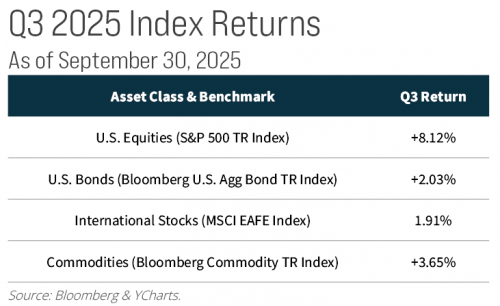
As we close the books on the third quarter of 2025, equity markets have once again defied skeptics with a robust performance that underscores the enduring power of technological innovation and accommodative monetary conditions. The quarter’s strength was anchored by the relentless momentum of Artificial Intelligence (AI) and mega-cap technology stocks, whose earnings trajectories continue to exceed even bullish expectations. Yet as we turn our attention to the final quarter of the year, investors must navigate an increasingly complex landscape where opportunity and uncertainty exist in delicate balance.

The third quarter’s rally was no accident. Beyond the AI narrative, which has captivated markets for nearly two years, lies a more fundamental driver: persistent liquidity. Despite official communications around quantitative tightening, the practical reality is that global central banks, led by the Federal Reserve, have maintained an accommodative stance that continues to channel capital into risk assets. This liquidity backdrop has proven decisive, steering flows away from traditional safe havens and cash equivalents toward equities that promise growth and innovation. The pattern is familiar and has repeated itself across recent quarters – when money remains abundant and inexpensive, markets climb.

Looking ahead to Q4, several critical questions demand attention. Foremost among them is the specter of inflation. While price pressures have moderated from their recent peaks, the underlying economic stability we’re experiencing could paradoxically reignite inflationary pressures through commodity price increases or wage acceleration. Our assessment suggests the Federal Reserve will maintain its current policy bias, prioritizing employment stability over preemptive rate hikes. This focus on the labor market component of the Fed’s dual mandate provides a constructive backdrop for continued equity appreciation, provided inflation metrics remain cooperative. Any meaningful re-acceleration in prices, however, would immediately challenge this benign scenario and force a rapid reassessment across asset classes.

Investors Should Beware of Potential Heightened Volatility

Our central thesis for the fourth quarter is that markets will continue their ascent while simultaneously experiencing heightened volatility, a phenomenon we describe as climbing the “wall of worry.” This expectation represents a notable departure from consensus thinking. Historically, rising equity prices and elevated volatility are inversely correlated; investors typically see low volatility during bull markets and vice versa. Yet current conditions suggest this relationship may break down. With the VIX trading near the lower end of its post-pandemic range despite elevated valuations, we believe the market is underpricing risk.

As stocks push higher into year-end, investors will inevitably demand greater compensation for holding risk, manifesting as sharper intraday swings and more frequent corrections even as the broader trend remains positive.

How We’re Positioned: High on Large Cap Tech and AI

This outlook informs our positioning strategy in our own portfolios. Rather than making binary directional bets, we’ve constructed a portfolio designed to perform across multiple market states, what we term being “covered both ways.” This approach allows us to participate fully in continued market advances while simultaneously benefiting from volatility spikes that would challenge more conventional long-only strategies. In an environment where complacency has been periodically punished, such flexibility is essential.
From a sector perspective, we remain constructive on Large-Cap Technology and the core AI infrastructure companies that have led this cycle. More compelling, however, is the broadening of AI adoption beyond hardware and chip manufacturers into the enablers and application layers across diverse industries. The next phase of this mega-trend will reward companies that successfully monetize AI capabilities rather than merely those building the foundational technology. Additionally, select opportunities within the Russell 2000 are emerging, representing smaller companies poised to become tomorrow’s growth engines.

The Verdict: Cautious Optimism in Equity Markets

As we navigate the final quarter of 2025, our stance is one of measured optimism grounded in fundamental drivers. The combination of persistent liquidity, technological leadership, and reasonable policy accommodation creates a supportive environment for equities over both the near-term and the next one to two years. However, success will require acknowledging and preparing for the increased volatility that inevitably accompanies markets at elevated valuations.
The wall of worry remains formidable, but history suggests it’s worth climbing.

Equity Armor sub-advises the Rational Equity Armor Fund (HDCTX) and the Catalyst Nasdaq-100 Hedged Equity Fund (CLPFX).

Fixed Income Outlook: Carry Opportunities, Tight Valuations, and Navigating Macro Risks Through Quality Credit Selection

By Dwayne Moyers, President and Chief Investment Officer, SMH Capital Advisors, LLC.

Fixed income markets posted solid results this past quarter, driven largely by monetary policy shifts and strong investor demand. The Bloomberg U.S. Aggregate Index and the High Yield Index both saw returns of more than 2% for the quarter. The Federal Reserve’s 25 basis point rate cut in September anchored short-term yields, while long-term yields rose modestly on deficit and supply concerns, steepening the curve.

Credit spreads in both investment grade and high yield tightened, supported by healthy corporate earnings, strong balance sheets, and modest net supply. Treasury performance was mixed with shorter maturities benefiting from policy expectations, while the long end faced pressure from higher term premiums. For instance, the 10-year Treasury came close to a -2% total return and the 30-year came close to a -1% total return.

Overall, credit markets delivered strong carry and spread-driven returns. However, valuations are increasingly tight, long-duration Treasuries remain vulnerable, and macro risks include inflation trends, fiscal deficits, and tariff uncertainty, which are likely to continue to shape performance. Quality credit selection will be the determining factor for producing very favorable returns. Worries in the private credit market with the recent blow ups and frauds with TriColor and First Brands have cast more doubt in the private credit markets.

Entering Q4, fixed income markets face several unresolved macro questions. Chief among them is the trajectory of inflation and how it shapes the Federal Reserve’s policy path. While one to two additional rate cuts remain likely this year, the pace will hinge on whether disinflation continues or stalls. The yield curve is expected to steepen further as front-end rates decline, and long-end yields remain pressured by heavy Treasury issuance, fiscal deficits, and elevated term premiums.

Growth is slowing, and the balance between a soft landing and a mild recession remains uncertain. Credit spreads, already tight, leave little room for further compression. Performance will therefore be driven more by carry than by spread tightening.

The Fixed Income Takeaways:

  • Quality and selectivity will matter: corporates and recession defensive sectors should fare better, while cyclical industries and weaker credits may face pressure.
  • Key risks include sticky services inflation, expanded tariffs, fiscal policy uncertainty and civil unrest. Global dynamics, including policy divergence across central banks and capital flow shifts, could add further market noise.

In summary, the quarter ahead is likely to reward higher-quality credit exposure, moderate duration, and careful sector allocation. Upside from spreads is limited, but steady income opportunities remain in corporate bonds, and selective high yield.

Mr. Moyer is a Portfolio Manager on the Catalyst/SMH High Income Fund (HIIIX) and the Catalyst/SMH Total Return Income Fund (TRIIIX)

Q4 Spotlight: How Trend Following Can Continue its Comeback

By Martin Lueck, Co-Founder and Director of Research, and Iain Cameron, Senior Investment Solutions, Aspect Capital.

Why Was Early 2025 Challenging for Trend Following? What is Behind the Recovery?

Strategies that rely on quantitative trend signals and machine-learning techniques were caught by abrupt, policy-driven reversals in early April. The tariff announcement jolted positioning across currencies, equities, and certain commodities, producing sharp reversals that penalized pre-event exposures for trend strategies. The systematic models adapted quickly to the new price information, but prices reversed again, whipsawing the emerging trends. Meanwhile, several markets, most notably government bonds and parts of the energy complex, spent long stretches in range-bound, directionless price-patterns, a difficult backdrop for trend systems.

We described Q2’s difficult market pattern as akin to an aircraft hitting turbulence: sudden, aggressive air pockets force a course-correction until cleaner air reappears. Trend programs behave similarly, actively seeking “clean air” in the form of persistent price trends, and by Q3, the air did improve. Equities re-accelerated, supported by ongoing AI-related productivity enthusiasm, and managed futures strategies captured the upwards move across not just U.S. markets, but Asian and European indices as well. Select commodities like cattle and gold also offered substantial opportunities, reenforcing the benefit of investing in a diversified multi-asset portfolio.

Why We Are Optimistic for Trend Strategies from Here

We believe five key macroeconomic forces might cause dramatic shifts in markets; we have called them the 5 D’s of global change.

1) Decarbonization
Accelerating clean-energy investment is reshaping commodity demand curves. But different countries are moving at different speeds: China has pivoted rapidly toward EVs and solar, while others are transitioning more gradually, creating breadth and dispersion across commodities. On the near-term horizon is the growth of AI. Equity markets have been propelled higher by AI-induced euphoria. But have markets overlooked the energy demands of the AI revolution? Generation and storage capacity need to catch up, with potential knock-on trend opportunities in fuels and metals.

2) De-dollarization
The U.S. dollar was one of the biggest movers in H1. Sentiment surrounding its ability to be the global reserve currency has soured. Irrespective of whether it’s permanent or not, we expect to see flows to other G10 currencies and therefore opportunities in FX markets. The strong bull market in gold has also been a by-product of the de-dollarization effect. Gold behaved similarly in the 1970s, a decade characterized by geopolitical unrest and repeated bouts of inflation.

3) Defense Spending
NATO countries are being held accountable to their pledges. We have seen many dramatically increase their spending on defense and rearmament. This process is expensive, it could be pro-growth, it could have a similar effect on inflation, we will wait and see. What we know is that it will involve commodity markets.

4) Deglobalization
Post-pandemic supply-chain rewiring, tariff frictions, and ‘friend-shoring’ are fragmenting market microstructures. As production and sourcing regionalize, assets in different blocs might begin to behave differently, increasing geographical dispersion and potentially creating multiple, separate asset class trends.

5) Demographics
This one will play out over a longer time horizon. The composition of societies is changing; retirement portfolios need to change with them. Aging populations and shifting dependency ratios imply longer working lives and a longer need for growth-tilted portfolios. Bonds can’t be relied on as much and alternatives should be explored, but people will need liquidity. People are living longer and fertility rates are declining, but life still happens – liquidity should always be valued.

Overall, trend following is built for change, not stasis. After a whipsaw-heavy Q2, the return of directional moves in Q3 shows how quickly managed futures can re-engage when flows re-align. We expect the “5 Ds” to keep macro dispersion elevated into 2026 and beyond, providing strong tailwinds for a diversified multi-asset trend programme.

Aspect Capital is the sub-advisor to the Catalyst/Aspect Enhanced Multi-Asset Fund (CASIX).

IMPORTANT RISK DISCLOSURES

Past performance is not a guarantee of future results.

INVESTORS SHOULD CAREFULLY CONSIDER THE INVESTMENT OBJECTIVES, RISKS, CHARGES AND EXPENSES OF LIQUID ALTERNATIVE FUNDS, INCLUDING THE CATALYST FUNDS AND THE RATIONAL FUNDS. THIS AND OTHER IMPORTANT INFORMATION ABOUT A FUND IS CONTAINED IN THE PROSPECTUS, WHICH CAN BE OBTAINED BY CALLING 866-447-4228 OR AT WWW.CATALYSTMF.COM OR WWW.RATIONALMF.COM, AS APPLICABLE. THE RELEVANT PROSPECTUS SHOULD BE READ CAREFULLY BEFORE INVESTING. BOTH THE CATALYST FUNDS AND THE RATIONAL FUNDS ARE DISTRIBUTED BY NORTHERN LIGHTS DISTRIBUTORS, LLC (“NLD”). NLD HAS HAD NO ROLE IN THE STRUCTURING OR DISTRIBUTION OF ANY OTHER INVESTMENT PRODUCTS REFERENCED HEREIN, AND IS NOT RESPONSIBLE FOR THE MARKETING OR PROMOTIONAL MATERIAL RELATED TO THE OTHER INVESTMENT PRODUCTS PRODUCED OR SPONSORED BY ANY OTHER FIRM. DAVID MILLER, JOE TIGAY, DWAYNE MOYERS, MARTIN LUECK, IAIN CAMERON, STRATEGY SHARES, EQUITY ARMOR, SMH ADVISORS, AND ASPECT CAPITAL ARE NOT AFFILIATED WITH NLD AND ULTIMUS FUND SOLUTIONS.

Risk Considerations

Though the objectives, strategies and assets traded may differ significantly across liquid alternative approaches, investing in liquid alternatives generally carries certain risks. These risks may include, but are not necessarily limited to, the following: Certain funds may invest a percentage of their assets in derivatives, such as futures and options contracts. The use of such derivatives and the resulting high portfolio turn-over may expose such funds to additional risks that they would not be subject to if they invested directly in the securities and commodities underlying those derivatives. These funds may experience losses that exceed those experienced by funds that do not use futures contracts, options and hedging strategies. Investing in commodities markets may subject a fund to greater volatility than investments in traditional securities. Currency trading risks include market risk, credit risk and country risk. Foreign investing involves risks not typically associated with U.S. investments. Changes in interest rates and the liquidity of certain investments could affect a fund’s overall performance. Other risks include U.S. Government securities risks and investments in fixed income securities. Typically, a rise in interest rates causes a decline in the value of fixed income securities or derivatives owned by a fund. Furthermore, the use of leverage can magnify the potential for gain or loss and amplify the effects of market volatility on a fund’s share price. All funds are subject to regulatory change and tax risks; changes to current rules could increase costs associated with an investment in a fund.

The value of a fund may decrease in response to the activities and financial prospects of an individual security or group of securities held in a fund’s portfolio. Investments in foreign securities could subject a Fund to greater risks, including currency fluctuation, economic conditions, and different governmental and accounting standards. A fund’s portfolio may be focused on a limited number of industries, asset classes, countries or issuers. Certain funds may invest in high yield or junk bonds, which present a greater risk than bonds of higher quality. Other risks may include credit risks and interest rate risk, particularly with respect to floating rate loan funds. Changes in short-term market interest rates will directly affect the yield on the shares of a fund whose investments are normally invested in floating rate debt. Floating rate loan funds tend to be illiquid, and a fund might be unable to sell the loan in a timely manner as the secondary market is generally a private, unregulated inter-dealer or inter-bank re-sale market.

Any or all of the foregoing risk factors may affect the value of your investment.

The views expressed herein are as of June 30, 2025, and represent a general guide to the perspectives of the authors. The information and opinions contained in this document have been compiled or arrived at based on sources believed to be reliable and in good faith; however, no representations or warranties of any kind are intended or should be inferred with respect to the accuracy of the information contained herein or the economic return of an investment in a fund, and no assurance can be given that existing laws will not be changed or interpreted adversely. All such information and opinions are subject to change without notice.

Some of the statements in this presentation may contain or be based on forward looking statements, estimates, targets or prognoses (collectively, “forward looking statements”), which reflect the advisor’s current view of future events, economic developments and financial performance. Such forward looking statements are typically indicated by the use of words which express an estimate, expectation, belief, target or forecast. Such forward looking statements are based on an assessment of historical economic data, on the experience and current plans of the advisor and/or certain of its advisors, and on the indicated sources. These forward looking statements contain no representation or warranty of whatever kind that such future events will occur or that they will occur as described herein, or that such results will be achieved by any fund or the investments of any fund, as the occurrence of these events and the results of a fund are subject to various risks and uncertainties. The actual portfolio, and thus results, of a fund may differ substantially from those assumed in the forward looking statements. The opinions expressed reflect the advisor’s best judgment at the time this presentation was issued, and the advisorr and its affiliates will not undertake to update or review the forward looking statements contained in this presentation, whether as a result of new information or any future event or otherwise.

The advisor’s judgments about the growth, value or potential appreciation of an investment may prove to be incorrect or fail to have the intended results, which could adversely impact a Fund’s performance and cause it to underperform relative to other funds with similar investment goals or relative to its benchmark, or not to achieve its investment goal.
There is no assurance that these opinions or forecasts will come to pass, and past performance is no assurance of future results.

There is a risk that issuers and counterparties will not make payments on securities and other investments.

Glossary:

Bloomberg Commodity TR Index – designed to be a highly liquid and diversified benchmark for commodity investments.

Bloomberg US Aggregate Bond TR Index – A market capitalization-weighted index that is designed to measure the performance of the U.S. investment grade bond market with maturities of more than one year.

Commodities – a basic good used in commerce that is interchangeable with other commodities of the same type. Investors and traders can buy and sell commodities directly in the spot (cash) market or via derivatives such as futures and options.

Credit Spreads – The difference in yield (return) between two debt instruments of the same maturity but with different credit ratings, reflecting the additional risk investors take on when lending to a borrower with a lower credit rating.

Currencies – money in the form of paper and coins that’s used as a medium of exchange. Currencies are created and distributed by individual countries around the world.

MSCI EAFE Index – a broad market equity index that tracks the performance of large and mid-cap companies in 21 developed markets around the world, excluding the US and Canada.

S&P 500 TR Index – A market capitalization-weighted index that is used to represent the U.S. large-cap stock market.

20251002-4868015


Click here to read the full report.


Stability in Chaos: The Market Moves Forward Despite Global Tensions

Explore Catalyst FundsExplore Rational Funds

The Macro View: Volatility, Tariffs, and Fed Jitters

By David Miller, Co-Founder and Chief Investment Officer, Catalyst Capital Advisors LLC and Rational Advisors, Inc.

As we begin Q3 2025, the investing landscape continues to be shaped by three dominant macro forces: persistent trade tensions, evolving interest rate policy, and slowing global growth expectations.

Markets entered July still recovering from the tariff-driven dislocation that rattled Q2. While the worst fears of an all-out global trade war have not materialized, tariff escalation with China, Canada, and Mexico remains a live risk. Investors are weighing the paradoxical potential for a “tariff recession” to catalyze Fed rate cuts—an echo of what we saw in 2020. In fact, markets now price in two 25 bps cuts by year-end, even as inflationary impulses remain stickier than expected due to supply chain shocks and deficit spending.

Key Signals to Watch in Q3:

  • Federal Reserve Policy: After holding steady in Q2, markets expect clearer dovish signaling at the upcoming August Jackson Hole symposium and the September FOMC meeting.
  • GDP Trajectory: Q1 GDP showed a deceleration. It is an open-ended question as to the direction of the trajectory going forward, but the new bill will likely be a stimulus.
  • Consumer Confidence: Still fragile after a sharp Q2 drop, this remains a key sentiment barometer.
  • Yield Curve Dynamics: The 2s/10s curve remains relatively flat in slope.

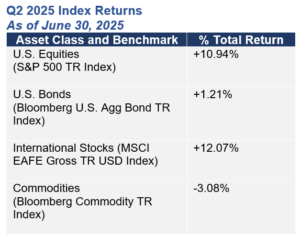
Source: Bloomberg & YCharts. From 3/31/25 to 6/30/25.

Equity Markets: A Q2 Comeback, but Volatility Remains the Name of the Game

By Michael Dzialo, Karen Culver, Peter Swan, Zachary Fellows, John Dalton, and Nicolas Vilotti of the Managed Asset Portfolios Investment Team.

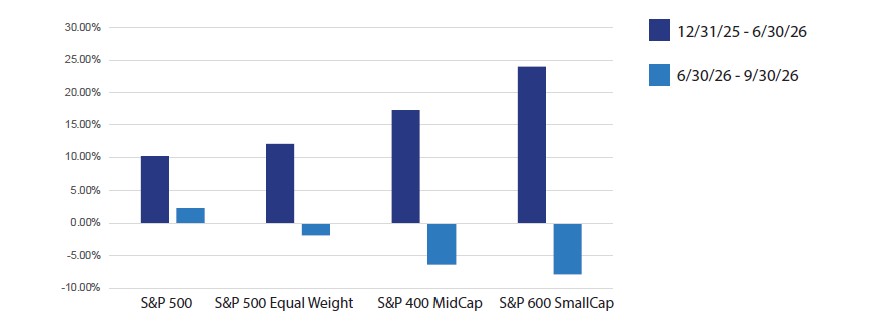
Investors would not know it from the slight gains in the broader market so far this year, but volatility has been the defining term for the first half of 2025. In fact, a recent Barron’s article mentioned that, on a risk-adjusted basis, returns for the S&P 500 this year have been in the 24th percentile since 1990, while volatility has been in the 89th percentile. Now, more so than ever, the broader markets react to headlines and tweets rather than facts and figures.

U.S. stocks fell in the first quarter after two consecutive years of gains amid rising policy uncertainty in Washington, marking the worst relative performance for U.S. stocks versus global markets in 23 years. Fast forward to the second quarter, and U.S. stocks rebounded following Liberation Day lows as global stocks treaded water. As we move into the third quarter, the same uncertainties that plagued the U.S. market in the first half of the year remain, including valuations, global macroeconomic activity, interest rates, and tariffs.

Despite the volatility this year, the S&P 500 is trading at 25.8 times trailing earnings, above the 5 and 10-year averages of 23.87 and 21.68, respectively. This compares to the MSCI ACWI ex-USA, trading at 15.92 times trailing earnings, slightly below the 5 and 10-year averages of 16.42 and 16.26, respectively. U.S. stocks have historically commanded premium valuations over most other countries for several reasons; however, we believe the delta between the two is too wide. Elevated valuations need the support of continued earnings growth. Companies reported decent earnings growth in the first quarter, yet many either pulled guidance for the rest of the year or issued softened guidance in the face of economic uncertainty.

Assessing the Health of the U.S. Economy

The U.S. economy has demonstrated remarkable resilience in 2025, but cracks are beginning to form. Our investment team is closely watching the labor market as layoffs rise, and recent college graduates are having difficulty finding a job. As such, we have a cautious view on the U.S. economy. At its most recent meeting, the Federal Reserve (the “Fed”) lowered its 2025 GDP forecast to 1.4% from 1.7% while raising its forecast for core inflation to 3.1% from 2.8% in anticipation of a tick up in inflation in the coming months stemming from tariffs. Eventually, we believe the Fed will succumb to political pressure and, as the economy slows, lower interest rates, further steepening the yield curve. Either way, Fed Chair Jerome Powell’s term ends in May 2026, and whoever President Trump selects to succeed him will likely share his views that the Fed needs to lower rates.

While U.S. investors grapple with uncertainty, markets outside the U.S. appear well-positioned over the long-term. We believe that U.S. trade policies should become catalysts to push foreign nations to spend more on infrastructure and defense. As we have witnessed in the U.S. over the past several decades, spending money is stimulative to the economy. We believe Europe may be in the preliminary stages of a substantial economic rebound as spending increases.

Why Investors Should Consider a Global, Active Approach

Overall, we believe an environment of heightened geopolitical and economic uncertainty strengthens the case for active management. While we monitor, we do not act on the seemingly daily barrage of tweets and headlines coming out of Washington. Rather, we look at the bigger picture. The investment team believes  the U.S. dollar will trend lower over the next few years, not necessarily in a straight line, benefiting global equities as well as select commodities. We are also overweight those sectors that historically do not rely on strong economic growth, including the Consumer Staples, Health Care, and Utilities sectors.

Managed Asset Portfolios sub-advises the Catalyst/MAP Global Equity Fund (CAXIX) and the Catalyst/MAP Global Balanced Fund (TRXIX).

Fixed Income Outlook: Bond Markets & Murphy’s Law

By Michael Perini, Perini Capital LLC.

Murphy’s Law stating “what can go wrong will go wrong” seems like an apt description of life for fixed income investors since the beginning of 2022. Since then, investors in the asset class have had to grapple with the following:

  • Multi trillion dollar increases in the Federal Reserve’s balance sheet.
  • Fiscal stimulus and budget deficits that are more in line with wartime or deep recessions.
  • Inflation that has not been seen since the 1970’s.
  • An increase in the Federal Funds rate from 0.25% to 5.50%.
  • Tariffs and the uncertainty associated with them.
  • Decreased demand for U.S. Treasuries.
  • Renewed conflict in the Middle East.
  • The “Big Beautiful Bill”

However, perhaps the problems are not what they seem when viewed through a different lens. Maybe what fixed income investors need is a paradigm shift. While all the above-mentioned headwinds make it seem like it may be time to reduce exposure to fixed income, we disagree because of our non-traditional way of viewing the risks associated with fixed income.

In our view, there are three distinct risks to fixed income investors:

  • Interest Rate Risk: The risk that interest rates rise.
  • Reinvestment Risk: The risk that interest rates fall.
  • Credit Risk: The risk of permanent impairment of capital due to defaults.

The events beginning in 2022 and continuing through today have been extremely painful from the standpoint of investors with significant interest rate risk. Interest rates have gone up (a lot!) and prices have gone down. From the standpoint of reinvestment risk, the interest rate environment since 2022 has been a big positive, as the reinvestment rate of incoming cash flows is much higher than it was prior to 2022. The reinvestment component of total return is often underappreciated, both as a counterweight to interest rate risk and as a key in creating return stability to a variety of forward interest rate scenarios. However, achieving this balance is not easy, nor is it often accessible via traditional fixed income solutions.

Traditional fixed income solutions, such as U.S. Treasuries, corporate bonds and municipal bonds, pay interest every six months and principal as a final payment at maturity; therefore, due to the lack of cash flow between issuance and maturity, the reinvestment rate of incoming cash flows is typically not a meaningful component of total return. In contrast, structured credit sectors, such as mortgage-backed-securities, often pay interest and principal every month, and because of this feature the reinvestment of incoming cash flows is generally a meaningful component of total return. Additionally, the higher the cash flow of a portfolio the lower price changes (because of changing rates) matter as a percentage of total return.

Given the uncertainty in today’s macro environment where interest rate volatility and direction will likely remain high and difficult to forecast, we believe investors should look to alternative fixed income solutions that can provide non-correlated returns, diversification and balance interest rate risk versus reinvestment risk. The paradigm shift mentioned herein has the potential to benefit investors when navigating the fixed income markets through the rest of 2025 and beyond.

Perini Capital LLC is the sub-advisor to the Catalyst/Perini Strategic Income Fund (CSIOX)

Spotlight: Why Gold Continues to Shine

By David Miller, Co-Founder and Chief Investment Officer, Catalyst Capital Advisors LLC and Rational Advisors, Inc.

Gold remains a standout asset class as we enter Q3—offering both a potential hedge against geopolitical chaos and an escape from fiat currency erosion. A few key reasons:

  1. Central Bank Demand Surging: BRICS nations—particularly China and India—are accelerating gold reserves accumulation as part of broader de-dollarization strategies.
  2. Deficits + Tariffs = Inflation Risk: Persistent U.S. fiscal deficits, now exacerbated by tariff-induced price pressures, add to the long-term inflation argument—which is generally supportive of gold prices.
  3. Yield Convergence: With bond yields declining and real rates pressured by inflation, the opportunity cost of holding gold is falling—reviving investor interest in gold ETFs and alternatives.
  4. Technical Breakout: Gold has held above $3,250/oz for much of June and shows signs of an upward breakout as volatility returns to equity markets.

Positioning Implications:

We believe that the current macro environment justifies a meaningful allocation to gold and gold-related strategies.

Looking ahead, the combination of fragile equity sentiment, uncertain policy direction, and structural macro headwinds reinforces our view: gold isn’t just a crisis hedge—it’s becoming a core asset class in the modern portfolio playbook.

IMPORTANT DISCLOSURES

Past performance is not a guarantee of future results.

INVESTORS SHOULD CAREFULLY CONSIDER THE INVESTMENT OBJECTIVES, RISKS, CHARGES AND EXPENSES OF LIQUID ALTERNATIVE FUNDS, INCLUDING THE CATALYST FUNDS AND THE RATIONAL FUNDS. THIS AND OTHER IMPORTANT INFORMATION ABOUT A FUND IS CONTAINED IN THE PROSPECTUS, WHICH CAN BE OBTAINED BY CALLING 866-447-4228 OR AT WWW.CATALYSTMF.COM OR WWW.RATIONALMF.COM, AS APPLICABLE. THE RELEVANT PROSPECTUS SHOULD BE READ CAREFULLY BEFORE INVESTING. BOTH THE CATALYST FUNDS AND THE RATIONAL FUNDS ARE DISTRIBUTED BY NORTHERN LIGHTS DISTRIBUTORS, LLC (“NLD”). NLD HAS HAD NO ROLE IN THE STRUCTURING OR DISTRIBUTION OF ANY OTHER INVESTMENT PRODUCTS REFERENCED HEREIN, AND IS NOT RESPONSIBLE FOR THE MARKETING OR PROMOTIONAL MATERIAL RELATED TO THE OTHER INVESTMENT PRODUCTS PRODUCED OR SPONSORED BY ANY OTHER FIRM. DAVID MILLER, STRATEGY SHARES, MICHAEL DZIALO, KAREN CULVER, PETER SWAN, ZACHARY FELLOWS, JOHN DALTON, NICOLAS VILOTTI, MANAGED ASSET PORTFOLIOS, MICHAEL PERINI, AND PERINI CAPITAL LLC ARE NOT AFFILIATED WITH NLD.

Risk Considerations

Though the objectives, strategies and assets traded may differ significantly across liquid alternative approaches, investing in liquid alternatives generally carries certain risks. These risks may include, but are not necessarily limited to, the following: Certain funds may invest a percentage of their assets in derivatives, such as futures and options contracts. The use of such derivatives and the resulting high portfolio turn-over may expose such funds to additional risks that they would not be subject to if they invested directly in the securities and commodities underlying those derivatives. These funds may experience losses that exceed those experienced by funds that do not use futures contracts, options and hedging strategies. Investing in commodities markets may subject a fund to greater volatility than investments in traditional securities. Currency trading risks include market risk, credit risk and country risk. Foreign investing involves risks not typically associated with U.S. investments. Changes in interest rates and the liquidity of certain investments could affect a fund’s overall performance. Other risks include U.S. Government securities risks and investments in fixed income securities. Typically, a rise in interest rates causes a decline in the value of fixed income securities or derivatives owned by a fund. Furthermore, the use of leverage can magnify the potential for gain or loss and amplify the effects of market volatility on a fund’s share price. All funds are subject to regulatory change and tax risks; changes to current rules could increase costs associated with an investment in a fund.

The value of a fund may decrease in response to the activities and financial prospects of an individual security or group of securities held in a fund’s portfolio.  Investments in foreign securities could subject a Fund to greater risks, including currency fluctuation, economic conditions, and different governmental and accounting standards.  A fund’s portfolio may be focused on a limited number of industries, asset classes, countries or issuers.  Certain funds may invest in high yield or junk bonds, which present a greater risk than bonds of higher quality.  Other risks may include credit risks and interest rate risk, particularly with respect to floating rate loan funds.  Changes in short-term market interest rates will directly affect the yield on the shares of a fund whose investments are normally invested in floating rate debt.  Floating rate loan funds tend to be illiquid, and a fund might be unable to sell the loan in a timely manner as the secondary market is generally a private, unregulated inter-dealer or inter-bank re-sale market.

Any or all of the foregoing risk factors may affect the value of your investment.

The views expressed herein are as of June 30, 2025, and represent a general guide to the perspectives of the authors. The information and opinions contained in this document have been compiled or arrived at based on sources believed to be reliable and in good faith; however, no representations or warranties of any kind are intended or should be inferred with respect to the accuracy of the information contained herein or the economic return of an investment in a fund, and no assurance can be given that existing laws will not be changed or interpreted adversely. All such information and opinions are subject to change without notice.

Some of the statements in this presentation may contain or be based on forward looking statements, estimates, targets or prognoses (collectively, “forward looking statements”), which reflect the advisor’s current view of future events, economic developments and financial performance. Such forward looking statements are typically indicated by the use of words which express an estimate, expectation, belief, target or forecast. Such forward looking statements are based on an assessment of historical economic data, on the experience and current plans of the advisor and/or certain of its advisors, and on the indicated sources. These forward looking statements contain no representation or warranty of whatever kind that such future events will occur or that they will occur as described herein, or that such results will be achieved by any fund or the investments of any fund, as the occurrence of these events and the results of a fund are subject to various risks and uncertainties. The actual portfolio, and thus results, of a fund may differ substantially from those assumed in the forward looking statements. The opinions expressed reflect the advisor’s best judgment at the time this presentation was issued, and the advisorr and its affiliates will not undertake to update or review the forward looking statements contained in this presentation, whether as a result of new information or any future event or otherwise.

The advisor’s judgments about the growth, value or potential appreciation of an investment may prove to be incorrect or fail to have the intended results, which could adversely impact a Fund’s performance and cause it to underperform relative to other funds with similar investment goals or relative to its benchmark, or not to achieve its investment goal.

There is no assurance that these opinions or forecasts will come to pass, and past performance is no assurance of future results.

There is a risk that issuers and counterparties will not make payments on securities and other investments.

Glossary:

Bloomberg Commodity TR Index – designed to be a highly liquid and diversified benchmark for commodity investments.

Bloomberg US Aggregate Bond TR Index –  A market capitalization-weighted index that is designed to measure the performance of the U.S. investment grade bond market with maturities of more than one year.

BRICS –  an intergovernmental organization comprised of ten countries: Brazil, Russia, India, China, South Africa, Egypt, Ethiopia, Indonesia, Iran and the United Arab Emirates.

Commodities – a basic good used in commerce that is interchangeable with other commodities of the same type. Investors and traders can buy and sell commodities directly in the spot (cash) market or via derivatives such as futures and options.

Credit Spreads – The difference in yield (return) between two debt instruments of the same maturity but with different credit ratings, reflecting the additional risk investors take on when lending to a borrower with a lower credit rating.

Currencies – money in the form of paper and coins that’s used as a medium of exchange. Currencies are created and distributed by individual countries around the world.

MSCI EAFE Gross TR USD Index – a broad market equity index that tracks the performance of large and mid-cap companies in 21 developed markets around the world, excluding the US and Canada.

S&P 500 TR Index – A market capitalization-weighted index that is used to represent the U.S. large-cap stock market.

20250702-4633644


Click here to read the full report.

Short-Term Noise Can Lead to Long-Term Opportunity

Key Summary:

  • Markets have more noise and volatility than ever before.
  • The best forward returns happen when we build bigger positions in noisy periods.
  • Being a contrarian when fear, uncertainty, and panic has historically paid handsomely.

Very Important thesis: If equities generate roughly ~10-11% a year over time, the best companies with leading brands and dominant global franchises, in theory, should compound at 13-15%+ over time. Looking backward, that is exactly what’s happened. Our best opportunity as an investor: buy more great brands when the market acts irrationally short-term. Your long-term returns will thank you.

Today’s Short-term Noise Won’t Last Forever.

With so much fear, uncertainty, and doubt (FUD) in markets and the economy today, I thought I would try and turn this frown upside down using some contrarian thinking. I’ve been an investor for 30 years now, so I’ve seen a lot of different kinds of markets. Between the Internet boom and bust, to the raging housing boom and crash during the GFC to the Covid crash and money printing experiment that created the interest rate and inflationary “normalization” process, the ride has been a wild one. During times like today, it’s important to remember that the short periods of FUD, like hurricanes, don’t generally last very long and when the uncertainty starts to wane, stocks and animal spirits wake up in a big way. It’s only a matter of time.

If you only take one thing from today’s musing, take this: storms are a sideshow to sunnier days. Markets go up 80-85% of the time so it’s in the down periods that we get an opportunity to buy great merchandise on sale so when the sun comes out again, you’ll own more quality and your speed to recovery gets accelerated.

Pessimism is Everywhere. Contrarian Signal?

We live in very interesting times. Tariff announcements are happening daily. Self-induced cracks in the economy are developing. Friction is developing between U.S. politicians and our allies. This is a moment in time and cooler heads will prevail in time. Clearly, the market is sniffing out a slowing of economic growth coming from policy uncertainty. While deep selloffs never feel good, this one in particular feels quite extreme because investors of all kinds have simply decided to “step-away” from markets until some certainty re-appears. The selling has been persistent because it’s a 1-sided market for now. Buyers are on strike, sellers and shorts are bold. Need proof? The below chart from Goldman Sachs shows how severe the de-risking has been in a short period of time. Hedge Funds, CTA’s, systematic investors and even regular retail investors, have all been selling due to high bouts of uncertainty.

With few buyers on the other side, the market just drifts lower, and rallies get sold quickly. Imagine what markets will do if/when there is some better policy certainty, consumers and businesses have a better understanding of the rules of the road and earnings variability stabilizes. Sellers will dry up. Shorts will cover. Animal spirits will return with a vengeance. There will be a lot of buyers all rushing back at once. I suggest we all start building bigger positions so when the party heats up, we have a great seat.

To give you a sense how severe the policy uncertainty is today, the chart below shows an index that measures it. We are higher than any other period over the last 25 years. Kind of incredible really, there were some scary moments in these former spikes. There were some great buying opportunities then too, and they all felt terrible at the time.

To Reiterate:

“De-risked” is not a permanent state. At some point, when either A) markets sell-off to a level where sellers feel like the doom is fully reflected in prices, or B) situations are getting better on a rate of change basis, or C) the major drivers of vol and downside begin to vanish, there’s going to be a complete reversal of the de-risking as re-risking happens all at once. We never know the WHEN, but we do know investors will not stay de-risked forever.

This is not a complex concept but emotionally, it’s often difficult to execute. Trying to pick bottoms is a tricky business, particularly given every day we see a rash of new headlines that algorithms love to trade against. Be systematic about adding exposures to your favorite strategies on deep red days. Do not buy all at once, split your buy orders up and build these positions while the pessimism is incredibly high, and prices are attractive. Remember, volatility and opportunity are neighbors!

Pessimism is Everywhere & It’s at an Extreme.

I cannot tell you when cooler heads will prevail, just that they will one day. I’m sure you have seen all the charts and data showing how cautious and outright pessimistic investors, small businesses and even corporations are becoming. It’s a dangerous game our leaders are playing but the stakes are quite high if they push this too far. Therefore, we should expect they understand the risks too and will manage them accordingly. Here’s a few examples showing the FUD today.

The CNN Fear & Greed Index: Current Reading, Extreme Fear.

This indicator measures 7 important indicators and rolls them into a score. It’s a very low number today, historically a decent spot to start adding to stocks if you have some time. Like most sentiment indicators, only at extremes are they useful as a timing tool.

AAII Sentiment Survey: Current Reading, Extreme Bearishness.

This survey has been around for many decades. It helps to measure how positive or negative investors are, likely biased by current market activity. At the extremes, this bearish view has tended to be a wonderful contrarian buy signal.  It’s very rare to see 60% bearishness and <20% bullishness. Historically, these periods offered solid forward returns. Again, having time is important, things can always get more extreme before they get a lot better.

Stock Breadth Washout Signals

One of the ways we measure washouts is knowing what % of the stocks in the S&P 500 and Nasdaq are currently trading above the 20-day moving average. Generally, if under 20% of stocks are trading over the 20day, there’s a decent buying opportunity. Sometimes, volatility and uncertainty are so high, breadth can get fully washed out. I expect that to happen in today’s climate as no end in sight seems visible for these tariff and economic slowdown possibilities The current situation feels a lot like Q4 2018 to me and breadth got to <5% on the Christmas eve low. If we see this kind of extreme reading again in the next month or two, close your eyes and buy some quality stocks, we certainly will with eyes wide open.

Today, March 14, 17% of stocks are trading above this short-term moving average. AKA, we could have more selling until we get fully washed out if politicians keep pushing this odd approach.

Bottom line.

On a day-to-day basis, markets can be volatile. News headlines, earnings, political actions, and plenty of other items can whip-saw our portfolios. The more short-term term we focus, the more angst we can generate. Angst puts pressure on our emotions and emotions make us make irrational decisions. The best advice I can give anyone who invests is this: If you try to wire your brain to be opportunistic when the masses are filled with fear and be cautious when others have euphoria, you will become a very good investor.  Over the long-term, your portfolio will look like the green line, in short periods of time, it can look like the yellow line. Today we focus on yellow, but do not lose sight of the green!

Important Disclosure: The above data is for illustrative purposes only.  This information was produced by Accuvest and the opinions expressed are those of the author as of the date of writing and are subject to change. Any research is based on the author’s proprietary research and analysis of global markets and investing. The information and/or analysis presented have been compiled or arrived at from sources believed to be reliable, however the author does not make any representation as their accuracy or completeness and does not accept liability for any loss arising from the use hereof. Some internally generated information may be considered theoretical in nature and is subject to inherent limitations associated therein. There are no material changes to the conditions, objectives or investment strategies of the model portfolios for the period portrayed. Any sectors or allocations referenced may or may not be represented in portfolios managed by the author, and do not represent all of the securities purchased, sold or recommended for client accounts.  The reader should not assume that any investments in sectors and markets identified or described were or will be profitable. Investing entails risks, including possible loss of principal. The use of tools cannot guarantee performance. The charts depicted within this presentation are for illustrative purposes only and are not indicative of future performance. Past performance is no guarantee of future results.

Private Markets: The Largest Mega Trend in Financial Services

Key Summary:

  • Most of our investment dollars are invested in the casino called public markets.
  • Roughly 90% of companies are private; investors are missing a large market opportunity.
  • The average investor has very little or no private market exposure. This is changing.

Investors Have Virtually No Exposure to the Largest Market in the World: Privates.

As a consumption-based investor, there are several powerful mega-trends happening around the world. One of these trends is happening in the financial services industry and is still a game in the early innings.

Assets are migrating on the margin away from public equities and fixed income and into private market strategies. Institutions have been heavily invested in privates for decades. Its individual investors turn to benefit.

The investment opportunity: Invest in private market funds or invest in the brands gathering the lion’s share of the assets in the wealth management channels: Blackstone, KKR, and Apollo Global. The brands portfolio has chunky allocations to these wonderful brands and the opportunities for growth in assets and fee revenue remains robust.

Why Consider Private Market Exposure?

The stock market has roughly 4600 listed companies with trailing twelve-month total revenues of roughly $23 trillion. That’s a pretty big market.  Blackstone recently stated that about 90% of companies with >$250 million in annual revenue are PRIVATE, not public. There’s an estimated 22 million private companies across small, medium, and large sized companies just in the U.S. The estimated annual revenue is roughly the same as public markets, so most investors are missing half the total opportunity-set by staying “public-only.”  (Advisorpedia). For many years, investing in private companies was quite difficult, but that’s changed dramatically over the last 10 years. Private market access has become easier and often doesn’t require locking up our capital like it used to. New innovations in semi-liquid strategies seem to be introduced every day and are being consumed at a rapid rate but it’s still inning 1-2 given the estimated $80 trillion size of the wealth management channel. There’s a significant amount of fee-revenue and asset growth to come.

Blackrock, an asset manager with >$11 trillion in assets has recently made several large acquisitions of private market asset managers clearly see’s what we see. Goldman Sachs, in this week’s earnings call also stated a major initiative to grow their alternative asset management capabilities. Everyone sees the flows and they have done the same math.

Why Are HNW Investors Allocating to Privates?

In one word: diversification. But there’s more to the story. The bulk of the wealth in the U.S. and around the globe is with older consumers. They have been working, saving, and collecting assets for many decades. As we get older, our appetite for risk and volatility tends to fall. Because of algorithms, a wild index options market, and the voracious appetite for short-term trading, the public markets have become much more casino-oriented and volatile than at any time in my 30-year career. Wild volatility wears most investors out. People get emotional and emotions often drive poor decision making which ultimately hurts their ability to generate attractive returns. For a variety of reasons, even the public bond market feels more and more like a casino. And returns have been sub-par across most of the bond complex.

So, all or most of the largest pool of assets ever collected is invested in assets that are more volatile than ever and at a time when the owner of these assets wants a less volatile experience with lower risk of losses. That profile does not seem to jive with today’s public markets. Enter private markets. Here’s a few key reasons Advisors are allocating more and more to private markets. And I do not see this stopping, the problem is acute and the desire for other options is extreme:

  • Lower daily volatility – because these do not have to mark to market daily, the volatility is significantly muted. That helps reduce total portfolio volatility meaningfully which keeps investors engaged and sleeping well even during volatile periods. This keeps them on-track for goal achievement. In my opinion, this is the most important reason major asset flows are moving to private assets. Advisors & investors really like this feature.
  • Potentially better returns – if investors are going to give up some daily liquidity, they should demand better returns. That’s exactly what has been delivered by the best private market asset managers over many decades. Which firm and funds one chooses, is important. The best of the best has generally delivered solid returns per unit of risk.
  • Diversification across thematics – Public market portfolios are very similar and crowded in a handful of companies. We think we have a diversified portfolio, but we just have “beta & size exposure.” Generally, people do not have much exposure to things like inflation-oriented assets, differentiated real estate, private credit, infrastructure, private equity, next-gen energy innovation, etc. Adding exposure to many of these assets offers solid diversification from the crowded public markets.

Bottom Line:

Most individual investors are missing a major opportunity for attractive total returns that are delivered via a much smoother journey. With new and ongoing innovation, more migration of assets away from the public market casino and into private market strategies is sure to happen. This is a mega trend early in its lifespan. Investing in the leading brands gathering the most amount of assets while delivering for clients seems to be a logical decision.

What’s most unbelievable: the stocks of the most relevant alternative asset managers are still incredibly under-owned at the index-level and generally in portfolios. Investing in the leading private managers is not a crowded trade. We expect many more to invest in these stocks as the benefits become more obvious. Today’s “private equity” asset managers are not the same businesses they were in the wild 1980’s.

Disclosure: The above data is for illustrative purposes only.  This information was produced by Accuvest and the opinions expressed are those of the author as of the date of writing and are subject to change. Any research is based on the author’s proprietary research and analysis of global markets and investing. The information and/or analysis presented have been compiled or arrived at from sources believed to be reliable, however the author does not make any representation as their accuracy or completeness and does not accept liability for any loss arising from the use hereof. Some internally generated information may be considered theoretical in nature and is subject to inherent limitations associated therein. There are no material changes to the conditions, objectives or investment strategies of the model portfolios for the period portrayed. Any sectors or allocations referenced may or may not be represented in portfolios managed by the author, and do not represent all of the securities purchased, sold or recommended for client accounts.  The reader should not assume that any investments in sectors and markets identified or described were or will be profitable. Investing entails risks, including possible loss of principal. The use of tools cannot guarantee performance. The charts depicted within this presentation are for illustrative purposes only and are not indicative of future performance. Past performance is no guarantee of future results.

Income Shines: November 2024 HANDLS Monthly Report

Income Sectors Shine

November proved to be a strong month for income-focused investments, with all sectors delivering positive returns despite market volatility. Leading the charge were MLPs, which surged 12.60%, benefiting from a favorable energy environment and rising commodity prices. This sector’s robust income generation continues to attract investors seeking yield in a stable energy backdrop. REITs followed far behind with a 3.54% return. While interest rates remain a challenge, strong demand for both commercial and residential properties kept the sector resilient. Similarly, Dividend Equities posted a strong 5.40%, benefiting from the broader market’s continued strength and providing investors with a balance of income and growth. Utilities delivered 3.78%, as their defensive nature remained appealing to investors seeking stability. With ongoing market uncertainty, the reliable income stream from utilities remains attractive. Growth & Income strategies also performed well, returning 5.84%, reflecting a mix of steady income and equity exposure. High Yield Bonds generated a modest 1.67%, as investor appetite for riskier assets remained cautious in the face of tighter credit spreads. Covered Calls posted 4.31%, as the strategy took advantage of solid equity performance while generating additional income through options.

In fixed income, Preferreds saw a modest 0.80% return, weighed down by ongoing interest rate pressures. However, Build America Bonds and MBS performed decently with returns of 1.66% and 1.51%, respectively, supported by favorable market conditions in infrastructure and mortgages. Investment Grade Corporate Bonds saw a moderate 1.26%, while Active Fixed Income strategies posted 1.34%, as managers adjusted exposures to navigate rate changes. On the equity front, Large Cap Equity returned 5.57%, reflecting strong corporate earnings.

For the Nasdaq HANDL™ Indexes, November was a very solid month highlighting the strength of a diversified basket. For the month of November:

  • Nasdaq 5HANDL™ Index: 3.78%
  • Nasdaq 7HANDL™ Index: 4.81% (1.3x leveraged)
  • Nasdaq 10HANDL™ Index: 7.24% (2.0x leveraged)

Overall, November demonstrated the resilience of income-focused investments across various sectors, offering solid returns in a dynamic market environment. As interest rates continue to adjust, investors are finding attractive opportunities in sectors that blend stability and income, reinforcing the value of diversification within portfolios.

Disclosure: Nasdaq® is a registered trademark of Nasdaq, Inc. The information contained above is provided for informational and educational purposes only, and nothing contained herein should be construed as investment advice, either on behalf of a particular security or an overall investment strategy. Neither Nasdaq, Inc. nor any of its affiliates makes any recommendation to buy or sell any security or any representation about the financial condition of any company. Statements regarding Nasdaq-listed companies or Nasdaq proprietary indexes are not guarantees of future performance. Actual results may differ materially from those expressed or implied. Past performance is not indicative of future results. Investors should undertake their own due diligence and carefully evaluate companies before investing. ADVICE FROM A SECURITIES PROFESSIONAL IS STRONGLY ADVISED. © 2024. Nasdaq, Inc. All Rights Reserved

Important Disclosure. HANDLS Indexes receives compensation in connection with licensing its indices to third parties. Any returns or performance provided within are for illustrative purposes only and do not demonstrate actual performance. Past performance is not a guarantee of future investment results. It is not possible to invest directly in an index. Exposure to an asset class is available through investable instruments based on an index. HANDLS Indexes does not sponsor, endorse, sell, promote or manage any investment fund or other vehicle that is offered by third parties and that seeks to provide an investment return based on the returns of any index.  There is no assurance that investment products based on an index will accurately track index performance or provide positive investment returns. HANDLS Indexes is not an investment advisor, and HANDLS Indexes makes no representation regarding the advisability of investing in any such investment fund or other vehicle. A decision to invest in any such investment fund or other vehicle should not be made in reliance on any of the statements set forth in this document. Prospective investors are advised to make an investment in any such fund or other vehicle only after carefully considering the risks associated with investing in such funds, as detailed in an offering memorandum or similar document that is prepared by or on behalf of the issuer of the investment fund or other vehicle. Inclusion of a security within an index is not a recommendation by Indexes to buy, sell, or hold such security, nor is it considered to be investment advice. The information contained herein is intended for personal use only and should not be relied upon as the basis for the execution of a security trade. Investors are advised to consult with their broker or other financial representative to verify pricing information for any securities referenced herein. Neither Indexes nor any of its direct or indirect third-party data suppliers or their affiliates shall have any liability for the accuracy or completeness of the information contained herein, nor for any lost profits, indirect, special or consequential damages. Either Indexes or its direct or indirect third-party data suppliers or their affiliates have exclusive proprietary rights in any information contained herein. The information contained herein may not be used for any unauthorized purpose or redistributed without prior written approval from HANDLS Indexes. Copyright © 2024 by HANDLS Indexes. All rights reserved.


Building a Winning Portfolio for Trump’s Second Term

As speculation grows about a potential second Trump presidency, investors brace for a major shift in the markets. Energy stocks lead the charge, while cryptocurrencies remain a hot topic despite regulatory uncertainty. But is following the crowd the right move? Opportunities are emerging in unexpected places, and pitfalls abound for the unwary. Now is the time to craft a portfolio that not only survives but thrives in a Trump 2.0 economy.

Building a portfolio for a second Trump term means focusing on companies positioned to benefit from shifting regulatory priorities and trade dynamics. Tesla, Palantir, and Amazon stand out as key players likely to excel amid these changes. They are well-prepared to thrive in a trade war and capitalize on regulatory shifts. Blockchain technology is set to grow, but the regulatory uncertainty around Bitcoin makes direct investment risky. Nvidia and PayPal offer a safer way to tap into the blockchain boom, with potential gains whether Bitcoin thrives or a new digital currency takes the lead. This strategy creates a balanced approach, navigating both opportunities and risks in a Trump 2.0 economy.

Challenges for Energy Stocks Under a Trump Presidency

While the prospect of increased oil drilling on federal land and the opening of pipelines is widely seen as a boost to domestic energy production, the implications for energy stocks are more complex.

Recent Gains Already Priced In

Energy stocks have seen significant appreciation in recent months, largely driven by strong oil and natural gas prices. However, if a Trump administration leads to reduced geopolitical tensions or increased domestic production, commodity prices could decline. This could erode some of the recent gains, making further upside for energy stocks less certain.

Oversupply Risks

A more permissive regulatory environment could spur higher production levels of oil and natural gas. While this might benefit consumers through lower prices, it could also lead to supply gluts. Lower commodity prices would compress profit margins for energy companies, even as operational costs decrease.

Demand Uncertainty

Policies favoring domestic energy independence could inadvertently limit exports, reducing revenue opportunities for major energy players. At the same time, global initiatives to expand renewable energy adoption could create long-term demand challenges for traditional energy sources.

Tesla (TSLA): Leading the Charge in a Looser Regulatory Environment

Tesla stands out as a clear winner in a world of relaxed regulations and shifting trade policies.

  1. Minimal Impact from EV Tax Credit Removal
    While the removal of EV tax credits could hurt competitors like the Big Three automakers, Tesla is well-positioned to weather the change. Its strong brand and market dominance, coupled with a loyal customer base, make it less reliant on subsidies to drive sales.
  2. Domestic Manufacturing Advantage
    Tesla’s manufacturing approach gives it a unique edge. Unlike the Big Three, which depend heavily on components sourced from Mexico, Tesla produces many of its parts domestically at its Gigafactory in Texas. This reduces exposure to potential tariff hikes on imports and aligns well with policies prioritizing U.S.-based manufacturing.
  3. Potential Boost from Infrastructure Spending
    Investments in infrastructure under a second Trump term could include provisions for expanding EV charging networks, further supporting Tesla’s ecosystem. As the leader in electric vehicle adoption, Tesla would be a prime beneficiary of such initiatives.

Under these conditions, Tesla not only maintains its dominance but strengthens its position in the rapidly growing EV market.

Amazon (AMZN): A Strategic Shift for Political Neutrality

Amazon’s approach heading into a second Trump presidency suggests a calculated strategy to navigate the political landscape more effectively.

  1. A More Neutral Bezos
    Unlike during Trump’s first term, when tensions between the administration and Jeff Bezos over The Washington Post culminated in Amazon losing a major government contract to Microsoft, this time Bezos appears to be charting a more neutral course. The Washington Post notably refrained from endorsing any candidate in the recent election, potentially easing political friction that previously affected Amazon’s federal prospects.
  2. Regulatory Tailwinds for Distribution
    Amazon’s extensive network of distribution centers stands to benefit significantly from loosened regulations. Policies reducing red tape around zoning, labor laws, and environmental restrictions could lower operational costs and accelerate expansion. This positions Amazon to enhance its dominance as one of America’s largest employers and an indispensable player in e-commerce logistics.
  3. A Potential Ally in Job Creation
    As one of the country’s largest employers, Amazon’s contributions to local economies may resonate with Trump’s focus on domestic job creation. This dynamic could foster a more favorable relationship between the administration and the company, paving the way for new government contracts or policy advantages.

By taking a more politically neutral stance and leveraging reduced regulations, Amazon could position itself to thrive in a Trump 2.0 economy while avoiding the pitfalls of previous conflicts.

Palantir (PLTR): Driving Efficiency in Government and National Security

Palantir stands out as a company uniquely aligned with the priorities of a potential second Trump administration, particularly in its focus on cost reduction and AI-driven solutions.

  1. Support for Government Efficiency
    With a renewed emphasis on cutting government spending and increasing efficiency, Palantir’s technology is well-positioned to shine. Its suite of data analytics tools has already proven effective in streamlining processes and reducing costs for federal agencies, making it an attractive partner in an era of fiscal restraint.
  2. Alignment with the AI Revolution
    As artificial intelligence reshapes industries, Palantir’s advanced AI capabilities put it at the forefront of this technological transformation. The company’s ability to harness big data for actionable insights positions it as a key player in enhancing both efficiency and effectiveness for public and private sector clients alike.
  3. Opportunities in Defense and Security
    A second Trump presidency would likely bring continued investment in defense and border security, areas where Palantir has significant expertise. The company’s long-standing government contracts and proven track record in national security applications align perfectly with policies emphasizing border control and domestic safety.

By bridging the gap between cost-cutting measures and technological innovation, Palantir offers a compelling investment case in an administration focused on streamlining government operations.

Cryptocurrency Risks Under a Trump Presidency

While the deregulation mindset could help blockchain technology flourish, cryptocurrencies, especially Bitcoin, could face significant risks in a second Trump administration.

  1. Regulatory Uncertainty:
    Trump has expressed skepticism about cryptocurrencies, including Bitcoin, often viewing them as a threat to the U.S. dollar. While his administration may push for broader deregulation, this uncertainty could lead to selective regulation that benefits certain tokens and harms others. Investors could face sudden shifts in policy, leaving the crypto market vulnerable to unpredictable legal changes.
  2. Geopolitical Risks:
    A nationalist agenda could lead to trade restrictions or limitations on foreign blockchain projects, undermining international collaboration. Such moves might reduce liquidity in the crypto market, as cross-border transactions and investments could be curtailed. If foreign blockchain projects or cryptocurrencies are seen as competitors to U.S. interests, they may face heightened scrutiny or even bans.
  3. Market Volatility:
    Cryptocurrencies are already known for their volatility. If the U.S. government takes an inconsistent or unclear approach to regulating crypto, it could exacerbate this volatility, further deterring institutional investors and retail traders alike. The uncertainty surrounding their future use could result in major price swings, making it a risky asset class for those seeking stability.
  4. Risk of Outright Bans:
    Imagine a scenario where a terrorist attack occurs under a Trump presidency, and it’s discovered that Bitcoin was used to finance the terrorists’ operations. In this situation, Bitcoin could be outlawed with the snap of a finger, as the government could move quickly to curtail its use in illicit activities. The decentralized nature of Bitcoin and other cryptocurrencies might offer some resistance, but governments have the power to impose bans, making such an event a significant risk for investors.

Nvidia (NVDA): Blockchain and AI Synergy

Nvidia (NVDA) stands out as a key player in both the AI and blockchain space, making it a strong candidate to benefit from the emerging blockchain revolution, even though its core business is centered around AI technologies.

  1. Leader in Cryptocurrency Mining Hardware:
    Nvidia’s graphics processing units (GPUs) are a critical component in the mining of many altcoins. While the company’s primary growth engine remains AI and data centers, the demand for its high-performance GPUs from the cryptocurrency mining community has been a significant revenue contributor. In a deregulated environment where blockchain adoption grows, Nvidia stands to benefit from increased demand for mining equipment, especially for altcoins that depend on GPU power for validation.
  2. AI & Blockchain Synergy:
    The AI revolution and blockchain are increasingly intertwined. Nvidia’s expertise in building GPUs for AI processing makes the company well-positioned to benefit from the growth of blockchain technology, which requires heavy computational power. As AI-driven applications become more widespread, Nvidia’s hardware will continue to support both AI-driven financial systems and blockchain technology, positioning the company as a dual beneficiary in this evolving landscape.
  3. Infrastructure Investment:
    As blockchain networks expand and new altcoins emerge, the demand for high-performance computing infrastructure will likely increase. Nvidia’s robust portfolio of GPUs places it in an excellent position to capitalize on this trend. While regulatory uncertainties may impact certain cryptocurrencies, Nvidia’s role in the underlying infrastructure that supports both crypto and AI will help secure its continued success, regardless of market fluctuations in individual tokens like Bitcoin.

PayPal (PYPL): Positioned for Blockchain Integration and E-commerce Growth

PayPal, a trailblazer in online payments, is well-positioned to take advantage of the blockchain revolution, leveraging its vast network, innovative fintech services, and history of disruption in the payments space. Though its leadership has changed over the years, the company’s foundational role in the evolution of digital payments links it directly to the ongoing transformation in both e-commerce and cryptocurrency.

  1. E-commerce and Fintech Growth:
    With deregulation in financial technology, PayPal has a unique opportunity to expand and innovate in the online payment ecosystem. The loosening of regulatory barriers could allow PayPal to offer even more diverse payment solutions, potentially incorporating blockchain technology to facilitate faster, more secure transactions. Whether it’s Bitcoin or a new cryptocurrency, PayPal’s infrastructure is primed to serve as a major player in the future of digital payments, continuing its legacy of simplifying online transactions.
  2. Blockchain Integration:
    Though PayPal has integrated cryptocurrency into its platform, its true potential lies in its ability to take advantage of blockchain technology more broadly. Having been at the forefront of digital payments, PayPal is positioned to expand into new forms of payment, such as cryptocurrency transactions, by leveraging its global user base. Whether it’s Bitcoin or another token that emerges as dominant, PayPal is ready to act as a major facilitator in online payments, driving adoption of digital currencies while serving as a bridge to the traditional financial system.
  3. Tax Incentives for Digital Transactions:
    A pro-digital tax policy that incentivizes cashless and cryptocurrency transactions could be a significant boon for PayPal, which already benefits from widespread adoption across merchants and consumers. With a focus on reducing transaction costs and enabling faster, more seamless payments, PayPal is poised to benefit from these policy shifts and extend its leadership in the digital payment space.
  4. Expansion of Small Business Support:
    Policies aimed at supporting small businesses could further accelerate PayPal’s growth. By providing small and medium-sized businesses with easy access to payment processing services, PayPal stands to benefit from both its established merchant services and its ability to adapt to new, deregulated payment systems, including those based on blockchain technology.

Conclusion

A potential second Trump presidency could reshape the landscape for innovation and investment, especially in technology, finance, and infrastructure. The former president’s deregulation mindset may create opportunities for companies like Tesla, Amazon, Palantir, and PayPal to thrive. However, it also presents significant risks for cryptocurrencies and blockchain projects.

Companies that adapt to changing regulations could see major growth. Tesla could benefit from policies supporting electric vehicles and domestic manufacturing. Amazon, a logistics giant, may strengthen as regulations ease. Palantir, with its advanced AI and data analytics, is positioned to capitalize on increased government scrutiny and national security priorities. PayPal, deeply rooted in digital payments, stands ready to embrace blockchain technology and the cashless trend.

But the risks are real. Cryptocurrencies could face significant hurdles, from regulatory uncertainty to geopolitical tensions. If the Trump administration cracks down on cryptocurrencies, Bitcoin and others could face existential challenges. However, blockchain technology itself may still thrive as part of a broader trend.

In conclusion, a second Trump term offers both opportunities and risks. Investors must stay vigilant. Success will depend on adapting to new policies, embracing innovation, and navigating government shifts. The most successful companies will be those that can balance growth with careful strategy in uncertain times.

David Miller on CNBC’s Market Navigator: Will Overheating Hurt Nvidia?

Will Mag 7 stock Nvidia beat estimates? David Miller, Co-Founder and Chief Investment Officer of Catalyst Funds, Rational Funds, and Strategy Shares, provided his insights to CNBC on Nov. 19 on why he believes the company will come out ahead this week despite potentially challenging headlines.

Chart of the Week: is the Stock Market Getting Ahead of Itself?

S&P 500 Cyclically Adjusted Price-to-Earnings Ratio (CAPE)

Even before November’s post-election rally, Wall Street was growing increasingly worried that the stock market was starting to get ahead of itself.

  • In October, Goldman Sachs strategists cautioned investors to be prepared for stock market returns during the next decade that are toward the lower end of their typical performance distribution.
  • As of November 11, 2024, the cyclically adjusted price-to-earnings ratio (or CAPE) hit a staggering 38.12x. Looking at these valuation levels going back to 1900, there has only been one instance where the S&P 500 produced a positive return in the following 10 years. In July 1998, the CAPE hit 38.26x and the 10-year return after was 0.84% annualized.
  • S&P 500 10-year returns averaged -2.75% annualized following valuations like in November 2024.