
Defining Alternatives
February 2026
Building a Risk-Balanced Portfolio for Volatile Markets
Defining Alternatives
Have You Done Enough to Diversify Your Portfolio?
Introducing Balanced Risk Strategies to Your Clients
Put simply, what are alternatives? Think of traditional investments as long-only public stocks, public bonds, or cash. Anything else can generally be considered part of the alternative investment universe.
Investment managers that we partner with at Catalyst Capital Advisors LLC and Rational Advisors, Inc. specialize in liquid alternatives, which typically have goals such as adding alpha, reducing correlation to market indexes, and mitigating downside risk.
David Miller, Co-Founder and Chief Investment Officer of Catalyst and Rational, believes investors need to think about avoiding downfalls and adding more uncorrelated return streams, and that investing in alternatives may be one way to do this.
A 60% stock/40% bond allocation may not be enough to offer a downside hedge (as demonstrated by the 2022 bond and equity bear market) and research shows that losses could have been mitigated if investors had allocated among a greater number of uncorrelated return streams. He states:
“Alternatives in and of themselves are neither good nor bad. If an alternative or traditional strategy has a high risk-adjusted return, it is objectively good to have it in a portfolio. If it doesn’t, it has no place. So investing in alternatives really isn’t, or at least it shouldn’t be, an opinion. It is a math problem which has a right and a wrong answer.”
In highlighting the power of integrating noncorrelated strategies into a portfolio, Miller explains further:
“If you have four equal-returning, equal-risk assets that are uncorrelated, you cut your risk in half without reducing your return.
If you have nine equal-returning, equal-risk assets that are uncorrelated, you cut your risk by two-thirds without reducing your return.
If you have 25 equal-returning, equal-risk assets that are uncorrelated, you cut your risk by 80% (four-fifths) without reducing your return.
The math is objective, which means that a traditional 60% equity/40% bond portfolio is objectively a sub-optimal construct, as that is only two return streams. Combining multiple uncorrelated return streams is objectively a more optimal construct.
You shouldn’t be asking should you or should you not invest in alternatives. Rather, the question is really, “how do you identify multiple uncorrelated return streams beyond stocks and bonds so you can get to a better risk adjusted return?”
Invest Like the Institutions
Alternative investments have been utilized by institutions for decades to deliver a better investing experience for clients. Professional investors often struggle to balance client (and perhaps their own) internal struggles between the fear of missing out and risk aversion. We continue to hear too many stories about buying at the market highs and selling in panic near the market lows – a path which can be destructive to an investor’s long-term objectives.
Whether you are an institutional investor or an end client, most investors are generally not good at timing the market. Alternatives can play an important role in helping clients overcome this seemingly unbridgeable gap without the need to time the stock market. As shown below, when integrated into a portfolio of traditional assets, alternatives offer the potential to both enhance returns and mitigate losses. Manager access, perception of costs, and high investment minimums have historically been the reason why, according to a 2023 Fidelity study, the average allocation to alternatives among institutions has been 23%, versus only 6% among retail investors.1
If the landscape were simplified, we believe more investors would consider alternatives and make them an essential part of their approach. There is a reason why so many knowledgeable institutional investors have decided to include a larger allocation to alternatives.
Why You Are Missing Out with Only Stocks and Bonds
A 60/40 Stock/Bond Portfolio Has Historically Provided Limited Diversification Benefits as the Monthly Returns are Highly Correlated to Returns of the S&P 500.
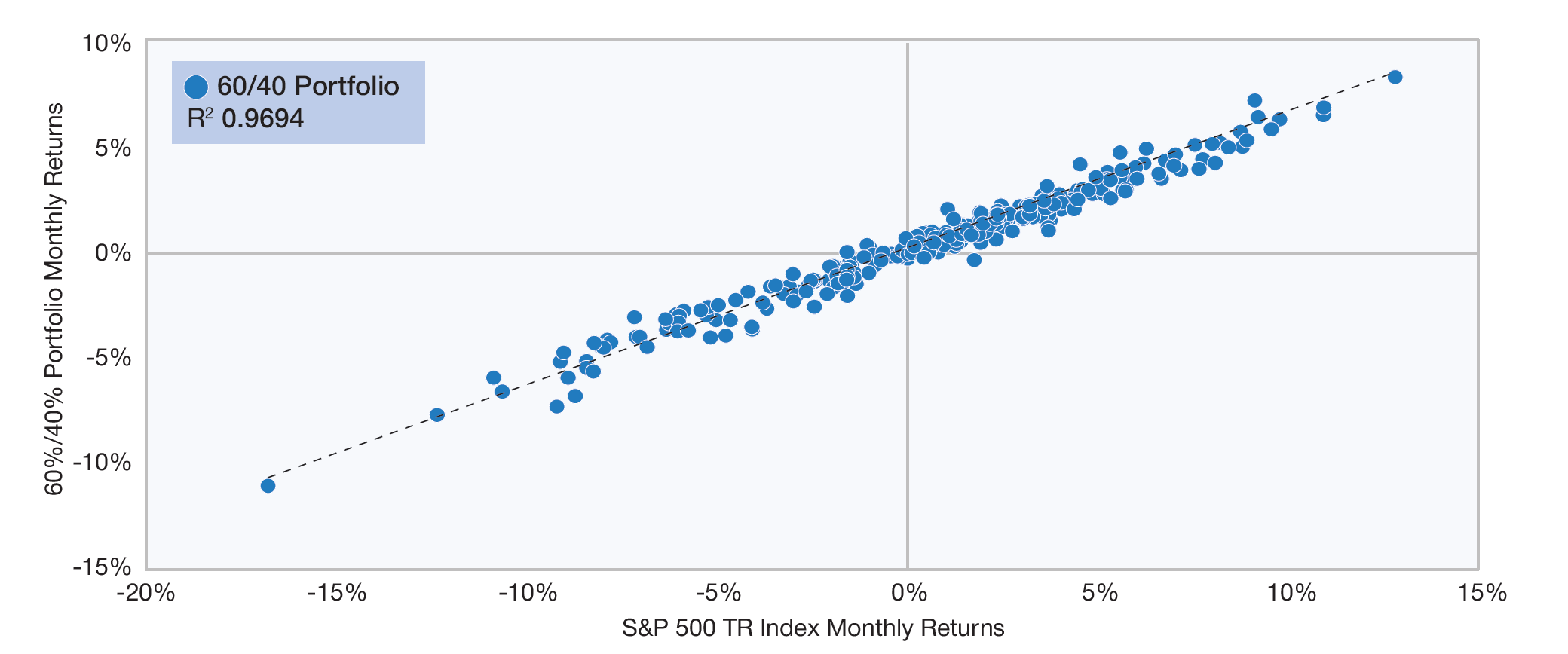
Data Source: Bloomberg LP and Catalyst Capital Advisors LLC. Based on monthly return data from 12/31/1999 to 12/31/2025. Stocks are represented by the S&P 500 TR Index; bonds are represented by the Bloomberg US Aggregate Bond Index. See important disclosures at the end of this presentation, including with respect to the inherent limitations of hypothetical performance comparisons.
1 A Study of Allocations to Alternative Investments by Institutions and Financial Advisors, May 15, 2024, https://institutional.fidelity.com/app/proxy/content?literatureURL=/9909709.PDF
Liquid Alternatives Category Matrix
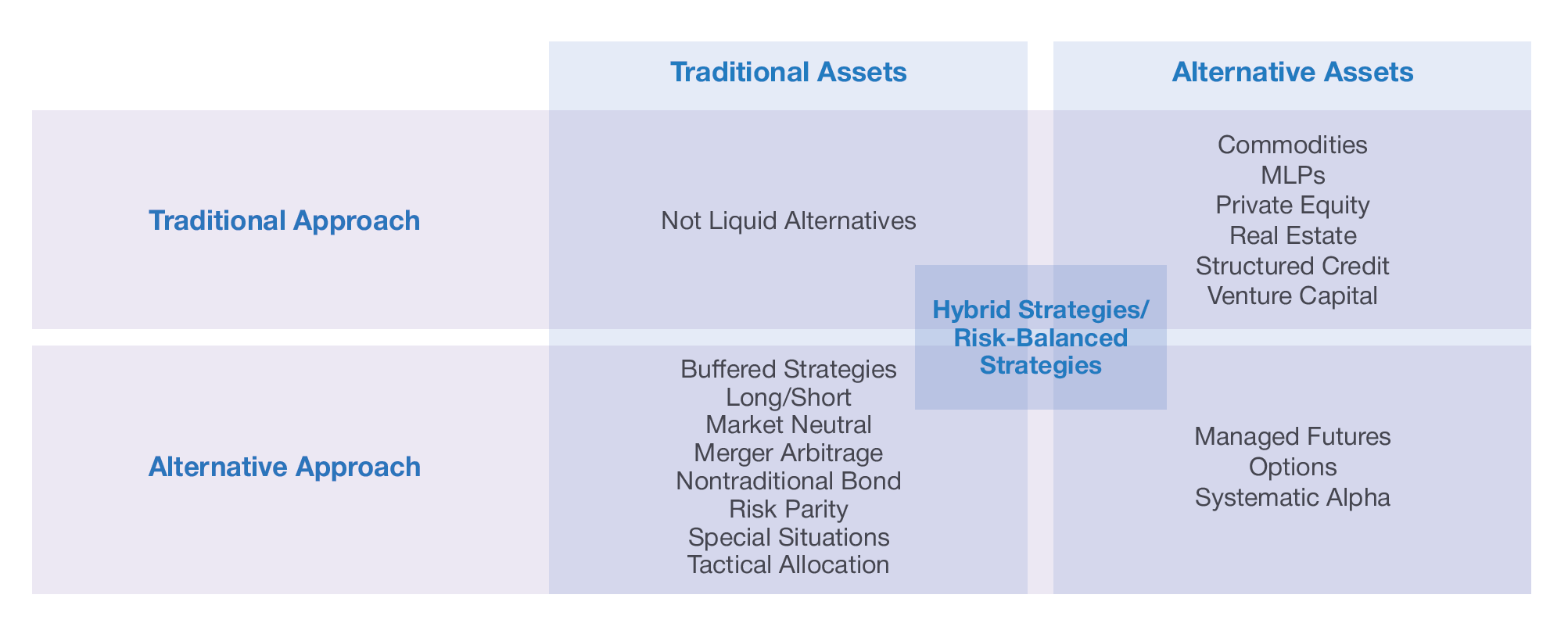
This table reinforces the breadth of possibilities for liquid alternatives as compared to traditional investment approaches.
Some financial professionals may feel the mountain is too hard to summit to get clients on board with selecting the appropriate liquid alternative option(s) given the differences between approaches and even material differences between funds implementing a particular approach (i.e., managed futures strategies may vary materially in their approach and risk/return profiles).
This challenge can be overcome by understanding the goal liquid alternatives should serve as well as knowing how to integrate the liquid alternative into a client’s existing portfolio.
Learn this and more by reading our other papers on balanced risk, Introduction to Balanced Risk, Goals and Integration of Liquid Alternatives, and The Math of Diversification, or by visiting CatalystMF.com and RationalMF.com for additional information about our full product lineup and how our alternatives can help provide your clients with diversification benefits.
IMPORTANT DISCLOSURES
YOU SHOULD CAREFULLY CONSIDER THE INVESTMENT OBJECTIVES, RISKS, CHARGES AND EXPENSES OF LIQUID ALTERNATIVE INVESTMENT FUNDS. THIS AND OTHER IMPORTANT INFORMATION ABOUT ANY SUCH FUND IS CONTAINED IN THE FUND’S PROSPECTUS, WHICH CAN BE OBTAINED BY CALLING 866.447.4228 OR AT WWW.CATALYSTMF.COM OR WWW.RATIONALMF.COM, AS APPLICABLE. THE RELEVANT PROSPECTUS SHOULD BE READ CAREFULLY BEFORE INVESTING. BOTH THE CATALYST FUNDS AND THE RATIONAL FUNDS ARE DISTRIBUTED BY NORTHERN LIGHTS DISTRIBUTORS, LLC, MEMBER FINRA/SIPC. NEITHER CATALYST CAPITAL ADVISORS, LLC NOR RATIONAL ADVISORS, INC. ARE AFFILIATED WITH NORTHERN LIGHTS DISTRIBUTORS, LLC.
Risk Considerations
Though the objectives, strategies and assets traded may differ significantly across liquid alternative approaches, investing in liquid alternatives generally carries certain risks. These risks may include, but are not necessarily limited to, the following: Certain funds may invest a percentage of their assets in derivatives, such as futures and options contracts. The use of such derivatives and the resulting high portfolio turn-over may expose such funds to additional risks that they would not be subject to if they invested directly in the securities and commodities underlying those derivatives. These funds may experience losses that exceed those experienced by funds that do not use futures contracts, options and hedging strategies. Investing in commodities markets may subject a fund to greater volatility than investments in traditional securities. Currency trading risks include market risk, credit risk and country risk. Foreign investing involves risks not typically associated with U.S. investments. Changes in interest rates and the liquidity of certain investments could affect a fund’s overall performance. Other risks include U.S. Government securities risks and investments in fixed income securities. Typically, a rise in interest rates causes a decline in the value of fixed income securities or derivatives owned by a fund. Furthermore, the use of leverage can magnify the potential for gain or loss and amplify the effects of market volatility on a fund’s share price. All funds are subject to regulatory change and tax risks; changes to current rules could increase costs associated with an investment in a fund.
The value of a fund may decrease in response to the activities and financial prospects of an individual security or group of securities held in a fund’s portfolio. Investments in foreign securities could subject a Fund to greater risks, including currency fluctuation, economic conditions, and different governmental and accounting standards. A fund’s portfolio may be focused on a limited number of industries, asset classes, countries or issuers. Certain funds may invest in high yield or junk bonds, which present a greater risk than bonds of higher quality. Other risks may include credit risks and interest rate risk, particularly with respect to floating rate loan funds. Changes in short-term market interest rates will directly affect the yield on the shares of a fund whose investments are normally invested in floating rate debt. Floating rate loan funds tend to be illiquid, and a fund might be unable to sell the loan in a timely manner as the secondary market is generally a private, unregulated inter-dealer or inter-bank re-sale market.
Any or all of the foregoing risk factors may affect the value of your investment.
Hypothetical Performance Limitations
The blended portfolio returns set forth herein represent a series of differently weighted portfolios comprised of index returns; you cannot invest in indices and no fees taken out of indices; any such blended portfolio returns should be considered hypothetical in nature. You are cautioned that hypothetical performance results have many inherent limitations, some of which are described herein. No representation is being made that any account will or is likely to achieve profits similar to those shown or will not be able to avoid substantial losses. In fact, frequently there are sharp differences between hypothetical performance results and the actual performance results subsequently achieved by a particular portfolio of investments. One of the limitations of hypothetical performance results is that they are generally prepared with the benefit of hindsight. In addition, the construction of a hypothetical portfolio of investments does not involve financial risk, and no hypothetical portfolio of investments can completely account for the impact of financial risk in actual trading. For example, the ability to withstand losses or to adhere to a particular trading program in spite of trading losses are material points which can also adversely affect actual trading results. There are numerous other factors related to the markets in general or the implementation of a portfolio of investments which cannot be fully accounted for in the preparation of hypothetical performance results, all of which can adversely affect actual trading results. You cannot invest directly in an index and unmanaged index returns do not reflect any fees, expenses or sales charges.
Glossary of Index Definitions
S&P 500 Index Total Return: A market-capitalization-weighted index of 500 leading publicly traded companies in the U.S that also includes dividend gains. Bloomberg US Aggregate Bond Index: A market capitalization-weighted index that is designed to measure the performance of the U.S. investment grade bond market with maturities of more than one year.
