What’s the Real Value of Active Management?

Key Summary:

  • ETF’s have become the preferred investment wrapper of choice for investors.
  • The vast majority of ETF assets are passive, rules-based, & market-cap weighted.
  • Active strategies with high tracking error can add significant value to the portfolio mix.

Very Important thesis: If equities generate roughly ~10-11% a year over time, leading brands, dominant global franchises, particularly those serving the dominant driver of the economy, in theory, should compound at 13-15%+ over time. In a world where rates and inflation will likely trend higher for longer, business models with pricing power, exposure to quality factors, and that generate strong profits and free cash are set up to win versus broad markets. Brands Matter.

ETFs are the Preferred Investment Wrapper.

The data is very clear: actively managed mutual funds continue to lose assets to ETF’s. That’s the headline we all see every day. Remember, headlines are bold because they want your attention, the real story lives in the details. It makes sense that a portion of the active market is losing share to ETFs. Why pay a higher fee for a less tax efficient strategy, particularly if it’s a closet index strategy? In my opinion, true active strategies have a very important role in portfolios as complements to passive, cheap beta. Advisors need to understand what they own. Are the active funds’ benchmark huggers or do they do things very differently than the benchmark? Is there a similar strategy available in an ETF wrapper? Important: to have the chance to beat a benchmark, a strategy needs to look very different than the benchmark. The way to track this is by using Tracking Error. A high tracking error means the fund looks very different and can therefore be very valuable to a portfolio from a diversification and returns perspective. If you can get access to the themes you want and do it in a tax efficient wrapper while gaining high tracking error, congratulations, that’s valuable! Spoiler alert: that’s not easy to do, it requires a lot of research and sadly, the analytics providers do not make the research easy because they rarely look at the sector, sub-industry, and single-stock level.

In this week’s note, I’ll make the case that active deserves a place in portfolio’s along with passive ETF’s. Thank heavens there are more active ETF’s being launched because the market has been dominated by passive, rules-based, market cap weighted ETF’s (90% of ETF assets). What does that mean for a portfolio? It means more and more portfolio’s look the same and they are more tied to MOMENTUM as a style factor than ever before. That works until it doesn’t. This also means, benchmark hugging active managers are also too tethered to the momentum factor making “size and momentum” the biggest part of most portfolios.

Active, Contrarian Opportunities Are Everywhere.

Image: Created for Eric Clark by ChatGPT.

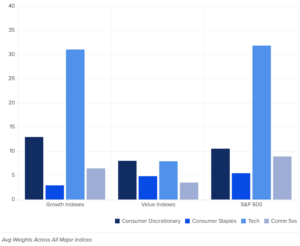
I am not saying run from passive, market-cap weighted ETF’s, I’m simply saying properly active strategies should be blended with passive, so portfolio’s get the benefit from many different style factors and exposures. As more and more “active funds” take on more passive characteristics, the value of true active strategies will grow by leaps and bounds. One area that’s likely the least crowded trade: the Consumer Discretionary, Consumer Staples, and Communication Services sectors. Our team traffics in highly relevant, high quality global brands. Many of which live in these three sectors and as you can see below, at the index level, these sectors are under-represented in a meaningful way, while a heavy tech weighting drives the returns. If the S&P 500 is the proxy investment for an allocation to the U.S. economy, and the economy is 70% household consumption, why on earth would the weighting to Consumer Discretionary & Staples be this low? We think that’s the opportunity today for investors.

I can almost guarantee your portfolio is chronically underweight the primary beneficiaries of a consumption-led economy. As you can see below, Tech holds the highest weighting across blend and growth indexes and Consumer Discretionary, Staples, and Communication Services is low. In the brands portfolio, we have 2-3x the discretionary and staples exposure, 40% more communication services and one-third the tech exposure. Our tracking error is almost 10, and this is not an accident.

What Does High Tracking Error Look Like?

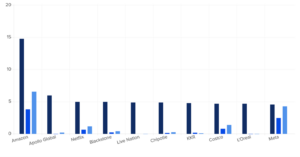
To highlight the high tracking error theme, below I show a chart of the top 10 brands and the weights in the Brands portfolio relative to the S&P 500 and the Russell 1000 Growth Index. Remember, these two broad style boxes are where the bulk of the typical portfolio is allocated. In the brands strategy, we focus on the dominant global theme of household consumption and business innovation spending through the leading brands. According to the economy and business cycle, we allocate to important sub-themes through market share leaders. Here’s why the tracking error is high. We own a lot of brands that are significantly under-represented or fully absent from indexes. That’s valuable!

The Top 10 Brands in the Brands Portfolio (57% of the total):

  1. Amazon: 15% versus 3.8% (S&P 500), 6.6% (R1Growth).
  2. Apollo Global: 6% versus ,0.55% in both indexes.
  3. Netflix: 5% versus <1.2%.
  4. Live Nation: 4.9% versus essentially 0%.
  5. Blackstone: 5% versus <.50%.
  6. Chipotle: 4.9% versus <.30%.
  7. KKR: 4.9% versus <0.20%.
  8. Costco: 4.7% versus <1.5%.
  9. L’Oreal: 4.7% versus 0%.
  10. Meta: 4.6% versus <4%.

Bottom Line:

  1. If you own any active funds or ETF’s, make sure they are truly active and have high tracking error to the benchmark.
  2. Blend active and passive in a portfolio to achieve maximum diversification and return benefits.
  3. Do not ignore the winners in a consumption led global economy, these brands are wonderful businesses, have significant economic moats, generate massive profits, and always have demand for their shares when the stocks go on sale. That makes them terrific adds to a portfolio and right now, buying consumer-focused brands is likely the least crowded trade in markets.

BE A CONTRARIAN

Disclosure: The above data is for illustrative purposes only.  This information was produced by Accuvest and the opinions expressed are those of the author as of the date of writing and are subject to change. Any research is based on the author’s proprietary research and analysis of global markets and investing. The information and/or analysis presented have been compiled or arrived at from sources believed to be reliable, however the author does not make any representation as their accuracy or completeness and does not accept liability for any loss arising from the use hereof. Some internally generated information may be considered theoretical in nature and is subject to inherent limitations associated therein. There are no material changes to the conditions, objectives or investment strategies of the model portfolios for the period portrayed. Any sectors or allocations referenced may or may not be represented in portfolios managed by the author, and do not represent all of the securities purchased, sold or recommended for client accounts.  The reader should not assume that any investments in sectors and markets identified or described were or will be profitable. Investing entails risks, including possible loss of principal. The use of tools cannot guarantee performance. The charts depicted within this presentation are for illustrative purposes only and are not indicative of future performance. Past performance is no guarantee of future results.

How to Position Your Portfolio for A Lost Decade for Stocks and Bonds

[vc_row][vc_column css=”.vc_custom_1532034303005{background-color: #ffffff !important;}”][vc_row_inner][vc_column_inner][mk_padding_divider size=”150″][mk_fancy_title size=”40″ force_font_size=”true” size_smallscreen=”40″ size_tablet=”30″ size_phone=”30″ font_weight=”bold” txt_transform=”capitalize” margin_bottom=”0″ font_family=”none”]

How to Position Your Portfolio for A Lost Decade for Stocks and Bonds

[/mk_fancy_title][vc_column_text css=”.vc_custom_1734009183306{margin-bottom: 0px !important;}”]A fund like MBXIX has the potential to add value to a portfolio during a lost decade.[/vc_column_text][vc_column_text css=”.vc_custom_1734009316859{margin-bottom: 0px !important;}”]October 2024[/vc_column_text][mk_divider style=”thin_solid” margin_top=”0″][vc_column_text css=”.vc_custom_1734009333979{margin-bottom: 0px !important;}”]A lost decade | a decade where an asset class generates negative returns – can derail an investor’s

long-term financial goals. Near-zero yields that are bound to increase combined with stretched equity valuations and growing risks have had investors with heavy exposure to “traditional” portfolio models on alert for years. While investors may have seen the S&P’s bounceback in 2023 as a sign that we’re out of the woods, it’s important to note that this recovery also happened in the 2000’s (as illustrated below) during the prior lost decade and we believe that investors should remain vigilant given the fragile market environment in which we remain.

Additionally, an October 2024 article from Investment News notes that Goldman Sachs strategists are “warning of lackluster returns over the next decade.” The strategists noted that “investors should be prepared for equity returns during the next decade that are toward the lower end of their typical

performance distribution.” In short, we believe investors shouldn’t view any recent rallies as a sign that a lost decade should be dismissed.

Trying to manage upside participation and downside market risk makes a fund like the Catalyst/Millburn Hedge Strategy Fund (MBXIX) a potentially compelling option for a portfolio. Whether looking to complement traditional investments or replacing pure equity, MBXIX combines an allocation to long-only equity ETFs with a long/short futures portfolio that spans 125+ global markets. This strategy has the potential to provide positive returns in both bear and bull markets, and MBXIX has done so historically since inception in 1997.[/vc_column_text][/vc_column_inner][/vc_row_inner][vc_row_inner][vc_column_inner css=”.vc_custom_1553117738807{background-color: #ffffff !important;}”][mk_fancy_title color=”#000000″ size=”18″ font_weight=”bold” txt_transform=”capitalize” margin_bottom=”0″ font_family=”none” align=”center”]MBXIX Generated a +164% Return During the Last Lost Decade for the S&P 500 Index.[/mk_fancy_title][vc_column_text css=”.vc_custom_1734012817177{margin-bottom: 0px !important;}”][/vc_column_text][vc_column_text css=”.vc_custom_1734009379474{margin-bottom: 0px !important;}”]Source: Catalyst Capital Advisors LLC and Bloomberg LP.
Past performance does not guarantee future results and there is no assurance that the Fund will achieve its investment objective.
[/vc_column_text][vc_column_text css=”.vc_custom_1734009398683{margin-bottom: 0px !important;}”]Despite the drawdown in equities that has already occurred, the S&P 500 TR’s cyclically adjusted price-to-earnings ratio as of September 2024 is still at 38.7x (compared to the long-term average of 20.9x). This suggests that equities could still see an ongoing decline. Likewise, bond yields still remain near historical lows.[/vc_column_text][vc_column_text css=”.vc_custom_1695670169602{margin-bottom: 0px !important;}”][/vc_column_text][/vc_column_inner][/vc_row_inner][vc_row_inner][vc_column_inner css=”.vc_custom_1553117738807{background-color: #ffffff !important;}”][mk_fancy_title color=”#000000″ size=”18″ font_weight=”bold” txt_transform=”capitalize” margin_bottom=”0″ font_family=”none” align=”center”]The S&P 500 Index has not Historically Delivered Strong Returns Following Valuations like September 2024.[/mk_fancy_title][vc_single_image image=”4064″ img_size=”full”][vc_column_text css=”.vc_custom_1734009470756{margin-bottom: 0px !important;}”]Source: Robert Shiller and Catalyst Capital Advisors LLC based on data from 1900 to September 2024.[/vc_column_text][vc_column_text css=”.vc_custom_1695670169602{margin-bottom: 0px !important;}”][/vc_column_text][/vc_column_inner][/vc_row_inner][vc_row_inner][vc_column_inner css=”.vc_custom_1553117738807{background-color: #ffffff !important;}”][mk_fancy_title color=”#000000″ size=”18″ font_weight=”bold” txt_transform=”capitalize” margin_bottom=”0″ font_family=”none” align=”center”]How Does MBXIX Currently Implement its Strategy[/mk_fancy_title][vc_column_text css=”.vc_custom_1695670169602{margin-bottom: 0px !important;}”][/vc_column_text][/vc_column_inner][/vc_row_inner][vc_row_inner attached=”true” column_padding=”5″][vc_column_inner width=”1/2″ css=”.vc_custom_1734011233785{border-bottom-width: 10px !important;background-color: #e8e8e8 !important;border-bottom-color: #8059bd !important;border-bottom-style: solid !important;}”][vc_column_text css=”.vc_custom_1695670169602{margin-bottom: 0px !important;}”][/vc_column_text][mk_fancy_title color=”#000000″ size=”20″ font_weight=”bold” font_family=”none” align=”center”]Passive Equity Portfolio
Approximately $0.50 of notional exposure for every $1.00 invested[/mk_fancy_title][vc_column_text css=”.vc_custom_1734009959451{margin-bottom: 0px !important;}”]

  • Designed to provide beta exposure to equities for normal, upward trending markets
  • Domestic, developed, and emerging market exposure via ETFs
  • U.S. equity exposure diversified by market capitalization (small, mid, and large)

[/vc_column_text][/vc_column_inner][vc_column_inner width=”1/2″ css=”.vc_custom_1734011240266{border-bottom-width: 10px !important;background-color: #e8e8e8 !important;border-bottom-color: #8059bd !important;border-bottom-style: solid !important;}”][mk_fancy_title size=”20″ font_weight=”bold” font_family=”none” align=”center”]Futures Program
Approximately $0.70 of notional exposure for every $1.00 invested[/mk_fancy_title][vc_column_text css=”.vc_custom_1734009980754{margin-bottom: 0px !important;}”]

  • Designed to leverage uncorrelated nature for both incremental returns and to offset equities during periods of long-term structural market change
  • Multiple model approach
  • Implements machine learning technology

[/vc_column_text][/vc_column_inner][/vc_row_inner][vc_row_inner][vc_column_inner css=”.vc_custom_1553117738807{background-color: #ffffff !important;}”][vc_column_text css=”.vc_custom_1734009571515{margin-bottom: 0px !important;}”]The approach cannot be replicated through two different funds as $1.00 allocated separately to futures and equities will only give an investor $1.00 in exposure. With the investment approach of MBXIX, more than 100% notional exposure is possible because collateral required for futures is less than the notional exposure provided (i.e., $0.30 in collateral may be needed for $0.70 in exposure).[/vc_column_text][vc_column_text css=”.vc_custom_1695670169602{margin-bottom: 0px !important;}”][/vc_column_text][/vc_column_inner][/vc_row_inner][vc_row_inner][vc_column_inner css=”.vc_custom_1553117738807{background-color: #ffffff !important;}”][vc_single_image image=”4059″ img_size=”full”][vc_column_text css=”.vc_custom_1734010341626{margin-bottom: 0px !important;}”]Managed Futures involve risks different from, or possibly greater than, the risks associated with investing directly in securities and other traditional investments. there is no guarantee that any investment strategy will achieve its objectives, generate profits or avoid losses. Past performance does not guarantee future results and there is no assurance that the Fund will achieve its investment objective.[/vc_column_text][vc_column_text css=”.vc_custom_1734010362970{margin-bottom: 0px !important;}”]The result for MBXIX over multiple market cycles has been a fund that has outperformed major equity markets during five-year rolling periods without a single negative period from inception to September 30, 2024.
[/vc_column_text][vc_single_image image=”4061″ img_size=”full”][vc_column_text css=”.vc_custom_1734010501466{margin-bottom: 0px !important;}”]Going forward, it’s difficult to predict where markets will end up in 2024. In managing money for clients, we understand the goal is to help investors meet their long-term financial objectives, and this implies not only trying to avoid outsized drawdowns but also generating positive returns. It is for this reason we believe it is an ideal time to replace a meaningful portion of any equity allocation you may have with a strategy like MBXIX, which maintains the upside equity exposure but also provides a diversified and non-correlated futures component that could lead to positive returns in various market environments, including the environment we are in for in 2024 and beyond.

[/vc_column_text][/vc_column_inner][/vc_row_inner][vc_row_inner][vc_column_inner][mk_divider style=”thin_solid”][vc_column_text css=”.vc_custom_1732572074821{margin-bottom: 0px !important;}”]The Fund’s maximum sales charge for Class “A” shares is 5.75%. Investments in mutual funds involve risks. Performance is historic and does not guarantee future results. Investment return and principal value will fluctuate with changing market conditions so that when redeemed, shares may be worth more or less than their original cost. Current performance may be lower or higher than the performance data quoted. To obtain the most recent month end performance information or the funds prospectus please call the fund, toll free at 1-866-447-4228. You can also obtain a prospectus at www.CatalystMF.com.The Fund’s gross expense ratios are 2.28%, 3.03%, and 2.03% for Class A, C, and I, respectively.

There is no assurance that the Fund will achieve its investment objective. You cannot invest directly in an index and unmanaged index returns do not reflect any fees, expenses or sales charges. Performance shown before December 28, 2015 is for the Fund’s Predecessor Fund (Millburn Hedge Fund, L.P.).[/vc_column_text][vc_column_text css=”.vc_custom_1732572302206{margin-bottom: 0px !important;}”]Past performance is not a guarantee of future results.

Investors should carefully consider the investment objectives, risks, charges and expenses of the Catalyst Funds. This and other important information about the Fund can be obtained by calling 866-447-4228. The Catalyst Funds are distributed by Northern Lights Distributors, LLC, member FINRA/SIPC. Catalyst Capital Advisors, LLC is not affiliated with Northern Lights Distributors, LLC.

Risk Considerations:

Investing in the Fund carries certain risks. The Fund will invest a percentage of its assets in derivatives, such as futures and options contracts. The use
of such derivatives and the resulting high portfolio turnover may expose the Fund to additional risks that it would not be subject to if it invested directly
in the securities and commodities underlying those derivatives. The Fund may experience losses that exceed those experienced by funds that do not use futures contracts, options and hedging strategies. Investing in commodities markets may subject the Fund to greater volatility than investments in traditional securities. Currency trading risks include market risk, credit risk and country risk. Foreign investing involves risks not typically associated with U.S. investments. Changes in interest rates and the liquidity of certain investments could affect the Fund’s overall performance. The Fund is non-diversified and as a result, changes in the value of a single security may have significant effect on the Fund’s value. Other risks include U.S. Government securities risks and investments in fixed income securities. Typically, a rise in interest rates causes a decline in the value of fixed income securities or derivatives owned by the Fund. Furthermore, the use of leveraging can magnify the potential for gain or loss and amplify the effects of market volatility on the Fund’s share price. The Fund is subject to regulatory change and tax risks; changes to current rules could increase costs associated with an investment in the Fund. These factors may affect the value of your investment.

Performance shown before December 28, 2015 is for the Fund’s Predecessor Fund (Millburn Hedge Fund, L.P.). The prior performance is net of management fees and other expenses including the effect of the performance fee. The Predecessor Fund had an investment objective and strategies that were, in all material respects, the same as those of the Fund, and was managed in a manner that, in all material respects, complied with the investment guidelines and restrictions of the Fund. From its inception through December 28, 2015, the Predecessor Fund was not subject to certain investment restrictions, diversification requirements and other restrictions of the 1940 Act or the Code, which if they had been applicable, might have adversely affected its performance. In addition, the Predecessor Fund was not subject to sales loads that would have adversely affected performance. Performance of the predecessor fund is not an indicator of future results.

Investors cannot directly invest in an index and unmanaged index returns do not reflect any fees, expenses or sales charges.

There is no guarantee that any investment strategy will achieve its objectives, generate profits, or avoid losses.[/vc_column_text][vc_column_text css=”.vc_custom_1732571915029{margin-bottom: 0px !important;}”]Data as of quarter end: 2021-03-31T00:00:00
Annualized if greater than a year[/vc_column_text][mk_table]

Share Class 1 Month 3 Months 6 Months YTD 1 Year 3 Years Annualized 5 Years Annualized 10 Years Annualized Since Inception Annualized
Class I 0.73% 7.43% 18.30% 7.43% 40.19% 7.48% 8.16% 7.28% 10.69%
Class A 0.70% 7.36% 18.16% 7.36% 39.83% 7.20% 7.89% N/A 8.95%
Class C 0.65% 7.18% 17.72% 7.18% 38.79% 6.41% 7.09% N/A 8.13%
Class C-1 0.65% 7.18% N/A 7.18% N/A N/A N/A N/A 22.67%
Class A w/Sales Load -5.10% 1.19% 11.36% 1.19% 31.81% 5.11% 6.62% N/A 7.73%

[/mk_table][mk_divider style=”thin_solid”][vc_column_text css=”.vc_custom_1734011355634{margin-bottom: 0px !important;}”]Definitions

Lost Decade: A decade where an asset class generates negative returns. With regards to this piece, the “Lost Decade” referenced is for stocks starting on 12/31/1999 and lasting until 12/31/2009.

Price-to-Earnings Ratio: one of the most widely used metrics for investors and analysts to determine stock valuation. It shows whether a company’s stock price is overvalued or undervalued and can reveal how a stock’s valuation compares with its industry group or a benchmark like the S&P 500 Index.

Cyclically Adjusted Price to Earnings (CAPE) Ratio: A valuation measure that uses real earnings per share (EPS) over a 10-year period to smooth out fluctuations in corporate profits that occur over different periods of a business cycle.

Notional Exposure: A term used by derivatives traders to refer to the total value of the underlying asset in a contract.

Standard deviation: a statistical measurement of the dispersion of a dataset relative to its mean.

S&P 500 Index: A market capitalization-weighted index that is used to represent the U.S. large-cap stock market.

The MSCI All Country World Index (ACWI): a stock index designed to provide a broad measure of global equity market performance.

Russell 2000 Index: a subset of the Russell 3000® Index which is designed to represent approximately 98% of he investable US equity market.

20241025-3969551[/vc_column_text][/vc_column_inner][/vc_row_inner][mk_padding_divider size=”20″][vc_raw_html]JTNDc2NyaXB0JTIwdHlwZSUzRCUyMnRleHQlMkZqYXZhc2NyaXB0JTIyJTIwc3JjJTNEJTIyaHR0cHMlM0ElMkYlMkZjb2RlLmpxdWVyeS5jb20lMkZqcXVlcnktMS45LjEubWluLmpzJTIyJTNFJTNDJTJGc2NyaXB0JTNFJTBBJTNDc2NyaXB0JTIwc3JjJTNEJTIyaHR0cHMlM0ElMkYlMkZjZG5qcy5jbG91ZGZsYXJlLmNvbSUyRmFqYXglMkZsaWJzJTJGbW9tZW50LmpzJTJGMi4xOC4xJTJGbW9tZW50Lm1pbi5qcyUyMiUzRSUzQyUyRnNjcmlwdCUzRSUwQSUwQSUzQ3NjcmlwdCUyMHR5cGUlM0QlMjJ0ZXh0JTJGamF2YXNjcmlwdCUyMiUzRSUwQSUyMCUyMCUyNCUyOGRvY3VtZW50JTI5LnJlYWR5JTI4ZnVuY3Rpb24lMjglMjklMjAlN0IlMEElMjAlMjAlMjAlMjQlMjglMjIuZGF0ZWZvcm1hdCUyMiUyOS5odG1sJTI4ZnVuY3Rpb24lMjhpbmRleCUyQyUyMHZhbHVlJTI5JTIwJTdCJTBBJTIwJTIwJTIwJTIwcmV0dXJuJTIwbW9tZW50JTI4dmFsdWUlMkMlMjAlMjJZWVlZLU1NLUREVEhIJTNBbW0lM0FzcyUyMiUyOS5mb3JtYXQlMjglMjJNTS1ERC1ZWVlZJTIyJTI5JTNCJTBBJTdEJTI5JTNCJTBBJTBBJTIwJTIwJTdEJTI5JTNCJTBBJTNDJTJGc2NyaXB0JTNF[/vc_raw_html][/vc_column][/vc_row]

The Case for Continued Investment in Senior Secured Loans

[vc_row][vc_column css=”.vc_custom_1532034303005{background-color: #ffffff !important;}”][vc_row_inner][vc_column_inner][mk_padding_divider size=”150″][mk_fancy_title size=”40″ force_font_size=”true” size_smallscreen=”40″ size_tablet=”30″ size_phone=”30″ font_weight=”bold” txt_transform=”capitalize” margin_bottom=”0″ font_family=”none”]

The Case for Continued Investment in Senior Secured Loans

[/mk_fancy_title][mk_divider style=”thin_solid” margin_top=”0″][vc_column_text css=”.vc_custom_1726690983290{margin-bottom: 0px !important;}”]Traditionally, many investors have viewed senior secured loans as a tactical, rate-based trade. However, more are now recognizing the resilient attributes of the asset class.

Loans are now becoming a strategic core holding in a variety of investor portfolios. This shift is being driven by a deeper understanding of how the asset class performs across different interest rate and economic environments. An important piece of analysis that many retail investors have underappreciated is the 30+ years of data which demonstrates that senior secured loans have historically enhanced fixed-income portfolios and reduced overall portfolio volatility (Chart 1). While fixed-rate bonds may slightly outperform during periods of intensely falling rates, the long-term benefits of loans should not be overlooked.

In the following charts, we outline the combined returns of the Bloomberg U.S. Aggregate Bond Index (represented by the percentage of the left) and the Credit Suisse Leveraged Loan Index (represented by the percentage on the right) to showcase how adding a percentage of this asset class has historically helped investors.[/vc_column_text][/vc_column_inner][/vc_row_inner][vc_row_inner][vc_column_inner css=”.vc_custom_1553117738807{background-color: #ffffff !important;}”][mk_fancy_title color=”#000000″ size=”20″ font_weight=”bold” margin_bottom=”0″ font_family=”none”]Chart 1: Allocating to Loans Has Historically Increased Returns and Reduced Risk (Shown as % of Bonds/% of Loans)[/mk_fancy_title][vc_single_image image=”3892″ img_size=”full”][vc_column_text css=”.vc_custom_1726691038329{margin-bottom: 0px !important;}”]Source: Catalyst Capital Advisors LLC., Bloomberg LP, and Credit Suisse. Based on monthly return data from 12/31/1993 to 6/30/2024. “90%/10% Portfolio” composed of a 90% allocation to the Bloomberg U.S. Aggregate Bond Index and a 10% allocation to the Credit Suisse Leveraged Loan Index. Remaining portfolio descriptions refer to %Agg / %Leveraged Loan described in the “90%/10%” portfolio. Past performance does not guarantee future results.[/vc_column_text][vc_column_text css=”.vc_custom_1695670169602{margin-bottom: 0px !important;}”][/vc_column_text][/vc_column_inner][/vc_row_inner][vc_row_inner][vc_column_inner css=”.vc_custom_1553117738807{background-color: #ffffff !important;}”][mk_fancy_title color=”#000000″ size=”20″ font_weight=”bold” margin_bottom=”0″ font_family=”none”]Chart 2: Bonds Only Slightly Outperformed Loans During the Longest Falling Rate Period Since 1994[/mk_fancy_title][vc_single_image image=”3893″ img_size=”full”][vc_column_text css=”.vc_custom_1726691205538{margin-bottom: 0px !important;}”]Source: Bloomberg LP & Credit Suisse. Total return based on monthly return data from 2/28/2001 to 05/31/2004. Falling Rate period indicated by a decrease of more than 50 bps and reflects Federal Funds Target Rate rolling 12-month periods from 12/31/1993 to 6/30/2024. Past performance is not a guarantee of future results.[/vc_column_text][vc_column_text css=”.vc_custom_1695670169602{margin-bottom: 0px !important;}”][/vc_column_text][/vc_column_inner][/vc_row_inner][vc_row_inner][vc_column_inner css=”.vc_custom_1553117738807{background-color: #ffffff !important;}”][mk_fancy_title color=”#000000″ size=”20″ font_weight=”bold” margin_bottom=”0″ font_family=”none”]Chart 3: Loans Outperformed Bonds During the Longest Flat Rate Environment Since 1994[/mk_fancy_title][vc_single_image image=”3890″ img_size=”full”][vc_column_text css=”.vc_custom_1726752276354{margin-bottom: 0px !important;}”]Source: Bloomberg LP & Credit Suisse. Total return based on monthly return data from 12/31/2009 to 11/30/2015. Flat rate period indicated by a decrease of less than 50 bps or an increase of less than 50 bps and reflects Federal Funds Target Rate rolling 12-month periods from 12/31/1993 to 6/30/2024. Past performance is not a guarantee of future results.[/vc_column_text][vc_column_text css=”.vc_custom_1695670169602{margin-bottom: 0px !important;}”][/vc_column_text][/vc_column_inner][/vc_row_inner][vc_row_inner][vc_column_inner css=”.vc_custom_1553117738807{background-color: #ffffff !important;}”][mk_fancy_title color=”#000000″ size=”20″ font_weight=”bold” margin_bottom=”0″ font_family=”none”]Chart 4: Loans Outperformed Bonds During the Longest Rising Rate Environment Since 1994[/mk_fancy_title][vc_single_image image=”3891″ img_size=”full”][vc_column_text css=”.vc_custom_1726691455285{margin-bottom: 0px !important;}”]Source: Bloomberg LP & Credit Suisse. Total return based on monthly return data from 12/31/2015 to 08/31/2019. Rising Rate period indicated by an increase of more than 50 bps and reflects Federal Funds Target Rate rolling 12-month periods from 12/31/1993 to 6/30/2024. Past performance is not a guarantee of future results.[/vc_column_text][vc_column_text css=”.vc_custom_1695670169602{margin-bottom: 0px !important;}”][/vc_column_text][/vc_column_inner][/vc_row_inner][vc_row_inner][vc_column_inner css=”.vc_custom_1553117738807{background-color: #ffffff !important;}”][vc_column_text css=”.vc_custom_1726691477119{margin-bottom: 0px !important;}”]While we understand the impulse to move assets to fixed-rate bonds as rates fall, we remind investors that senior secured loans have demonstrated resiliency in rising, falling and flat interest rate environments. We therefore encourage investors to look at the past 30+ years of data and take a long-term approach to constructing their portfolios.[/vc_column_text][mk_fancy_title color=”#000000″ size=”20″ font_weight=”bold” margin_bottom=”0″ font_family=”none”]Summary[/mk_fancy_title][vc_column_text css=”.vc_custom_1695670169602{margin-bottom: 0px !important;}”][/vc_column_text][mk_custom_list]

  • Fixed-income portfolios that utilize senior secured loans alongside traditional bonds have seen greater annualized returns with lower volatility since 1994. This has been consistent through numerous rate environments and bear markets investors have faced in the past 30+
  • During the longest continuous falling rate environment since 1994, a bond only fixed-income portfolio only slightly outperformed a fixed income portfolio with a 40% allocation to In our view, the performance difference of ~170 bps was offset by the reduced volatility profile of the portfolio that employed loans.
  • During the longest continuous flat and rising rate environments, the portfolio that employed a 40% loan allocation outperformed the bond only portfolio by over 300 bps and 200 bps,
  • While fixed-rate bonds slightly outperform loans when rates are falling, this effect does not outweigh the outperformance of senior secured loans demonstrated in flat and rising rate
  • We believe investors should maintain loan allocations as they evaluate the long-term risk / reward performance prospects of their portfolios.

[/mk_custom_list][/vc_column_inner][/vc_row_inner][vc_row_inner][vc_column_inner][mk_divider style=”thin_solid”][vc_column_text css=”.vc_custom_1726691784676{margin-bottom: 0px !important;}”]Definitions:

Bloomberg US Aggregate Bond Index: A market capitalization-weighted index that is designed to measure the performance of the U.S. investment grade bond market with maturities of more than one year.

Credit Suisse Leveraged Loan Index: An index that tracks the investable market of the U.S. dollar denominated leveraged loan market.

Volatility: A statistical measure of the dispersion of returns for a given security or market index.[/vc_column_text][/vc_column_inner][/vc_row_inner][mk_padding_divider size=”20″][vc_raw_html]JTNDc2NyaXB0JTIwdHlwZSUzRCUyMnRleHQlMkZqYXZhc2NyaXB0JTIyJTNFJTBBX2xpbmtlZGluX3BhcnRuZXJfaWQlMjAlM0QlMjAlMjIxMjczNjY2JTIyJTNCJTBBd2luZG93Ll9saW5rZWRpbl9kYXRhX3BhcnRuZXJfaWRzJTIwJTNEJTIwd2luZG93Ll9saW5rZWRpbl9kYXRhX3BhcnRuZXJfaWRzJTIwJTdDJTdDJTIwJTVCJTVEJTNCJTBBd2luZG93Ll9saW5rZWRpbl9kYXRhX3BhcnRuZXJfaWRzLnB1c2glMjhfbGlua2VkaW5fcGFydG5lcl9pZCUyOSUzQiUwQSUzQyUyRnNjcmlwdCUzRSUzQ3NjcmlwdCUyMHR5cGUlM0QlMjJ0ZXh0JTJGamF2YXNjcmlwdCUyMiUzRSUwQSUyOGZ1bmN0aW9uJTI4bCUyOSUyMCU3QiUwQWlmJTIwJTI4JTIxbCUyOSU3QndpbmRvdy5saW50cmslMjAlM0QlMjBmdW5jdGlvbiUyOGElMkNiJTI5JTdCd2luZG93LmxpbnRyay5xLnB1c2glMjglNUJhJTJDYiU1RCUyOSU3RCUzQiUwQXdpbmRvdy5saW50cmsucSUzRCU1QiU1RCU3RCUwQXZhciUyMHMlMjAlM0QlMjBkb2N1bWVudC5nZXRFbGVtZW50c0J5VGFnTmFtZSUyOCUyMnNjcmlwdCUyMiUyOSU1QjAlNUQlM0IlMEF2YXIlMjBiJTIwJTNEJTIwZG9jdW1lbnQuY3JlYXRlRWxlbWVudCUyOCUyMnNjcmlwdCUyMiUyOSUzQiUwQWIudHlwZSUyMCUzRCUyMCUyMnRleHQlMkZqYXZhc2NyaXB0JTIyJTNCYi5hc3luYyUyMCUzRCUyMHRydWUlM0IlMEFiLnNyYyUyMCUzRCUyMCUyMmh0dHBzJTNBJTJGJTJGc25hcC5saWNkbi5jb20lMkZsaS5sbXMtYW5hbHl0aWNzJTJGaW5zaWdodC5taW4uanMlMjIlM0IlMEFzLnBhcmVudE5vZGUuaW5zZXJ0QmVmb3JlJTI4YiUyQyUyMHMlMjklM0IlN0QlMjklMjh3aW5kb3cubGludHJrJTI5JTNCJTBBJTNDJTJGc2NyaXB0JTNFJTBBJTNDbm9zY3JpcHQlM0UlMEElM0NpbWclMjBoZWlnaHQlM0QlMjIxJTIyJTIwd2lkdGglM0QlMjIxJTIyJTIwc3R5bGUlM0QlMjJkaXNwbGF5JTNBbm9uZSUzQiUyMiUyMGFsdCUzRCUyMiUyMiUyMHNyYyUzRCUyMmh0dHBzJTNBJTJGJTJGcHguYWRzLmxpbmtlZGluLmNvbSUyRmNvbGxlY3QlMkYlM0ZwaWQlM0QxMjczNjY2JTI2Zm10JTNEZ2lmJTIyJTIwJTJGJTNFJTBBJTNDJTJGbm9zY3JpcHQlM0U=[/vc_raw_html][/vc_column][/vc_row]

Business Insider: An Inside Look at the Workings of the 4-Part Arbitrage and Momentum Quant Strategy Driving an Award-Winning Fund

[vc_row][vc_column css=”.vc_custom_1532034303005{background-color: #ffffff !important;}”][vc_row_inner][vc_column_inner][mk_padding_divider size=”130″ visibility=”hidden-sm”][mk_fancy_title size=”40″ force_font_size=”true” size_smallscreen=”40″ size_tablet=”30″ size_phone=”30″ font_weight=”bold” txt_transform=”capitalize” margin_bottom=”0″ font_family=”none”]

Business Insider: An Inside Look at the Workings of the 4-Part Arbitrage and Momentum Quant Strategy Driving an Award-Winning Fund

[/mk_fancy_title][vc_column_text css=”.vc_custom_1726613234313{margin-bottom: 0px !important;}”]In this article, Business Insider highlights the Catalyst Systematic Alpha Fund (ATRFX) and its portfolio construction. [/vc_column_text][mk_divider style=”thin_solid” margin_top=”0″][vc_column_text css=”.vc_custom_1726613257491{margin-bottom: 0px !important;}”]From the article: “The underlying levers that push and pull the parts of the multi-strategy fund were built by a group of Ph.D.’s in math and finance who make up the quantitative investment strategies team at BNP Paribas.”[/vc_column_text][mk_button dimension=”flat” corner_style=”full_rounded” size=”medium” url=”https://go.pardot.com/l/497001/2024-09-17/2b6442b/497001/1726613434QsPSlAKU/ATR_Buisiness_Insider_Summer_Article_Reprint_Final.pdf” target=”_blank” bg_color=”#0473aa” btn_hover_bg=”#04a6ce” btn_hover_txt_color=”#ffffff”]Download the Full Article Here[/mk_button][/vc_column_inner][/vc_row_inner][mk_padding_divider size=”20″][vc_raw_html]JTNDc2NyaXB0JTIwdHlwZSUzRCUyMnRleHQlMkZqYXZhc2NyaXB0JTIyJTNFJTBBX2xpbmtlZGluX3BhcnRuZXJfaWQlMjAlM0QlMjAlMjIxMjczNjY2JTIyJTNCJTBBd2luZG93Ll9saW5rZWRpbl9kYXRhX3BhcnRuZXJfaWRzJTIwJTNEJTIwd2luZG93Ll9saW5rZWRpbl9kYXRhX3BhcnRuZXJfaWRzJTIwJTdDJTdDJTIwJTVCJTVEJTNCJTBBd2luZG93Ll9saW5rZWRpbl9kYXRhX3BhcnRuZXJfaWRzLnB1c2glMjhfbGlua2VkaW5fcGFydG5lcl9pZCUyOSUzQiUwQSUzQyUyRnNjcmlwdCUzRSUzQ3NjcmlwdCUyMHR5cGUlM0QlMjJ0ZXh0JTJGamF2YXNjcmlwdCUyMiUzRSUwQSUyOGZ1bmN0aW9uJTI4bCUyOSUyMCU3QiUwQWlmJTIwJTI4JTIxbCUyOSU3QndpbmRvdy5saW50cmslMjAlM0QlMjBmdW5jdGlvbiUyOGElMkNiJTI5JTdCd2luZG93LmxpbnRyay5xLnB1c2glMjglNUJhJTJDYiU1RCUyOSU3RCUzQiUwQXdpbmRvdy5saW50cmsucSUzRCU1QiU1RCU3RCUwQXZhciUyMHMlMjAlM0QlMjBkb2N1bWVudC5nZXRFbGVtZW50c0J5VGFnTmFtZSUyOCUyMnNjcmlwdCUyMiUyOSU1QjAlNUQlM0IlMEF2YXIlMjBiJTIwJTNEJTIwZG9jdW1lbnQuY3JlYXRlRWxlbWVudCUyOCUyMnNjcmlwdCUyMiUyOSUzQiUwQWIudHlwZSUyMCUzRCUyMCUyMnRleHQlMkZqYXZhc2NyaXB0JTIyJTNCYi5hc3luYyUyMCUzRCUyMHRydWUlM0IlMEFiLnNyYyUyMCUzRCUyMCUyMmh0dHBzJTNBJTJGJTJGc25hcC5saWNkbi5jb20lMkZsaS5sbXMtYW5hbHl0aWNzJTJGaW5zaWdodC5taW4uanMlMjIlM0IlMEFzLnBhcmVudE5vZGUuaW5zZXJ0QmVmb3JlJTI4YiUyQyUyMHMlMjklM0IlN0QlMjklMjh3aW5kb3cubGludHJrJTI5JTNCJTBBJTNDJTJGc2NyaXB0JTNFJTBBJTNDbm9zY3JpcHQlM0UlMEElM0NpbWclMjBoZWlnaHQlM0QlMjIxJTIyJTIwd2lkdGglM0QlMjIxJTIyJTIwc3R5bGUlM0QlMjJkaXNwbGF5JTNBbm9uZSUzQiUyMiUyMGFsdCUzRCUyMiUyMiUyMHNyYyUzRCUyMmh0dHBzJTNBJTJGJTJGcHguYWRzLmxpbmtlZGluLmNvbSUyRmNvbGxlY3QlMkYlM0ZwaWQlM0QxMjczNjY2JTI2Zm10JTNEZ2lmJTIyJTIwJTJGJTNFJTBBJTNDJTJGbm9zY3JpcHQlM0U=[/vc_raw_html][/vc_column][/vc_row]

Allocating to Balanced Risk Strategies

[vc_row][vc_column css=”.vc_custom_1532034303005{background-color: #ffffff !important;}”][vc_row_inner][vc_column_inner][mk_padding_divider size=”130″ visibility=”hidden-sm”][mk_fancy_title size=”40″ force_font_size=”true” size_smallscreen=”40″ size_tablet=”30″ size_phone=”30″ font_weight=”bold” txt_transform=”capitalize” margin_bottom=”0″ font_family=”none”]

Allocating to Balanced Risk Strategies

[/mk_fancy_title][vc_column_text css=”.vc_custom_1726503804584{margin-bottom: 0px !important;}”]How to Integrate a Multifunctional Balanced Risk Strategy into Your Portfolio[/vc_column_text][mk_divider style=”thin_solid” margin_top=”0″][vc_column_text css=”.vc_custom_1726503872858{margin-bottom: 0px !important;}”]The 60/40 stock/bond portfolio model has been the primary balanced investment approach for decades. Prior to 2022, a 40-year bond bull market created an environment where bonds buffered the losses during equity bear markets. Cracks started to form in 2018, and the approach suffered significantly in 2022, leading to the worst year on record for the 60/40 portfolio going back to the 1930’s.

Regardless of whether bonds return as a reliable defensive investment, we believe there is a better approach that has been utilized by sophisticated institutional investors for decades, an approach relying on Nobel Prize Laureate Harry Markowitz’s efficient frontier. We refer to this approach as a balanced risk strategy (or hybrid strategy), which integrates multiple uncorrelated investment approaches into one product. In this report, we provide historical analysis for a sample balanced risk strategy to highlight the benefits and to provide some context on how to think about integrating such a strategy into a portfolio. A balanced risk strategy tends to set the efficient frontier and is one where a portfolio optimizer may tell you that it would be best to skip everything else and go 100% into that fund.[/vc_column_text][mk_fancy_title color=”#0a0a0a” size=”20″ font_weight=”bold” font_family=”none”]SAMPLE BALANCED RISK STRATEGY EXPOSURE (as used in this report)[/mk_fancy_title][vc_single_image image=”3874″ img_size=”full” alignment=”center”][vc_column_text css=”.vc_custom_1726504198703{margin-bottom: 0px !important;}”]Balanced risk strategies come in various formats. Since a 60/40 stock/bond portfolio has historically served as a generic basis of a balanced portfolio, we started there.

The example balanced risk strategy used in this report provides the following exposure: 60% exposure to the S&P 500 Index, 40% to Treasurys (Bloomberg US Treasury TR Index), and 100% exposure to the SG CTA Trend Index (60/40/100 Strategy). For investors that hold a traditional 60/40 stock/bond, they can simply reduce the stocks and bonds on a pro rata basis, add the balanced risk strategy, and then get back the same stock/bond exposure they had to sell to access the hybrid strategy. But now, they also have a alternative overlay.
[/vc_column_text][mk_fancy_title color=”#0a0a0a” size=”20″ font_weight=”bold” font_family=”none”]KEY BENEFITS OF A BALANCED RISK STRATEGY[/mk_fancy_title][vc_column_text css=”.vc_custom_1726504329169{margin-bottom: 0px !important;}”]Easier Integration. Investors don’t have to sacrifice traditional asset class exposure to get exposure to integrate alternative investments.

Offense + Defense. Can play both offense and defense which means it can contribute to returns in various market environments (versus just weathering the storm), making it easier for investors to stay disciplined and not sell at an adverse time.

Leveraging Modern Portfolio Theory. By combining several strategies with low correlation to each other in one portfolio, the potential returns of a balanced risk strategy can be enhanced at a given level of risk, and the probability of a negative year can decrease.

More Consistent Returns. % Positive Rolling Return Periods:[/vc_column_text][vc_single_image image=”3875″ img_size=”full” alignment=”center”][vc_column_text css=”.vc_custom_1726504430525{margin-bottom: 0px !important;}”]Data source: Bloomberg LP and Catalyst Capital Advisors LLC. Based on monthly return data from 12/31/1999 to 8/31/2024.[/vc_column_text][mk_fancy_title color=”#0a0a0a” size=”20″ font_weight=”bold” font_family=”none”]HOW MUCH SHOULD AN INVESTOR ALLOCATE TO A BALANCED RISK STRATEGY?[/mk_fancy_title][vc_column_text css=”.vc_custom_1726504730978{margin-bottom: 0px !important;}”]Start with the efficient frontier. An efficient frontier is the resulting plot of the returns of a portfolio on the y-axis against the risk level on the x-axis. The resulting line is curved (the frontier) because there is a diminishing marginal return to increased risk. The concept of an efficient frontier is that it allows investors to compare portfolios and select the one that offers the best level of return at the corresponding level of risk.

The chart below presents a series of portfolios allocated between stocks and bonds (green series). It then presents a starting 60/40 stock/bond portfolio and reducing the stocks and bonds on a pro rata basis to allocate to the balanced risk strategy previously discussed in this report, with increasing allocations to the balanced risk strategy (blue series).

Key takeaway from the efficient frontier: At any given level of risk, the portfolio integrating the balanced risk strategy offers a higher level of return which demonstrates mathematically it is the more favorable choice. But what can investors do with this information?
Before answering that question, there is one caveat to this analysis. We have analyzed using the starting basis of a 60/40 portfolio. If your situation differs materially, we would be happy to produce a customized analysis.

If 60/40 is a valid starting point, one thing investors can do is determine the level of risk they want in their portfolios. If an investor is looking to slightly lower risk, then allocating between 10% to 20% in a balanced strategy would have historically achieved that goal while also enhancing returns. If investors are looking to differentiate and materially enhance returns, a larger allocation to a balanced strategy may make sense.[/vc_column_text][mk_fancy_title color=”#0a0a0a” size=”20″ font_weight=”bold” font_family=”none”]EFFICIENT FRONTIER. The case for allocating 10% to 20% of a portfolio to a balanced risk strategy.[/mk_fancy_title][mk_fancy_title color=”#0a0a0a” size=”18″ font_weight=”bold” font_family=”none” align=”center”]% S&P 500 / % Bloomberg Agg. Bond / % Balanced Risk Strategy[/mk_fancy_title][vc_single_image image=”3877″ img_size=”full”][vc_column_text css=”.vc_custom_1726505023092{margin-bottom: 0px !important;}”]Data Source: Bloomberg LP and Catalyst Capital Advisors LLC. Based on monthly return data from 12/31/1999 to 8/31/2024. Rebalanced monthly. performance does not guarantee future results.[/vc_column_text][mk_fancy_title color=”#0a0a0a” size=”20″ font_weight=”bold” font_family=”none”]RETURNS VERSUS WORST DRAWDOWNS. Highlighting the value that a balanced risk strategy can add to a portfolio in mitigating pain points.[/mk_fancy_title][vc_single_image image=”3878″ img_size=”full”][vc_column_text css=”.vc_custom_1726505232562{margin-bottom: 0px !important;}”]Data Source: Bloomberg LP and Catalyst Capital Advisors LLC. Based on monthly return data from 12/31/1999 to 8/31/2024. Rebalanced monthly. performance does not guarantee future results.[/vc_column_text][mk_fancy_title color=”#0a0a0a” size=”20″ font_weight=”bold” font_family=”none”]HOW ARE FINANCIAL ADVISORS ALLOCATING ALTERNATIVES?[/mk_fancy_title][vc_column_text css=”.vc_custom_1726505282449{margin-bottom: 0px !important;}”]Cerulli Associates conducted a survey of 200 financial advisors to understand how they were allocating to alternative investments. The sample base tended to be advisors with clients that had higher-than-average net worth.

As demonstrated in the chart below, there were some useful insights into the use of alternatives. First, with half of the advisors at 5% or less and then the average advisor allocation at over 9%, that means the half of advisors using alternatives at more than 5% were doing so in a large way (i.e., 10% or more). Second, the optimal allocation of 13% indicates that advisors generally expect to increase their allocation to alternatives over time.
[/vc_column_text][vc_single_image image=”3879″ img_size=”full” alignment=”center”][vc_column_text css=”.vc_custom_1726505370905{margin-bottom: 0px !important;}”]For advisors looking to increase their allocation to alternatives, their goals were enhancing returns, reducing volatility, and diversifying their portfolio. The more advisors indicated that they used alts, the more they prioritized enhanced return potential. Most advisors believed that alternatives differentiated their practices allowing them to better attract high-net-worth clients and retain assets under management.[/vc_column_text][mk_fancy_title color=”#0a0a0a” size=”20″ font_weight=”bold” font_family=”none”]PUTTING IT ALL TOGETHER[/mk_fancy_title][vc_column_text css=”.vc_custom_1726505432377{margin-bottom: 0px !important;}”]Balanced risk strategies tend to offer what advisors indicate that they are looking for when integrating alternatives into a portfolio: enhanced returns, reduced volatility, and diversification.

While the Cerulli Associates report was focused on all alternatives, it supports the analyses we found with a balanced risk strategy: a 10% to 20% allocation is enough to make a meaningful difference to your overall portfolio and that there is a good case to make in doing a larger allocation.

[/vc_column_text][mk_divider style=”thin_solid” margin_top=”0″][vc_column_text css=”.vc_custom_1726505546131{margin-bottom: 0px !important;}”]Disclosures:

Past performance is not a guarantee of future results. Diversification does not ensure a profit or guarantee against loss.

There is no guarantee that any investment strategy will achieve its objectives, generate profits or avoid losses.

The use of derivatives and the resulting high portfolio turnover may expose investors to additional risks that they would not be subject to if it invested directly in the securities and commodities underlying those derivatives. A hybrid strategy may experience losses that exceed those experienced by strategies that do not use futures contracts, options and hedging strategies. Investing in the commodities markets may subject the hybrid strategy to greater volatility than investments in traditional securities. There are also risks associated with the sale and purchase of forward contracts.[/vc_column_text][vc_column_text css=”.vc_custom_1726505503187{margin-bottom: 0px !important;}”]Definitions:

Bloomberg US Aggregate Bond Index: A market capitalization-weighted index that is designed to measure the performance of the U.S. investment grade bond market with maturities of more than one year.

Bloomberg US Treasury Index: Measures US dollar- denominated, fixed-rate, nominal debt issued by the US Treasury.

Diversification: A risk management strategy that creates a mix of various investments within a portfolio.

Futures: contracts to buy or sell a specific underlying asset at a future date.

S&P 500 Index: A market capitalization-weighted index that is used to represent the U.S. large-cap stock market/

SG CTA Trend Index: The SG CTA Trend Sub-Index is a subset of the SG CTA Index, and follows traders of trend following methodologies. The SG CTA Index is equal weighted, calculates the daily rate of return for a pool of CTAs selected from the larger managers that are open to new investment.

Volatility: A statistical measure of the dispersion of returns for a given security or market index.[/vc_column_text][/vc_column_inner][/vc_row_inner][mk_padding_divider size=”20″][vc_raw_html]JTNDc2NyaXB0JTIwdHlwZSUzRCUyMnRleHQlMkZqYXZhc2NyaXB0JTIyJTNFJTBBX2xpbmtlZGluX3BhcnRuZXJfaWQlMjAlM0QlMjAlMjIxMjczNjY2JTIyJTNCJTBBd2luZG93Ll9saW5rZWRpbl9kYXRhX3BhcnRuZXJfaWRzJTIwJTNEJTIwd2luZG93Ll9saW5rZWRpbl9kYXRhX3BhcnRuZXJfaWRzJTIwJTdDJTdDJTIwJTVCJTVEJTNCJTBBd2luZG93Ll9saW5rZWRpbl9kYXRhX3BhcnRuZXJfaWRzLnB1c2glMjhfbGlua2VkaW5fcGFydG5lcl9pZCUyOSUzQiUwQSUzQyUyRnNjcmlwdCUzRSUzQ3NjcmlwdCUyMHR5cGUlM0QlMjJ0ZXh0JTJGamF2YXNjcmlwdCUyMiUzRSUwQSUyOGZ1bmN0aW9uJTI4bCUyOSUyMCU3QiUwQWlmJTIwJTI4JTIxbCUyOSU3QndpbmRvdy5saW50cmslMjAlM0QlMjBmdW5jdGlvbiUyOGElMkNiJTI5JTdCd2luZG93LmxpbnRyay5xLnB1c2glMjglNUJhJTJDYiU1RCUyOSU3RCUzQiUwQXdpbmRvdy5saW50cmsucSUzRCU1QiU1RCU3RCUwQXZhciUyMHMlMjAlM0QlMjBkb2N1bWVudC5nZXRFbGVtZW50c0J5VGFnTmFtZSUyOCUyMnNjcmlwdCUyMiUyOSU1QjAlNUQlM0IlMEF2YXIlMjBiJTIwJTNEJTIwZG9jdW1lbnQuY3JlYXRlRWxlbWVudCUyOCUyMnNjcmlwdCUyMiUyOSUzQiUwQWIudHlwZSUyMCUzRCUyMCUyMnRleHQlMkZqYXZhc2NyaXB0JTIyJTNCYi5hc3luYyUyMCUzRCUyMHRydWUlM0IlMEFiLnNyYyUyMCUzRCUyMCUyMmh0dHBzJTNBJTJGJTJGc25hcC5saWNkbi5jb20lMkZsaS5sbXMtYW5hbHl0aWNzJTJGaW5zaWdodC5taW4uanMlMjIlM0IlMEFzLnBhcmVudE5vZGUuaW5zZXJ0QmVmb3JlJTI4YiUyQyUyMHMlMjklM0IlN0QlMjklMjh3aW5kb3cubGludHJrJTI5JTNCJTBBJTNDJTJGc2NyaXB0JTNFJTBBJTNDbm9zY3JpcHQlM0UlMEElM0NpbWclMjBoZWlnaHQlM0QlMjIxJTIyJTIwd2lkdGglM0QlMjIxJTIyJTIwc3R5bGUlM0QlMjJkaXNwbGF5JTNBbm9uZSUzQiUyMiUyMGFsdCUzRCUyMiUyMiUyMHNyYyUzRCUyMmh0dHBzJTNBJTJGJTJGcHguYWRzLmxpbmtlZGluLmNvbSUyRmNvbGxlY3QlMkYlM0ZwaWQlM0QxMjczNjY2JTI2Zm10JTNEZ2lmJTIyJTIwJTJGJTNFJTBBJTNDJTJGbm9zY3JpcHQlM0U=[/vc_raw_html][/vc_column][/vc_row]

Allocating to Hybrid Alternative Strategies: A Path to More Than Just Weathering the Storm

[vc_row][vc_column css=”.vc_custom_1532034303005{background-color: #ffffff !important;}”][vc_row_inner][vc_column_inner][mk_padding_divider size=”130″ visibility=”hidden-sm”][mk_fancy_title size=”40″ force_font_size=”true” size_smallscreen=”40″ size_tablet=”30″ size_phone=”30″ font_weight=”bold” txt_transform=”capitalize” margin_bottom=”0″ font_family=”none”]

Allocating to Hybrid Alternative Strategies: A Path to More Than Just Weathering the Storm

[/mk_fancy_title][mk_divider style=”thin_solid” margin_top=”0″][vc_column_text css=”.vc_custom_1723832754312{margin-bottom: 0px !important;}”]A hybrid alternative strategy (or simply, hybrid strategy) combines alternative and traditional investment strategies within one product wrapper. Many alternative strategies are defense-only, helping portfolios weather the storm but often contributing little otherwise. Hybrid strategies play both offense and defense and have the potential to contribute to an overall portfolio in various market environments.[/vc_column_text][vc_column_text css=”.vc_custom_1723832807353{margin-bottom: 0px !important;}”]Chart 1: Growth of $100. Outperformance of Hybrid Strategy’s Offense + Defense Approach[/vc_column_text][vc_single_image image=”3817″ img_size=”full”][vc_column_text css=”.vc_custom_1723833008739{margin-bottom: 0px !important;}”]Data Source: Bloomberg LP and Catalyst Capital Advisors LLC. Based on monthly return data from 12/31/1999 to 7/31/2024. Graph presented in logarithmic scale. 60%/40% Portfolio represented by 60% allocation to the S&P 500 TR Index (“S&P 500”) and 40% allocation to the Bloomberg Agg TR Index (“Agg”) rebalanced monthly. Hybrid Strategy represented by 100% notional exposure to SG CTA Trend Index, 60% allocation to the S&P 500 and a 40% allocation to the Bloomberg US Treasury TR Index (to represent collateral for futures program), rebalanced monthly. Past performance does not guarantee future results.[/vc_column_text][vc_column_text css=”.vc_custom_1723832891764{margin-bottom: 0px !important;}”]Chart 2: Risk Curve. Allocating to Hybrid Strategies Historically Reduced Risk Without Sacrificing Returns[/vc_column_text][vc_single_image image=”3818″ img_size=”full”][vc_column_text css=”.vc_custom_1723832999868{margin-bottom: 0px !important;}”]Data Source: Bloomberg LP and Catalyst Capital Advisors LLC. Based on monthly return data from 12/31/1999 to 7/31/2024. Portfolio descriptions refer to % S&P / % Agg / % Hybrid Strategy described under the first graph, rebalanced monthly.[/vc_column_text][vc_column_text css=”.vc_custom_1723832992995{margin-bottom: 0px !important;}”]Many risk-averse investors reduce equity exposure and increase bond exposure when markets turn, leading to meaningful risk reduction at the expense of returns (see Chart 2). However, as the allocation to a hybrid strategy increases from 5% to 20% of a portfolio, the returns increased while volatility decreased (i.e., returns were enhanced).[/vc_column_text][vc_column_text css=”.vc_custom_1723833065482{margin-bottom: 0px !important;}”]Chart 3: Worst Drawdown. Allocating to Hybrid Strategies Historically Reduced Worst Drawdowns[/vc_column_text][vc_single_image image=”3820″ img_size=”full”][vc_column_text css=”.vc_custom_1723833510739{margin-bottom: 0px !important;}”]Data Source: Bloomberg LP and Catalyst Capital Advisors LLC. Based on monthly return data from 12/31/1999 to 7/31/2024. Portfolio descriptions refer to % S&P / % Agg / % Hybrid Strategy described under the first graph, rebalanced monthly.[/vc_column_text][vc_column_text css=”.vc_custom_1723833239493{margin-bottom: 0px !important;}”]Chart 4: Equity Bear Markets. Allocating to Hybrid Strategies Improved Bear Market Performance[/vc_column_text][vc_single_image image=”3821″ img_size=”full”][vc_column_text css=”.vc_custom_1723833305771{margin-bottom: 0px !important;}”]Data Source: Bloomberg LP and Catalyst Capital Advisors LLC. Based on monthly return data. Portfolio descriptions refer to % S&P / % Agg / % Hybrid Strategy described under the first graph, rebalanced monthly.[/vc_column_text][vc_column_text css=”.vc_custom_1723833584972{margin-bottom: 0px !important;}”]Chart 3 demonstrates that a larger allocation to a hybrid strategy reduced the extent of a portfolio’s maximum drawdown (peak-to-trough loss). Chart 4 presents the returns during equity bear market periods since 1999. Investors could have reduced drawdowns by increasing their bond exposure or increasing their exposure to a hybrid strategy. However, as shown, the allocation to the hybrid strategy provided more protection.[/vc_column_text][vc_column_text css=”.vc_custom_1723833593210{margin-bottom: 0px !important;}”]Chart 5: Monthly Return Scatterplot. Hybrid Strategy Returns Were More Uncorrelated Than 60/40 Returns[/vc_column_text][vc_single_image image=”3822″ img_size=”full”][vc_column_text css=”.vc_custom_1723833793349{margin-bottom: 0px !important;}”]Data Source: Bloomberg LP and Catalyst Capital Advisors LLC. Based on monthly return data from 12/31/1999 to 7/31/2024. Descriptions described under first graph.[/vc_column_text][vc_column_text css=”.vc_custom_1723833694844{margin-bottom: 0px !important;}”]Unlike the 60/40 approach, which is highly correlated to the S&P 500 TR Index, a hybrid strategy has the potential to provide more of an uncorrelated return stream, which is critical to long-term outperformance (Chart 4).[/vc_column_text][vc_column_text css=”.vc_custom_1723833713916{margin-bottom: 0px !important;}”]Chart 6: Growth of $100. The Challenges of Allocating to Defense-Only.[/vc_column_text][vc_single_image image=”3823″ img_size=”full”][vc_column_text css=”.vc_custom_1723833805882{margin-bottom: 0px !important;}”]Data Source: Bloomberg LP and Catalyst Capital Advisors LLC. Based on monthly return data from 12/31/1999 to 7/31/2024.[/vc_column_text][vc_column_text css=”.vc_custom_1723833836618{margin-bottom: 0px !important;}”]When evaluating hybrid strategies, many potential investors will say something to the extent of, “Can’t I just allocate to a defensive strategy myself?”. Our response usually involves the following concerns:

  • Investor discipline. How certain are you that you will be able to withstand the very long periods of flat or negative years to reap the benefits that come during periods of turmoil (see Chart 6)?
  • Capital allocation. A dollar invested in a hybrid strategy is a dollar of alternative exposure and a dollar of traditional exposure.
  • Ease of allocation. In this paper, we used a hybrid strategy that included 60/40 exposure plus alternative exposure. In this case, the 60/40 exposure you would need to reduce to add to a hybrid strategy would simply get replaced by the hybrid strategy itself (i.e., you don’t lose anything you already had).

[/vc_column_text][vc_column_text css=”.vc_custom_1723833927998{margin-bottom: 0px !important;}”]

Summary:

  • Hybrid strategies offer a compelling way to integrate defensive exposure into your portfolio.
  • Historically, allocating to hybrid strategies has proven to provide more than just a path to weather the storm. It has enhanced returns, reduced volatility, minimized the extent of drawdowns, and reduced a portfolio’s correlation to equities.
  • The larger the allocation to a hybrid strategy, the better the long-term benefits for an overall portfolio.
  • Hybrid strategies are not short-term, tail-risk strategies. The defensive component is typically designed to perform well during structural bear markets or long-term adverse market conditions. A one-off bad month in the market may coincide with a bad month for the hybrid strategy (Chart 5). Evaluate hybrid strategies over the long-term.

[/vc_column_text][mk_divider][vc_column_text css=”.vc_custom_1723833991799{margin-bottom: 0px !important;}”]Past performance is not a guarantee of future results. Diversification does not ensure a profit or guarantee against loss. 

There is no assurance that any strategy will achieve its investment objective. 

The use of derivatives and the resulting high portfolio turnover may expose investors to additional risks that they would not be subject to if it invested directly in the securities and commodities underlying those derivatives. A hybrid strategy may experience losses that exceed those experienced by strategies that do not use futures contracts, options and hedging strategies. Investing in the commodities markets may subject the hybrid strategy to greater volatility than investments in traditional securities. There are also risks associated with the sale and purchase of forward contracts.

Definitions: 

Bloomberg US Aggregate Bond Index: A market capitalization-weighted index that is designed to measure the performance of the U.S. investment grade bond market with maturities of more than one year.

Bloomberg US Treasury Index: Measures US dollar-denominated, fixed-rate, nominal debt issued by the US Treasury.

Diversification: A risk management strategy that creates a mix of various investments within a portfolio.

Futures: contracts to buy or sell a specific underlying asset at a future date.

S&P 500 Index: A market capitalization-weighted index that is used to represent the U.S. large-cap stock market.

SG CTA Trend Index: The SG CTA Trend Sub-Index is a subset of the SG CTA Index, and follows traders of trend following methodologies. The SG CTA Index is equal weighted, calculates the daily rate of return for a pool of CTAs selected from the larger managers that are open to new investment.

Volatility: A statistical measure of the dispersion of returns for a given security or market index.[/vc_column_text][/vc_column_inner][/vc_row_inner][mk_padding_divider size=”20″][vc_raw_html]JTNDc2NyaXB0JTIwdHlwZSUzRCUyMnRleHQlMkZqYXZhc2NyaXB0JTIyJTNFJTBBX2xpbmtlZGluX3BhcnRuZXJfaWQlMjAlM0QlMjAlMjIxMjczNjY2JTIyJTNCJTBBd2luZG93Ll9saW5rZWRpbl9kYXRhX3BhcnRuZXJfaWRzJTIwJTNEJTIwd2luZG93Ll9saW5rZWRpbl9kYXRhX3BhcnRuZXJfaWRzJTIwJTdDJTdDJTIwJTVCJTVEJTNCJTBBd2luZG93Ll9saW5rZWRpbl9kYXRhX3BhcnRuZXJfaWRzLnB1c2glMjhfbGlua2VkaW5fcGFydG5lcl9pZCUyOSUzQiUwQSUzQyUyRnNjcmlwdCUzRSUzQ3NjcmlwdCUyMHR5cGUlM0QlMjJ0ZXh0JTJGamF2YXNjcmlwdCUyMiUzRSUwQSUyOGZ1bmN0aW9uJTI4bCUyOSUyMCU3QiUwQWlmJTIwJTI4JTIxbCUyOSU3QndpbmRvdy5saW50cmslMjAlM0QlMjBmdW5jdGlvbiUyOGElMkNiJTI5JTdCd2luZG93LmxpbnRyay5xLnB1c2glMjglNUJhJTJDYiU1RCUyOSU3RCUzQiUwQXdpbmRvdy5saW50cmsucSUzRCU1QiU1RCU3RCUwQXZhciUyMHMlMjAlM0QlMjBkb2N1bWVudC5nZXRFbGVtZW50c0J5VGFnTmFtZSUyOCUyMnNjcmlwdCUyMiUyOSU1QjAlNUQlM0IlMEF2YXIlMjBiJTIwJTNEJTIwZG9jdW1lbnQuY3JlYXRlRWxlbWVudCUyOCUyMnNjcmlwdCUyMiUyOSUzQiUwQWIudHlwZSUyMCUzRCUyMCUyMnRleHQlMkZqYXZhc2NyaXB0JTIyJTNCYi5hc3luYyUyMCUzRCUyMHRydWUlM0IlMEFiLnNyYyUyMCUzRCUyMCUyMmh0dHBzJTNBJTJGJTJGc25hcC5saWNkbi5jb20lMkZsaS5sbXMtYW5hbHl0aWNzJTJGaW5zaWdodC5taW4uanMlMjIlM0IlMEFzLnBhcmVudE5vZGUuaW5zZXJ0QmVmb3JlJTI4YiUyQyUyMHMlMjklM0IlN0QlMjklMjh3aW5kb3cubGludHJrJTI5JTNCJTBBJTNDJTJGc2NyaXB0JTNFJTBBJTNDbm9zY3JpcHQlM0UlMEElM0NpbWclMjBoZWlnaHQlM0QlMjIxJTIyJTIwd2lkdGglM0QlMjIxJTIyJTIwc3R5bGUlM0QlMjJkaXNwbGF5JTNBbm9uZSUzQiUyMiUyMGFsdCUzRCUyMiUyMiUyMHNyYyUzRCUyMmh0dHBzJTNBJTJGJTJGcHguYWRzLmxpbmtlZGluLmNvbSUyRmNvbGxlY3QlMkYlM0ZwaWQlM0QxMjczNjY2JTI2Zm10JTNEZ2lmJTIyJTIwJTJGJTNFJTBBJTNDJTJGbm9zY3JpcHQlM0U=[/vc_raw_html][/vc_column][/vc_row]

Investors Don’t Have to ‘Ace’ Every Month; Fall in ‘Love’ with a Long-Term Approach

[vc_row][vc_column css=”.vc_custom_1532034303005{background-color: #ffffff !important;}”][vc_row_inner][vc_column_inner][mk_padding_divider size=”130″ visibility=”hidden-sm”][mk_fancy_title size=”40″ force_font_size=”true” size_smallscreen=”40″ size_tablet=”30″ size_phone=”30″ font_weight=”bold” txt_transform=”capitalize” margin_bottom=”0″ font_family=”none”]

Investors Don’t Have to ‘Ace’ Every Month; Fall in ‘Love’ with a Long-Term Approach

[/mk_fancy_title][vc_column_text css=”.vc_custom_1721856827964{margin-bottom: 0px !important;}”]What the Catalyst/Millburn Hedge Strategy Fund (MBXIX) Has in Common with Roger Federer’s Tennis Success[/vc_column_text][mk_divider style=”thin_solid” margin_top=”0″][vc_column_text css=”.vc_custom_1721856877126{margin-bottom: 0px !important;}”]With the Wimbledon & U.S. Open Tennis tournaments generating buzz this summer, we at Catalyst thought, wouldn’t it be great if you had an investment approach that could produce with the efficiency of a tennis superstar like Roger Federer? While Federer has won approximately 80% of his career matches, he noted in a recent commencement address that he won only 54% of his career points. Federer is arguably the greatest tennis player of all time, yet being among the best doesn’t have to mean winning every serve. It’s about winning the points that matter most.

At Catalyst Funds, we believe Federer’s successful path can be applied to investing. Funds don’t need to beat the market every month. There will be ups, and there will be downs. But outperformance over the long-term, which in our mind is most important, can come from a series of wins during the right times. When the market falters, does your portfolio fall with it? Or do you have the potential to pick up small victories and limit downsides?

We’d like to offer the Catalyst/Millburn Hedge Strategy Fund (MBXIX) as an example of this approach – which aims to protect investors when the market slides, picking up points as other investments in your portfolio may falter. Taking a long-term view, MBXIX has outperformed the S&P 500 TR Index since its inception in 1997 despite having a slightly less positive monthly return frequency, as shown below:[/vc_column_text][vc_single_image image=”3782″ img_size=”full”][vc_column_text css=”.vc_custom_1721856898948{margin-bottom: 0px !important;}”]Source: Bloomberg LP and Catalyst Capital Advisors LLC. Monthly return data from 01/01/1997 to 06/30/2024. Past performance does not guarantee future results and there is no assurance that the Fund will achieve its investment objective.[/vc_column_text][vc_column_text css=”.vc_custom_1721856913212{margin-bottom: 0px !important;}”]The Fund has had positive one-year periods 85% of the time compared to only 78% for the S&P 500. But on a monthly basis, MBXIX has only been positive 61% of the time. The lesson here, from our view, is that investors who rode out the bumps and stayed allocated to the Fund benefited through taking the long-view and trusting the process that Millburn has worked to improve for decades.[/vc_column_text][vc_single_image image=”3783″ img_size=”full”][vc_column_text css=”.vc_custom_1721856927819{margin-bottom: 0px !important;}”]Source: Bloomberg LP and Catalyst Capital Advisors LLC. Monthly return data from 01/01/1997 to 06/30/2024. Past performance does not guarantee future results and there is no assurance that the Fund will achieve its investment objective.[/vc_column_text][vc_column_text css=”.vc_custom_1721856973381{margin-bottom: 0px !important;}”]

HOW MBXIX HAS OUTPERFORMED OVER THE LONG-TERM

MBXIX combines a passive equity portfolio with a managed futures portfolio. The Fund’s equity component is designed to provide beta exposure to equities for normal, upward-trending market environments via a combination of ETFs that are diversified across market capitalization.

MBXIX’s managed futures strategy is intended to offer an effective hedge during market uncertainty by leveraging the alternative asset classes’ uncorrelated nature for incremental returns. The sub-advisor of the Fund, the Millburn Ridgefield Corporation, utilizes machine learning technology and artificial intelligence to continuously improve the managed futures portfolio. MBXIX’s hybrid equity/managed futures strategy has led to tangible results in multiple market environments.[/vc_column_text][vc_single_image image=”3784″ img_size=”full”][vc_column_text css=”.vc_custom_1721856999364{margin-bottom: 0px !important;}”]Source: Catalyst Capital Advisors LLC. Data from 01/01/1997 to 06/30/2024.[/vc_column_text][vc_column_text css=”.vc_custom_1721857027949{margin-bottom: 0px !important;}”]Volatility, interest rate changes, bear markets, etc., will continue to affect investors so long as they stay allocated to markets. MBXIX’s managed futures component has been able to help mitigate the impact of these events by offsetting equity losses. The Fund was positive during the structural bear markets of 2000-2002, 2008, & 2022, and its own worst drawdown, occurring at the onset of the COVID-19 pandemic, is less than half that of the S&P 500’s worst drawdown since 1997.[/vc_column_text][vc_column_text css=”.vc_custom_1721857084959{margin-bottom: 0px !important;}”]

IN SUMMARY:

  • MBXIX has seen long-term success due to its consistency over many different market While the Fund has a lower positive monthly frequency than the S&P 500, MBXIX has had positive years 85% of the time compared to 78% for the market.
  • MBXIX uses a hybrid passive equity/active futures strategy to achieve its investment objective of long-term capital appreciation. The Fund’s approach is 100% systematic and has the potential to invest in over 125 different global markets.
  • Like Roger Federer, who understood that winning matches wasn’t decided by every single point, investors should remember that winning in the right moments can be the key to long-term

[/vc_column_text][mk_divider][vc_column_text css=”.vc_custom_1721857159397{margin-bottom: 0px !important;}”]Data as of quarter end: 2021-03-31T00:00:00

Share Class 1 Month 3 Months 6 Months YTD 1 Year 3 Years Annualized 5 Years Annualized 10 Years Annualized Since Inception Annualized
Class I 0.73% 7.43% 18.30% 7.43% 40.19% 7.48% 8.16% 7.28% 10.69%
Class A 0.70% 7.36% 18.16% 7.36% 39.83% 7.20% 7.89% N/A 8.95%
Class C 0.65% 7.18% 17.72% 7.18% 38.79% 6.41% 7.09% N/A 8.13%
Class C-1 0.65% 7.18% N/A 7.18% N/A N/A N/A N/A 22.67%
Class A w/Sales Load -5.10% 1.19% 11.36% 1.19% 31.81% 5.11% 6.62% N/A 7.73%

[/vc_column_text][vc_column_text css=”.vc_custom_1721857263118{margin-bottom: 0px !important;}”]The Fund’s maximum sales charge for Class “A” shares is 5.75%. Investments in mutual funds involve risks. Performance is historic and does not guarantee future results. Investment return and principal value will fluctuate with changing market conditions so that when redeemed, shares may be worth more or less than their original cost. Current performance may be lower or higher than the performance data quoted. To obtain the most recent month end performance information please call the fund, toll free at 1-866-447-4228. Total operating expenses for the A, C, and I share classes are 2.24%, 2.99%, and 1.99%, respectively.

There is no assurance that the Fund will achieve its investment objective. You cannot invest directly in an index and unman- aged index returns do not reflect any fees, expenses or sales charges. Performance shown before December 28, 2015 is for the Fund’s Predecessor Fund (Millburn Hedge Fund, L.P.). Gross expense ratios for share classes A, C, and I are 2.24%, 2.99%, and 1.99%, respectively.

Past performance is not a guarantee of future results.

Investors should carefully consider the investment objectives, risks, charges and expenses of the Catalyst Funds. This and other important information about the Fund can be obtained by calling 866- 447-4228. The Catalyst Funds are distributed by Northern Lights Distributors, LLC, member FINRA/ SIPC. Catalyst Capital Advisors, LLC is not affiliated with Northern Lights Distributors, LLC.

Risk Considerations:

Investing in the Fund carries certain risks. The Fund will invest a percentage of its assets in derivatives, such as futures and options contracts. The use of such derivatives and the resulting high portfolio turn-over may expose the Fund to additional risks that it would not be subject to if it invested directly in the securities and commodities underlying those derivatives. The Fund may experience losses that exceed those experienced by funds that do not use futures contracts, options and hedging strategies. Investing in commodities markets may subject the Fund to greater volatility than investments in traditional securities. Currency trading risks include market risk, credit risk and country risk. Foreign investing involves risks not typically associated with U.S. investments.

Changes in interest rates and the liquidity of certain investments could affect the Fund’s overall performance. The Fund is non-diversified and as a result, changes in the value of a single security may have significant effect on the Fund’s value. Other risks include U.S. Government securities risks and investments in fixed income se- curities. Typically, a rise in interest rates causes a decline in the value of fixed income securities or derivatives owned by the Fund. Furthermore, the use of leveraging can magnify the potential for gain or loss and amplify the effects of market volatility on the Fund’s share price. The Fund is subject to regulatory change and tax risks; changes to current rules could increase costs associated with an investment in the Fund. These factors may affect the value of your investment.

The adviser’s judgments about the growth, value or potential appreciation of an investment may prove to be incorrect or fail to have the intended results, which could adversely impact the Fund’s performance and cause it to underperform relative to other funds with similar investment goals or relative to its benchmark, or not to achieve its investment goal.

Performance shown before December 28, 2015 is for the Fund’s Predecessor Fund (Millburn Hedge Fund, L.P.). The prior performance is net of management fees and other expenses including the effect of the performance fee. The Predecessor Fund had an investment objective and strategies that were, in all material respects, the same as those of the Fund, and was managed in a manner that, in all material respects, complied with the in- vestment guidelines and restrictions of the Fund. From its inception through December 28, 2015, the Predeces- sor Fund was not subject to certain investment restrictions, diversification requirements and other restrictions of the 1940 Act or the Code, which if they had been applicable, might have adversely affected its performance. In addition, the Predecessor Fund was not subject to sales loads that would have adversely affected perfor- mance. Performance of the predecessor fund is not an indicator of future results.

Investors cannot directly invest in an index and unmanaged index returns do not reflect any fees, expenses or sales charges.

There is no guarantee that any investment strategy will achieve its objectives, generate profits or avoid losses.

20240723-3730629[/vc_column_text][/vc_column_inner][/vc_row_inner][mk_padding_divider size=”20″][vc_raw_html]JTNDc2NyaXB0JTIwdHlwZSUzRCUyMnRleHQlMkZqYXZhc2NyaXB0JTIyJTNFJTBBX2xpbmtlZGluX3BhcnRuZXJfaWQlMjAlM0QlMjAlMjIxMjczNjY2JTIyJTNCJTBBd2luZG93Ll9saW5rZWRpbl9kYXRhX3BhcnRuZXJfaWRzJTIwJTNEJTIwd2luZG93Ll9saW5rZWRpbl9kYXRhX3BhcnRuZXJfaWRzJTIwJTdDJTdDJTIwJTVCJTVEJTNCJTBBd2luZG93Ll9saW5rZWRpbl9kYXRhX3BhcnRuZXJfaWRzLnB1c2glMjhfbGlua2VkaW5fcGFydG5lcl9pZCUyOSUzQiUwQSUzQyUyRnNjcmlwdCUzRSUzQ3NjcmlwdCUyMHR5cGUlM0QlMjJ0ZXh0JTJGamF2YXNjcmlwdCUyMiUzRSUwQSUyOGZ1bmN0aW9uJTI4bCUyOSUyMCU3QiUwQWlmJTIwJTI4JTIxbCUyOSU3QndpbmRvdy5saW50cmslMjAlM0QlMjBmdW5jdGlvbiUyOGElMkNiJTI5JTdCd2luZG93LmxpbnRyay5xLnB1c2glMjglNUJhJTJDYiU1RCUyOSU3RCUzQiUwQXdpbmRvdy5saW50cmsucSUzRCU1QiU1RCU3RCUwQXZhciUyMHMlMjAlM0QlMjBkb2N1bWVudC5nZXRFbGVtZW50c0J5VGFnTmFtZSUyOCUyMnNjcmlwdCUyMiUyOSU1QjAlNUQlM0IlMEF2YXIlMjBiJTIwJTNEJTIwZG9jdW1lbnQuY3JlYXRlRWxlbWVudCUyOCUyMnNjcmlwdCUyMiUyOSUzQiUwQWIudHlwZSUyMCUzRCUyMCUyMnRleHQlMkZqYXZhc2NyaXB0JTIyJTNCYi5hc3luYyUyMCUzRCUyMHRydWUlM0IlMEFiLnNyYyUyMCUzRCUyMCUyMmh0dHBzJTNBJTJGJTJGc25hcC5saWNkbi5jb20lMkZsaS5sbXMtYW5hbHl0aWNzJTJGaW5zaWdodC5taW4uanMlMjIlM0IlMEFzLnBhcmVudE5vZGUuaW5zZXJ0QmVmb3JlJTI4YiUyQyUyMHMlMjklM0IlN0QlMjklMjh3aW5kb3cubGludHJrJTI5JTNCJTBBJTNDJTJGc2NyaXB0JTNFJTBBJTNDbm9zY3JpcHQlM0UlMEElM0NpbWclMjBoZWlnaHQlM0QlMjIxJTIyJTIwd2lkdGglM0QlMjIxJTIyJTIwc3R5bGUlM0QlMjJkaXNwbGF5JTNBbm9uZSUzQiUyMiUyMGFsdCUzRCUyMiUyMiUyMHNyYyUzRCUyMmh0dHBzJTNBJTJGJTJGcHguYWRzLmxpbmtlZGluLmNvbSUyRmNvbGxlY3QlMkYlM0ZwaWQlM0QxMjczNjY2JTI2Zm10JTNEZ2lmJTIyJTIwJTJGJTNFJTBBJTNDJTJGbm9zY3JpcHQlM0U=[/vc_raw_html][/vc_column][/vc_row]

The Magic Behind Modern Portfolio Theory

[vc_row][vc_column css=”.vc_custom_1532034303005{background-color: #ffffff !important;}”][vc_row_inner][vc_column_inner][mk_padding_divider size=”150″][mk_fancy_title size=”38″ force_font_size=”true” size_smallscreen=”38″ size_tablet=”30″ size_phone=”30″ font_weight=”bold” txt_transform=”capitalize” margin_bottom=”0″ font_family=”none”]

The Magic Behind Modern Portfolio Theory

[/mk_fancy_title][vc_column_text css=”.vc_custom_1717020513881{margin-bottom: 0px !important;}”]“Diversification is the only free lunch in investing.” -Harry Markowitz[/vc_column_text][mk_divider style=”thin_solid” margin_top=”0″][/vc_column_inner][/vc_row_inner][vc_row_inner][vc_column_inner width=”1/4″][vc_single_image image=”3671″ img_size=”full”][/vc_column_inner][vc_column_inner width=”3/4″][vc_column_text css=”.vc_custom_1717020840884{margin-bottom: 0px !important;}”]Nobel Prize laureate Harry Markowitz coined the phrase, “diversification is the only free lunch in investing” based on his work with modern portfolio theory. Markowitz’s groundbreaking work demonstrated that, through diversification, investors could decrease portfolio risk without sacrificing returns or conversely increase returns without proportionately increasing risk.
[/vc_column_text][/vc_column_inner][/vc_row_inner][vc_row_inner][vc_column_inner][mk_divider style=”thin_solid” margin_top=”0″][/vc_column_inner][/vc_row_inner][vc_row_inner][vc_column_inner css=”.vc_custom_1553117738807{background-color: #ffffff !important;}”][vc_column_text css=”.vc_custom_1716400074470{margin-bottom: 0px !important;}”]

[/vc_column_text][mk_fancy_title color=”#000000″ size=”20″ font_weight=”bold” margin_bottom=”0″ font_family=”none”]Combining Offensive and Defensive Strategies[/mk_fancy_title][vc_column_text css=”.vc_custom_1717019837137{margin-bottom: 0px !important;}”]Markowitz concluded that maximum diversification benefits could be achieved when the correlation between investments is zero. A simplified approach: allocate 100% to an offensive strategy, such as long-only equities, and another 100% to a defensive strategy, such as trend following, in the same portfolio. As demonstrated below from actual index data, returns have been more than double yet volatility was only 33% higher than the average of each investment individually (not double) with this approach.[/vc_column_text][vc_column_text css=”.vc_custom_1695670169602{margin-bottom: 0px !important;}”][/vc_column_text][/vc_column_inner][/vc_row_inner][vc_row_inner][vc_column_inner css=”.vc_custom_1553117738807{background-color: #ffffff !important;}”][mk_fancy_title color=”#000000″ size=”20″ font_weight=”bold” margin_bottom=”0″ font_family=”none” align=”center”]UNLOCKING THE MAGIC OF MODERN PORTFOLIO THEORY BY COMBINING OFFENSE AND DEFENSE IN ONE PORTFOLIO. GROWTH OF $10,000 (LOGARITHMIC SCALE).[/mk_fancy_title][vc_single_image image=”3669″ img_size=”full”][vc_column_text css=”.vc_custom_1717019892762{margin-bottom: 0px !important;}”]Source: Catalyst Capital Advisors LLC and Bloomberg LP. Data from December 1999 to March 2024. Offense = S&P 500 TR Index. Defense = SG CTA Trend Index.[/vc_column_text][vc_column_text css=”.vc_custom_1695670169602{margin-bottom: 0px !important;}”][/vc_column_text][mk_table]

Statistic Offense Only Defense Only Offense + Defense
Annualized Return 7.3% 6.0% 13.9%
Annualized Volatility 15.4% 13.5% 19.2%
Sharp Ratio (rf=0.25%) 0.46 0.42 0.71

[/mk_table][/vc_column_inner][/vc_row_inner][vc_row_inner][vc_column_inner css=”.vc_custom_1553117738807{background-color: #ffffff !important;}”][mk_fancy_title color=”#000000″ size=”20″ font_weight=”bold” margin_bottom=”0″ font_family=”none”]A summary of the magic: more than double the expected returns, volatility only 33% higher than the average of both strategies, and almost double the risk-adjusted returns.[/mk_fancy_title][vc_column_text css=”.vc_custom_1717020300081{margin-bottom: 0px !important;}”]For more information on our offerings and important disclosures, please visit CatalystMF.com.[/vc_column_text][vc_column_text css=”.vc_custom_1695670169602{margin-bottom: 0px !important;}”][/vc_column_text][/vc_column_inner][/vc_row_inner][mk_padding_divider size=”20″][vc_raw_html]JTNDc2NyaXB0JTIwdHlwZSUzRCUyMnRleHQlMkZqYXZhc2NyaXB0JTIyJTNFJTBBX2xpbmtlZGluX3BhcnRuZXJfaWQlMjAlM0QlMjAlMjIxMjczNjY2JTIyJTNCJTBBd2luZG93Ll9saW5rZWRpbl9kYXRhX3BhcnRuZXJfaWRzJTIwJTNEJTIwd2luZG93Ll9saW5rZWRpbl9kYXRhX3BhcnRuZXJfaWRzJTIwJTdDJTdDJTIwJTVCJTVEJTNCJTBBd2luZG93Ll9saW5rZWRpbl9kYXRhX3BhcnRuZXJfaWRzLnB1c2glMjhfbGlua2VkaW5fcGFydG5lcl9pZCUyOSUzQiUwQSUzQyUyRnNjcmlwdCUzRSUzQ3NjcmlwdCUyMHR5cGUlM0QlMjJ0ZXh0JTJGamF2YXNjcmlwdCUyMiUzRSUwQSUyOGZ1bmN0aW9uJTI4bCUyOSUyMCU3QiUwQWlmJTIwJTI4JTIxbCUyOSU3QndpbmRvdy5saW50cmslMjAlM0QlMjBmdW5jdGlvbiUyOGElMkNiJTI5JTdCd2luZG93LmxpbnRyay5xLnB1c2glMjglNUJhJTJDYiU1RCUyOSU3RCUzQiUwQXdpbmRvdy5saW50cmsucSUzRCU1QiU1RCU3RCUwQXZhciUyMHMlMjAlM0QlMjBkb2N1bWVudC5nZXRFbGVtZW50c0J5VGFnTmFtZSUyOCUyMnNjcmlwdCUyMiUyOSU1QjAlNUQlM0IlMEF2YXIlMjBiJTIwJTNEJTIwZG9jdW1lbnQuY3JlYXRlRWxlbWVudCUyOCUyMnNjcmlwdCUyMiUyOSUzQiUwQWIudHlwZSUyMCUzRCUyMCUyMnRleHQlMkZqYXZhc2NyaXB0JTIyJTNCYi5hc3luYyUyMCUzRCUyMHRydWUlM0IlMEFiLnNyYyUyMCUzRCUyMCUyMmh0dHBzJTNBJTJGJTJGc25hcC5saWNkbi5jb20lMkZsaS5sbXMtYW5hbHl0aWNzJTJGaW5zaWdodC5taW4uanMlMjIlM0IlMEFzLnBhcmVudE5vZGUuaW5zZXJ0QmVmb3JlJTI4YiUyQyUyMHMlMjklM0IlN0QlMjklMjh3aW5kb3cubGludHJrJTI5JTNCJTBBJTNDJTJGc2NyaXB0JTNFJTBBJTNDbm9zY3JpcHQlM0UlMEElM0NpbWclMjBoZWlnaHQlM0QlMjIxJTIyJTIwd2lkdGglM0QlMjIxJTIyJTIwc3R5bGUlM0QlMjJkaXNwbGF5JTNBbm9uZSUzQiUyMiUyMGFsdCUzRCUyMiUyMiUyMHNyYyUzRCUyMmh0dHBzJTNBJTJGJTJGcHguYWRzLmxpbmtlZGluLmNvbSUyRmNvbGxlY3QlMkYlM0ZwaWQlM0QxMjczNjY2JTI2Zm10JTNEZ2lmJTIyJTIwJTJGJTNFJTBBJTNDJTJGbm9zY3JpcHQlM0UlMEE=[/vc_raw_html][/vc_column][/vc_row]

Preparing Your Portfolio To Win in Any Environment

[vc_row][vc_column css=”.vc_custom_1532034303005{background-color: #ffffff !important;}”][vc_row_inner][vc_column_inner][mk_padding_divider size=”130″ visibility=”hidden-sm”][mk_fancy_title size=”40″ force_font_size=”true” size_smallscreen=”40″ size_tablet=”30″ size_phone=”30″ font_weight=”bold” txt_transform=”capitalize” margin_bottom=”0″ font_family=”none”]

Preparing Your Portfolio To Win in Any Environment

[/mk_fancy_title][vc_column_text css=”.vc_custom_1680018400164{margin-bottom: 0px !important;}”]When One Asset Class Slumps, the Catalyst Systematic Alpha Fund (ATRFX) Aims to Have a Power Hitter on Deck[/vc_column_text][mk_divider style=”thin_solid” margin_top=”0″][vc_column_text css=”.vc_custom_1713969688378{margin-bottom: 0px !important;}”]

As baseball season comes into full swing, we’re reminded that the top teams are built around a diverse lineup of power hitters, speedsters, great fielders, and a strong pitching rotation. At Catalyst, we believe your investment portfolio should take the same approach. In this article, we discuss the Catalyst Systematic Alpha Fund (ATRFX) and why it’s important to have a deep bench of investments that can do it all.

Highlights:

  • Through ATRFX, Catalyst Funds has partnered with BNP Paribas to gain exclusive access to a portfolio of BNP Paribas Quantitative Investment Strategies, which were previously only accessible to institutional investors.
  • ATRFX allocates to four asset classes: equities, fixed income, currencies, and commodities. The strategy seeks to maintain a diversified exposure to the selected asset classes and to generate positive risk-adjusted returns with low correlation to the broad markets, allowing investors to achieve true diversification.
  • ATRFX is long and short, which has led to historically strong risk-adjusted returns. According to Morningstar, ATRFX’s five-year alpha is 9.26 while its category’s is -0.19 (as of March 31, 2024)
  • Over the past five years, ATRFX has ranked in the number one percentile in the Morningstar Multi-Strategy Category and was given a 5-Star Overall Rating (as of March 31,2024).

[/vc_column_text][mk_button dimension=”two” corner_style=”full_rounded” size=”large” icon=”mk-icon-angle-right” url=”https://go.pardot.com/l/497001/2023-12-14/29wgsv3/497001/1702569758WcVzYnLb/ATR_Preparing_Your_Portfolio_to_Win_in_Any_Environment_6_30_2023_V2.pdf” target=”_blank” bg_color=”#86c9ff”]Read the Full Article Here[/mk_button][/vc_column_inner][/vc_row_inner][mk_padding_divider size=”20″][vc_raw_html]JTNDc2NyaXB0JTIwdHlwZSUzRCUyMnRleHQlMkZqYXZhc2NyaXB0JTIyJTNFJTBBX2xpbmtlZGluX3BhcnRuZXJfaWQlMjAlM0QlMjAlMjIxMjczNjY2JTIyJTNCJTBBd2luZG93Ll9saW5rZWRpbl9kYXRhX3BhcnRuZXJfaWRzJTIwJTNEJTIwd2luZG93Ll9saW5rZWRpbl9kYXRhX3BhcnRuZXJfaWRzJTIwJTdDJTdDJTIwJTVCJTVEJTNCJTBBd2luZG93Ll9saW5rZWRpbl9kYXRhX3BhcnRuZXJfaWRzLnB1c2glMjhfbGlua2VkaW5fcGFydG5lcl9pZCUyOSUzQiUwQSUzQyUyRnNjcmlwdCUzRSUzQ3NjcmlwdCUyMHR5cGUlM0QlMjJ0ZXh0JTJGamF2YXNjcmlwdCUyMiUzRSUwQSUyOGZ1bmN0aW9uJTI4bCUyOSUyMCU3QiUwQWlmJTIwJTI4JTIxbCUyOSU3QndpbmRvdy5saW50cmslMjAlM0QlMjBmdW5jdGlvbiUyOGElMkNiJTI5JTdCd2luZG93LmxpbnRyay5xLnB1c2glMjglNUJhJTJDYiU1RCUyOSU3RCUzQiUwQXdpbmRvdy5saW50cmsucSUzRCU1QiU1RCU3RCUwQXZhciUyMHMlMjAlM0QlMjBkb2N1bWVudC5nZXRFbGVtZW50c0J5VGFnTmFtZSUyOCUyMnNjcmlwdCUyMiUyOSU1QjAlNUQlM0IlMEF2YXIlMjBiJTIwJTNEJTIwZG9jdW1lbnQuY3JlYXRlRWxlbWVudCUyOCUyMnNjcmlwdCUyMiUyOSUzQiUwQWIudHlwZSUyMCUzRCUyMCUyMnRleHQlMkZqYXZhc2NyaXB0JTIyJTNCYi5hc3luYyUyMCUzRCUyMHRydWUlM0IlMEFiLnNyYyUyMCUzRCUyMCUyMmh0dHBzJTNBJTJGJTJGc25hcC5saWNkbi5jb20lMkZsaS5sbXMtYW5hbHl0aWNzJTJGaW5zaWdodC5taW4uanMlMjIlM0IlMEFzLnBhcmVudE5vZGUuaW5zZXJ0QmVmb3JlJTI4YiUyQyUyMHMlMjklM0IlN0QlMjklMjh3aW5kb3cubGludHJrJTI5JTNCJTBBJTNDJTJGc2NyaXB0JTNFJTBBJTNDbm9zY3JpcHQlM0UlMEElM0NpbWclMjBoZWlnaHQlM0QlMjIxJTIyJTIwd2lkdGglM0QlMjIxJTIyJTIwc3R5bGUlM0QlMjJkaXNwbGF5JTNBbm9uZSUzQiUyMiUyMGFsdCUzRCUyMiUyMiUyMHNyYyUzRCUyMmh0dHBzJTNBJTJGJTJGcHguYWRzLmxpbmtlZGluLmNvbSUyRmNvbGxlY3QlMkYlM0ZwaWQlM0QxMjczNjY2JTI2Zm10JTNEZ2lmJTIyJTIwJTJGJTNFJTBBJTNDJTJGbm9zY3JpcHQlM0U=[/vc_raw_html][/vc_column][/vc_row]

Business Insider: An Award-winning Fund Manager Explains the Investing Process That’s Delivered 4 top-2% finishes in the Last 5 Years

[vc_row][vc_column css=”.vc_custom_1532034303005{background-color: #ffffff !important;}”][vc_row_inner][vc_column_inner][mk_padding_divider size=”130″ visibility=”hidden-sm”][mk_fancy_title size=”40″ force_font_size=”true” size_smallscreen=”40″ size_tablet=”30″ size_phone=”30″ font_weight=”bold” txt_transform=”capitalize” margin_bottom=”0″ font_family=”none”]

Business Insider: An Award-winning Fund Manager Explains the Investing Process That’s Delivered 4 top-2% finishes in the Last 5 Years

[/mk_fancy_title][vc_column_text css=”.vc_custom_1714570548566{margin-bottom: 0px !important;}”]In this article, Business Insider highlights Catalyst CFO and Portfolio Manager David Miller’s approach to investing while discussing the Catalyst Systematic Alpha Fund (ATRFX).[/vc_column_text][mk_divider style=”thin_solid” margin_top=”0″][vc_column_text css=”.vc_custom_1715295246068{margin-bottom: 0px !important;}”]From the article: “Instead of buying or shorting stocks directly, Miller employs a trend-following strategy that rides positive or negative momentum in major indexes across the US, Europe, and Japan. That frees him from the pressures of stock selection while allowing him to win in any market environment.” Read the full article below and see the attached for important disclaimers.[/vc_column_text][mk_button dimension=”two” corner_style=”full_rounded” size=”large” icon=”mk-icon-angle-right” url=”https://go.pardot.com/l/497001/2024-05-01/2b2fjtw/497001/1714570599o6z7lQaH/Business_Insider_Reprint_April_24.pdf” target=”_blank” bg_color=”#86c9ff”]Read the Full Article Here[/mk_button][/vc_column_inner][/vc_row_inner][mk_padding_divider size=”20″][vc_raw_html]JTNDc2NyaXB0JTIwdHlwZSUzRCUyMnRleHQlMkZqYXZhc2NyaXB0JTIyJTNFJTBBX2xpbmtlZGluX3BhcnRuZXJfaWQlMjAlM0QlMjAlMjIxMjczNjY2JTIyJTNCJTBBd2luZG93Ll9saW5rZWRpbl9kYXRhX3BhcnRuZXJfaWRzJTIwJTNEJTIwd2luZG93Ll9saW5rZWRpbl9kYXRhX3BhcnRuZXJfaWRzJTIwJTdDJTdDJTIwJTVCJTVEJTNCJTBBd2luZG93Ll9saW5rZWRpbl9kYXRhX3BhcnRuZXJfaWRzLnB1c2glMjhfbGlua2VkaW5fcGFydG5lcl9pZCUyOSUzQiUwQSUzQyUyRnNjcmlwdCUzRSUzQ3NjcmlwdCUyMHR5cGUlM0QlMjJ0ZXh0JTJGamF2YXNjcmlwdCUyMiUzRSUwQSUyOGZ1bmN0aW9uJTI4bCUyOSUyMCU3QiUwQWlmJTIwJTI4JTIxbCUyOSU3QndpbmRvdy5saW50cmslMjAlM0QlMjBmdW5jdGlvbiUyOGElMkNiJTI5JTdCd2luZG93LmxpbnRyay5xLnB1c2glMjglNUJhJTJDYiU1RCUyOSU3RCUzQiUwQXdpbmRvdy5saW50cmsucSUzRCU1QiU1RCU3RCUwQXZhciUyMHMlMjAlM0QlMjBkb2N1bWVudC5nZXRFbGVtZW50c0J5VGFnTmFtZSUyOCUyMnNjcmlwdCUyMiUyOSU1QjAlNUQlM0IlMEF2YXIlMjBiJTIwJTNEJTIwZG9jdW1lbnQuY3JlYXRlRWxlbWVudCUyOCUyMnNjcmlwdCUyMiUyOSUzQiUwQWIudHlwZSUyMCUzRCUyMCUyMnRleHQlMkZqYXZhc2NyaXB0JTIyJTNCYi5hc3luYyUyMCUzRCUyMHRydWUlM0IlMEFiLnNyYyUyMCUzRCUyMCUyMmh0dHBzJTNBJTJGJTJGc25hcC5saWNkbi5jb20lMkZsaS5sbXMtYW5hbHl0aWNzJTJGaW5zaWdodC5taW4uanMlMjIlM0IlMEFzLnBhcmVudE5vZGUuaW5zZXJ0QmVmb3JlJTI4YiUyQyUyMHMlMjklM0IlN0QlMjklMjh3aW5kb3cubGludHJrJTI5JTNCJTBBJTNDJTJGc2NyaXB0JTNFJTBBJTNDbm9zY3JpcHQlM0UlMEElM0NpbWclMjBoZWlnaHQlM0QlMjIxJTIyJTIwd2lkdGglM0QlMjIxJTIyJTIwc3R5bGUlM0QlMjJkaXNwbGF5JTNBbm9uZSUzQiUyMiUyMGFsdCUzRCUyMiUyMiUyMHNyYyUzRCUyMmh0dHBzJTNBJTJGJTJGcHguYWRzLmxpbmtlZGluLmNvbSUyRmNvbGxlY3QlMkYlM0ZwaWQlM0QxMjczNjY2JTI2Zm10JTNEZ2lmJTIyJTIwJTJGJTNFJTBBJTNDJTJGbm9zY3JpcHQlM0U=[/vc_raw_html][/vc_column][/vc_row]